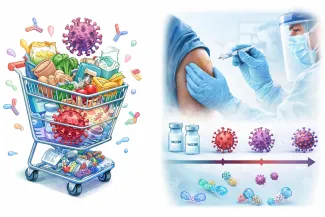
Order matters. Consider grocery shopping on today’s tighter budget. If you start with snacks, those early choices set the tone. By the time you reach basics like eggs, vegetables, and protein, you’re doing mental math, trimming plans, and making compromises. Start with essentials instead, and that foundation keeps you covered, with a little room left for treats. Two very different outcomes, shaped entirely by what came first.
The Immune System’s First Impression
Our immune system also responds to the order in which we are exposed to foreign antigens, as a new study in Nature Communications reports. During the pandemic, for some of us, our first exposure to COVID-19 was from infection (termed “natural” immunity), while for others, it was from vaccination. At this juncture, many of us have been vaccinated and had a COVID-19 infection, resulting in what is being termed “hybrid” immunity. The researchers asked an interesting question:
“Given that most of the population already has hybrid immunity to COVID-19, [does] the order of infection-acquired and vaccine-induced immunity affect the resulting immune response?”
To answer that question, the researchers followed immune responses from the very beginning of the pandemic to the later variants that reshaped the landscape.
Who Was Studied, and When
The study examined a cohort of 357 healthcare professionals in Spain in the earliest days of vaccine availability, when the OG “Wuhan variant” was ascendant and the more concerning Omicron variant was still a few months away. COVID status was documented by PCR [1] and serology. Among the entire hybrid immunity cohort, 197 participants were infected before vaccination, and 160 were vaccinated before becoming infected. In addition to the usual demographics, researchers assess antibody and T-cell responses to five viral antigens over a 3-year interval.
- The first-infected group had more prior exposures overall and more total infections than the first-vaccinated group.
- Asymptomatic infections, defined as rising antibody levels in individuals with negative PCR values, were similar between groups
- The first-vaccinated group had more prior vaccinations.
- Most were vaccinated with Pfizer’s vaccine (83%), and the Wuhan variant infected the overwhelming number (98%).
When Infection Came First
People whose first encounter with COVID-19 was infection appeared to have an early advantage. In the earliest days of the pandemic, they tended to have higher levels of the protective antibodies, and they also showed stronger “backup” immune responses from T cells years later. However, when Omicron arrived, this group showed lower antibody levels against it than those vaccinated first. The authors suggest this may be because early infections’ first “template” shaped later responses in a way that didn’t fit Omicron as well. Significantly, this gap shrank as people experienced repeated encounters, i.e., vaccinations or infections, gradually reducing the early disadvantage for Omicron antibodies.
When Vaccination Came First
People whose first exposure was vaccination showed the mirror image. Early antibody levels against Wuhan-related targets were lower, but once Omicron became dominant, this group developed higher antibody levels against multiple Omicron variants than those infected first.
Our Immune Call and Response
As the virus changes, our immune system behaves a bit like a call-and-response: each new variant “calls” with a slightly different shape, and our immune memory “responds” based on what it has seen before. In this study, that response depended strongly on the first encounter; the shifting antibody responses to the changing viral call aligned with real-world outcomes. People infected first were better protected early in the pandemic, when variants were closer to the original strain. But with the arrival of Omicron, the advantage shifted: those vaccinated first were better protected from breakthrough infections. The key lesson is that immune learning is influential—but not permanent. Repeated boosters and infections can soften early differences.
This idea—that early immune lessons can help or hinder later protection—shows up in other familiar viruses.
What Measles Teaches Us About Immune History
Measles vaccination is a powerful example of how the immune system’s “call-and-response” can be shaped for the better. The MMR vaccine uses a weakened version of the virus to train the body to make long-lasting protective antibodies and immune “memory” cells that can respond quickly if the real virus shows up later. Because measles doesn’t change as rapidly as viruses like flu or SARS-CoV-2, vaccination tends to remain effective for a very long time and is often one-and-done. On the other hand, actual measles infection can harm immune memory by wiping out some of the antibodies you built from past infections and vaccines, a phenomenon termed “immune amnesia.” A major Science study found that measles infection erased a substantial fraction of pre-existing antibodies, while vaccinated children did not show this loss. In this instance, vaccination doesn’t just prepare a strong response to measles; it also protects our immune library.
Flu’s Moving Target
For influenza, the “call-and-response” is an annual conversation because flu viruses constantly “change their voice.” Through small genetic changes, known as drift, the virus alters its surface just enough that last year’s immune memory becomes imperfect. That’s why health agencies update the flu vaccine formula every year based on global surveillance. The rising tide of influenza this year is due to the variant of concern, “subclade K,” emerging after the vaccine was developed. [2]
What This Means for Public Health
The lesson running through all of this is simple, but uncomfortable: immunity isn’t built in a single step. It is built over time, shaped by sequence, shaped by context, both personal and environmental. The same virus can “teach” the immune system different lessons depending on whether the first exposure is an infection or a vaccine, whether that exposure happens in the Wuhan or Omicron era, and what follows afterward, including boosters and reinfections. The immune system doesn’t just respond to COVID-19; it responds to our history of COVID-19.
That is why “vaccinated versus unvaccinated” or “infected versus not” is an incomplete frame. This complexity should change the tone of public health debates. Immune responses are shaped by past exposures, environments, and actions—what we encountered, when, how often, and in what form. There will never be a single, permanent rule that fits everyone equally, because immune systems do not begin from the same starting line. The stronger conclusion is not that vaccines fail or that infection is preferable. It is that vaccines are tools to guide immunity toward protection in a changing viral world, where each person’s immune “shopping cart” already reflects choices and circumstances that came before.
[1] Polymerase Chain Reaction (PCR) detects the presence of genetic material by making millions of copies. PCR testing for COVID-19 is the de facto standard in identifying infections.
[2] That said, vaccination still nudges the system towards a faster, stronger response, reducing severe illness and hospitalization
Source: Primary SARS-CoV-2 exposure by vaccination or infection shapes immune responses to omicron variants among a Spanish cohort Nature Communications DOI: 10.1038/s41467-025-67577-9

Chuck Dinerstein, MD, MBA
Director of Medicine
Charles Dinerstein, MD, MBA, is the Medical Director of the American Council on Science and Health. A vascular surgeon with more than 25 years of clinical experience, he brings a physician's understanding of medical decision-making, an appreciation for scientific uncertainty, and a broader perspective on healthcare economics and policy to his writing.