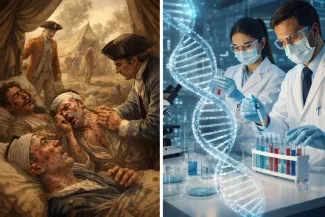
The events for America’s 250th are already underway. I am enjoying Ken Burns’ American Revolution, as it fills in the blanks and provides greater context for our origin story. The New England Journal of Medicine has found its own niche:
“Smallpox played a pivotal role throughout the American Revolution. Deliberate infection, as an act of war, was a real possibility. Washington knew he had to protect his forces from smallpox in order to defeat the British. But did British officers weaponize refugees to sow pestilence in the Continental Army? Were such reports just rumors circulating among anxious soldiers? The historical record remains ambiguous.”
From the NEJM, not staying completely in its lane, Smallpox at the Siege of Boston, November 1775–March 1776
The Black Death continues to haunt us, at least to the degree that understanding its “causes” remains incomplete. But as Nautilus reports in Did Volcanoes Spark the Black Death?
"Researchers have long known the Black Death’s central villain: the bacterium Yersinia pestis, which caused the bubonic plague that swept through towns and villages with a mortality rate of up to 60 percent. … But historians have had a tougher time recreating the sequence of events that initially started the devastating pandemic.
Now, a pair of scientists have found new … By looking at tree rings in the Spanish Pyrenees—as well as details in historical accounts of the time—they suggest that heightened volcanic activity sometime around 1345 may have sparked a famine, kicking off the sequence of events that eventually led to the Black Death …”
You can find the open-access full accounting from Communications Earth and Environment here. We are all interconnected, and this is an excellent example of how climate, social determinants of health, and a novel bacterium, introduced into a new locale, can create a pandemic.
I spent two years in the middle of Pennsylvania near Lancaster, so I have more than a nodding acquaintance with Amish and Mennonite views of medical care. The measles outbreak in a Mennonite community in Texas brought the issue to a more nationwide audience.
“But outside of the West Texas town of 7,000, health experts watched in horror as the once-dormant disease spread like a drop of blood in water across Seminole and the outlying counties, hitting at least three other states and breaching international borders. It killed two children, both Mennonites like Froese. It sickened at least 762 Texans — more than half of whom live in Seminole’s Gaines County — and hospitalized 99 statewide. The West Texas outbreak was the nation’s largest in more than 35 years.”
However, in this Texas Tribune article, we hear from members of the Mennonite community about their “lived experience.” Blamed for the nation’s historic measles outbreak, West Texas Mennonites have hardened their views on vaccines
The Works in Progress Newsletter provides an excellent review of the potential to use our growing understanding of genetics to identify new medications.
“Clinical trials for new drugs are expensive and uncertain. More than nine out of every ten drugs that enter human trials fail because of harmful side effects or a lack of efficacy. Safety and effectiveness in animals often fail to translate to humans. Imperfect as animal trials are, though, we need to know what happens when we block or boost certain biological pathways with drugs.
But there is another source of this data that we are beginning to draw on. Nature has already done lots of the trials we want to run, through random genetic mutations and natural selection. Since the first full mapping of the human genome in 2003, and the rise of technologies to sequence human DNA, we now can study the genetic mutations in nature that do the same thing as the drugs we want to test. For the first time, we are starting to peer into nature’s laboratory and learn from the millions of years of experiments it has done.”

Chuck Dinerstein, MD, MBA
Director of Medicine
Charles Dinerstein, MD, MBA, is the Medical Director of the American Council on Science and Health. A vascular surgeon with more than 25 years of clinical experience, he brings a physician's understanding of medical decision-making, an appreciation for scientific uncertainty, and a broader perspective on healthcare economics and policy to his writing.