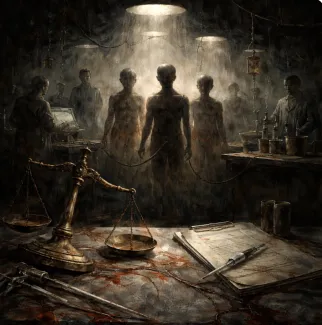
It was the horrendous Tuskegee experiment that eventually led to the formation of the Institutional Review Board system, designed to protect human research participants from unethical and harmful experimentation. In the United States, clinical trials involving human subjects must be approved by an IRB.
There is no way in the world that such an experiment would be approved today. None.
Yet, the CDC is funding a similar, perhaps worse study in Western Africa. As the head of HHS (thus the CDC), we must wonder whether Secretary Robert F. Kennedy Jr. is a driving force behind the funding of the trials.
The Tuskegee syphilis study is remembered as a moral catastrophe: government researchers knowingly denied effective treatment to vulnerable people so they could “observe” the consequences of the disease. Those abuses resulted in today’s institutional review boards (IRBs), which would reject ethically challenged research designs. However, Paul Offit writes on his Substack that Secretary Kennedy's planned hepatitis B vaccine study in Africa echoes that same logic— a disadvantaged population testing a preconceived narrative, deliberately withholding a proven, life-saving, cancer-preventing vaccine from newborns in a high-risk setting, to test a claim that has already been disproven.
The following, in italics is D. Paul Offit's Substack article:
"Between 1932 and 1972, the United States Public Health Service, in what was called “The Tuskegee Study of Untreated Syphilis in the Negro Male,” knowingly withheld life-saving antibiotics from 600 African American sharecroppers in Alabama. Most died from syphilis. Purposefully withholding antibiotics so that investigators could observe the neurological outcomes of untreated syphilis was then, and remains today, a dark stain on American history.
RFK Jr., the Secretary of Health and Human Services, will soon conduct his own Tuskegee experiment. He has chosen the resource-poor nation of Guinea-Bissau, West Africa, to do it. Guinea-Bissau is currently overwhelmed by hepatitis B virus. About 18 percent of the population is infected. The World Health Organization (WHO) strongly recommends that all children in all countries receive a birth dose of hepatitis B vaccine to prevent mother-to-child transmission. The United States implemented the birth dose in 1991, eventually eliminating tens of thousands of cases of hepatitis B virus in children less than 10 years of age. Guinea-Bissau, on the other hand, has struggled to implement the WHO recommendation, deferring the first dose to 6 weeks of age. Consequently, about 11 percent of children less than 18 months of age in Guinea-Bissau are infected with hepatitis B virus. These children have a 90 percent chance of developing cirrhosis (chronic liver disease) or liver cancer later in life. Realizing the problem, Guinea-Bissau has decided to launch a universal birth dose of hepatitis B vaccine for all infants in 2027.
RFK Jr. sees this one-year delay in implementation of the much-needed hepatitis B birth dose as a “window of opportunity” to test his theory that the vaccine causes long-term neurological problems even though more than 30 years of experience in the United States has disproved his claims.
Kennedy recently funded a $1.6 million, 14,000-person study in Guinea-Bissau set to begin in early 2026. Investigators will divide 14,000 newborns into two groups. One group will receive the hepatitis B vaccine at birth, as recommended by the WHO. The other group won’t receive the vaccine until 6 weeks of age, a continuation of the woefully substandard care that has put so many children in Guinea-Bissau at risk. Because it is unethical and cruel, this study could never be performed in the United States.
In addition to exposing children needlessly to a potentially fatal infection, RFK Jr. has manipulated the study to support his unsupportable, science-resistant beliefs about harms caused by the hepatitis B vaccine:
• The study will not be examining the efficacy of early or late vaccination, as it is clear that there is no value in delaying a hepatitis B vaccine, especially in a child whose mother is infected. RFK Jr. would prefer not to know that he is exposing children to unnecessary risk.
• The study will be conducted over 5 years. Children who are infected with hepatitis B virus at birth don’t develop chronic liver disease for decades. Therefore, RFK Jr. is unlikely to know about how much harm his “study” has done during the 5-year period.
• The study is single-blinded. This means that investigators will know whether children received a birth dose of hepatitis B vaccine, but the parents won’t know. This allows for investigator bias, where the investigator might find vague neurodevelopmental problems in the birth-dose group but not the 6-week group.
• RFK Jr. bypassed the standard bidding process so that he could choose his own investigators. He picked Peter Aaby and Christine Benn. Benn has several ties to the anti-vaccine movement in the United States. In 2018, Aaby and Been published a study claiming that the DTP vaccine had caused the premature deaths of young girls in Guinea-Bissau. In a subsequent paper, they recanted their findings.
• It is unlikely that parents will be asked to sign a consent form outlining the real risks of being in the 6-week vaccine group. As this study is funded by the American taxpayer through money provided by the CDC, the U.S. Congress should insist on seeing the details of the study, including the consent form.
In the next few months, as many as 7,000 children born in a country with a high-risk of hepatitis B infection early in life will be denied a birth dose of hepatitis B vaccine. Many of these children will have shortened, difficult lives as a result. Who will step forward to protect these children whom RFK Jr. considers expendable? When, pray tell, will someone in power stand up to this man. But we remain silent, much as we did during the Tuskegee experiment when we considered African American sharecroppers in rural Alabama expendable. Now it’s children in a resource-poor country. To quote W. H. Auden’s Shield of Achilles, “They were small and could not hope for help, and no help came.”
This study isn't designed to answer any scientific question. The value of a hepatitis B birth dose vaccination, one of the two vaccines in the world that can prevent cancer, is already established by decades of evidence and real-world experience. The feared long-term neurological harms cannot be meaningfully evaluated in a five-year window, and the single-blind design invites investigator bias rather than minimizing it.
In a setting with such a high disease burden, “delaying” protection is not a neutral scientific comparison. It is ethically indefensible, guaranteeing that an inordinate number of children will be placed at avoidable risk for chronic infection, future cirrhosis, and liver cancer.
If Tuskegee taught us anything, it is that exploiting people who “cannot hope for help” is never justified by the label of research. A study that produces no relevant answers while predictably exposing children to preventable disease is not science. Is there any reason, other than Secretary Kennedy’s beliefs, for this?

Josh Bloom
Dr. Jonathan (Josh) Bloom, ACSH's Director of Chemical and Pharmaceutical Sciences, earned his Ph.D. at the University of Virginia and completed postdoctoral training at the University of Pennsylvania. During his 20-plus years in drug discovery at Wyeth, his research group discovered the antibiotic Tygacil®, approved in 2005. He holds 25 issued patents and has authored 35 academic papers. Since joining ACSH in 2010, he has written more than 2,000 articles and dozens of op-eds for major newspapers, including The Wall Street Journal and Chicago Tribune.