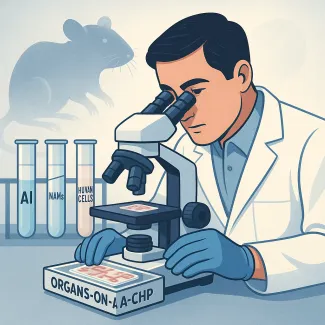
As I wrote in 2022 in Time for Change, there are many exciting and effective alternatives to animal testing, many of which outperform animal tests. The primary barrier to acceptance has been bureaucratic entrenchment, as animal testing is required by many of our federal agencies. Remarkably, the bureaucratic wall that has prevented the use of better and alternative testing methods is crumbling.
A Revolution
In April, the FDA announced the Roadmap to Reduce Animal Testing in Preclinical Safety Studies, a 3-5 year plan to make animal studies the exception, rather than the rule. According to FDA Commissioner Martin Makary, “This initiative marks a paradigm shift in drug evaluation…while reducing animal use”, aiming to accelerate cures and treatment. He emphasized three critical reasons for embracing non-animal methods:
- They can deliver cures and treatments faster.
- They can help lower drug development costs, supporting the administration’s goal of reducing drug prices.
- And they are more humane and ethical.
The FDA did not eliminate animal testing requirements outright but laid the groundwork for future elimination, shifting from conventional animal experiments to human-relevant New Approach Methodologies (NAMs) – a collective term for approaches involving computational modeling, AI-driven predictors, tests in cells, and “organs-on-a-chip” technologies.
Scientific validation of NAMs is essential to demonstrate that the method reliably predicts human response as effectively, or ideally more effectively, than conventional animal testing. The FDA plans to collaborate with other Federal agencies through the International Coordinating Committee on the Validation of Alternative Methods (ICCVAM) to develop implementation guidance for NAMs across federal agencies.
The FDA will offer a pilot program that:
- Allows select monoclonal antibody developers to use NAMs, instead of traditional animal studies, in their testing strategy
- Streamlines reviews for new drug applications that include scientifically validated NAMs
- Monitors the use of NAMs, publicly publishing costs, and accuracy
- Allows the use of pre-existing human safety data from international studies when appropriate.
The NIH followed the FDA's lead, announcing on July 1 that it would no longer award funding to new grant proposals that rely solely on animal studies. The NIH did not mandate alternative testing but stated that all new funding should include consideration of NAMs, although animal testing could still be included in the grant proposal.
The Progression of the Anti-Animal Testing Movement
In 1959, the “three R's” for animal research were developed. Replacement of animals with alternative research methods, reducing the use of animals whenever possible, and refining and improving animals’ living conditions to reduce suffering.
The three R’s were viewed as a lofty, albeit impractical goal, particularly because the federal government required animal testing before approving drugs and chemicals. In 2007, the National Academy of Sciences (NAS) recommended reducing animal testing and suggested using new technologies that could eventually eliminate the need for animal testing.
This is an issue where industry has been ahead of the curve. The Johns Hopkins Center for Alternatives to Animal Testing (CAAT) was established in 1981 with a grant from the Cosmetic, Toiletry and Fragrance Association, a trade association. A 2018 study, funded by CAAT, developed a database that predicts the toxicity of chemicals in humans more accurately than animal studies.
Scientists and executives in the pharmaceutical industry have begun questioning the efficacy of animal testing. Over 90% of drugs that appear safe and effective in animals fail during human clinical trials and never reach the market. This represents a huge financial burden on drug companies, contributing to high US drug prices.
In a time when there doesn’t seem to be consensus on many issues, there is remarkable consensus on this issue. Organizations such as the People for the Ethical Treatment of Animals (PETA), the American Anti-Vivisection Society, and the Physicians Committee for Responsible Medicine have long focused on the ethical issues surrounding animal experimentation. They have now been joined by organizations such as White Coat Waste, a “bipartisan government watchdog, ” committed to ending government-funded animal testing. They have been successful in many of their projects, including closing the FDA’s largest primate laboratory and slashing its monkey-based research by 63%, a move supported by members of both political parties.
Alliances have formed against animal testing among scientists at organizations across the political spectrum. An editorial authored by scientists from PETA, the EPA, a global tobacco company, a law firm focused on chemical products, and an agriscience company discussed the need for cross-partnerships to demonstrate the potential for NAMs to revolutionize biological science.
Institutional Laggards
During the first Trump Administration, EPA Administrator Andrew Wheeler pledged that the EPA would stop funding any studies on mammals by 2035, setting an interim goal of reducing these studies by 30% by 2025. However, these goals were eliminated under the Biden Administration. Although the EPA has done some impressive work in developing non-animal models for screening toxic chemicals, this has not been translated into policy changes. They still require animal testing for new chemicals and pesticides, with the exception being non-animal testing for skin toxicity in some pesticides.
Congress has jumped into the act after scandalous stories of animal abuse at the Department of Defense (DOD) and the Department of Veterans Affairs (VA).
The DOD has at least $57 million in contracts involving experiments in dogs and cats, with nearly all the contracts from the US Army. A bipartisan group of legislators is currently working to end this practice, inserting language in the House National Defense Authorization Act that bans the use of funds for testing on dogs and cats.
The VA spends millions of dollars on animal research, spending at least $5 million in one laboratory alone in 2021. Congress has attempted to restrict VA spending on dogs, cats, and primates since 2018 and was finally successful in 2024, passing legislation that requires the VA to eliminate the use of testing in these species by 2026. This was the result of successful lobbying efforts by several non-profits, lent scientific credence by a National Academy of Sciences, Engineering, and Medicine report critical of the VA’s use of laboratory dogs in research.
The FDA deserves credit for bringing down the wall of bureaucratic entrenchment. Their bold roadmap, closely followed by NIH’s funding pivot, signals a significant crack in the bureaucratic wall that has long propped up outdated animal testing requirements. While institutional inertia remains in places like the EPA, DOD, and the VA, the shift from regulatory lag to scientific leadership has begun. The private sector blazed the trail; the FDA and NIH are finally stepping up. The real test now is whether the rest of government can catch up or will be content watching from the sidelines.

Susan Goldhaber MPH
Susan Goldhaber, M.P.H., is an environmental toxicologist with over 40 years’ experience working at Federal and State agencies and in the private sector, with an emphasis on issues concerning chemicals in drinking water, air, and hazardous waste. Her current focus is on translating scientific data into usable information for the public.