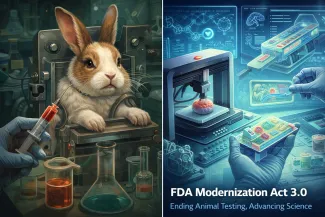
As 2025 comes to a close, you can be forgiven if you are cynical about the workings of the Federal government. After the 45-day government shutdown, it is hard to believe that our legislators can work together on anything. But it has happened – on December 16, the FDA Modernization Act 3.0 passed the Senate by unanimous consent. Not only that, but a diverse group of organizations across the policy spectrum, including animal rights groups, pharmaceutical and biotech companies, and patient advocacy groups, came together in support of this bill.
The FDA Modernization Act 2.0 was signed into law by President Biden in 2022. This law removed the longstanding requirement that new drugs undergo mandatory animal testing before human clinical trials. It provided drug developers with the option to use advanced, non-animal methods, including:
- Computational models: Advanced AI and computer modeling are used to predict toxicity and drug response. An example is the use of AI to identify potential drug molecules to target specific proteins in the body.
- Cell-based assays: Human cells are used to create miniature organs or systems in the human body. These can either be 2-D models, consisting of a simple plate of cells, or 3-D models, such as the multicellular brain model that mimics the blood-brain barrier to study drug delivery to the brain. Organs-on-chips, miniaturized systems that mimic the structure and function of human organs on a tiny scale. These devices are typically the size of a USB drive and consist of small tubes that allow nutrients, air, or blood substitutes to flow through living human cells that are grown inside the device.
- Bioprinting: Human cells are used to create artificial structures that mimic natural human tissues. Computed tomography (CT) or magnetic resonance imaging (MRI) scans are used to capture the precise architecture of a tissue or organ. A bioink, consisting of living cells, is then used to create these structures and test the effectiveness and potential toxicity of new drug candidates.
With all these advances in non-animal testing, there was no excuse for Federal agencies to drag their feet on moving forward. The FDA did not update its regulations to conform to the FDA Modernization Act 2.0, leaving numerous regulations that still require animal testing. Now the FDA is required to update its rules within the next twelve months to no longer require animal testing and to allow the use of non-animal methods in drug development. A House companion bill, HR 2821, was introduced in April of this year, but has not yet come to the floor for a vote.
This is an important issue and a focus of mine. In my first article on animal testing, I wrote about the intransigence of the people in positions of power at universities, federal agencies, and research centers who believe that the techniques they have used throughout their careers are the only correct ones and should continue to be used. I called out the EPA, the FDA, and other government agencies for not allowing alternatives to animal testing in drug development, for not registering new chemicals and pesticides, for food safety issues, and for other issues.
The Need for the Act
As I have subsequently written, FDA Commissioner Martin Makary has demonstrated leadership by emphasizing three critical reasons for embracing non-animal methods in drug development:
- They can deliver cures and treatments faster.
- They can help lower drug development costs, supporting the administration’s goal of reducing drug prices.
- And they are more humane and ethical.
From a practical perspective, scientists and executives in the pharmaceutical industry have long questioned the efficacy of animal testing, since over 90% of drugs that appear safe and effective in animals fail during human clinical trials and never reach the market. This is a substantial financial burden on drug companies, contributing to high US drug prices.
Why Hasn’t This Become a Whole-of-Government Approach?
The FDA Modernization Act 3.0 has a limited scope; it only applies to drug development within the FDA. It does not apply to over-the-counter drugs, such as sunscreen, for which the FDA requires animal studies that kill hundreds of animals per test ingredient. Hopefully, the FDA Modernization Act 3.0 will influence the regulatory framework for other significant areas within the FDA's purview.
In these past few years, the FDA has moved ahead of other governmental agencies, like the EPA, which have not taken significant steps to reduce animal testing. This is due to the broad-based coalition that aligned for the FDA on this issue. Pharmaceutical and biotech companies saw faster, more accurate results from non-animal testing; patient advocacy groups wanted quicker approval of drugs; animal rights groups wanted animal testing to end altogether; and scientists wanted to use cutting-edge science rather than outdated techniques.
- The National Institutes of Health (NIH) is moving toward implementing non-animal testing policies, but has not gone as far as the FDA in its requirements. The NIH announced in July that it would no longer fund new grant proposals that rely solely on animal studies. However, it creates a potential loophole that allows a research plan to be overwhelmingly based on animal studies, as long as some component is based on non-animal testing.
- The EPA still requires animal testing for registration of new chemicals, including pesticides. There is no broad-based coalition supporting non-animal testing at the EPA; chemical companies are not aligned with environmental or consumer groups on any issues, and producing more effective pesticides runs contrary to the MAHA movement, which wants to eliminate the use of all pesticides.
The FDA Modernization Act 3.0 is more than a technical regulatory fix—it is a test of whether government institutions can evolve when the science, ethics, and economics all point in the same direction. For decades, animal testing has persisted less because it works than because it is familiar and embedded in regulatory culture. The evidence is now overwhelming that non-animal methods are faster, more predictive of human outcomes, less costly, and far more humane.
The Senate’s action raises the stakes. Whether through House passage of the companion bill or future legislation, the pressure is now on to end the patchwork approach to animal testing and replace it with a coherent, science-driven policy. If lawmakers and regulators seize this moment, 2026 could mark the beginning of a genuine whole-of-government commitment to modern science—and a long-overdue gift to animals.

Susan Goldhaber MPH
Susan Goldhaber, M.P.H., is an environmental toxicologist with over 40 years’ experience working at Federal and State agencies and in the private sector, with an emphasis on issues concerning chemicals in drinking water, air, and hazardous waste. Her current focus is on translating scientific data into usable information for the public.