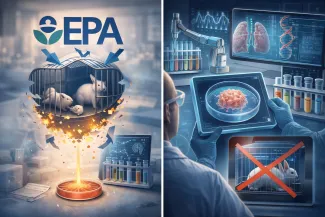
My recent article discussed the FDA Modernization Act 3.0, which removed the longstanding requirement that new drugs undergo mandatory animal testing before human clinical trials. The far slower pace of the EPA in ending animal testing remained an issue until last week.
Lee Zeldin, the EPA Administrator, took a giant step to catch up with the FDA in its quest to end animal testing, announcing:
“I am absolutely committed to making sure EPA gets back on track with the historic goal set out during President Trump’s first term in office. Unlike the previous administration, the Trump EPA will not delay scientific progress on developing alternatives to animal testing. We will pursue this goal while adhering to the law and the highest quality scientific standards.”
What is the statutory basis for the EPA requiring animal testing?
Several statutes drive animal testing:
- Federal Insecticide, Fungicide, and Rodenticide Act (FIFRA): Before a pesticide can be registered for sale, manufacturers must prove it will not cause “unreasonable adverse effects on the environment,” including non-target species such as birds, fish, and aquatic invertebrates. EPA regulations require data on short- and long-term effects, cancer, and reproductive harm.
- The Frank R. Lautenberg Chemical Safety Act (an update to the Toxic Substances Control Act, TSCA): Under TSCA, the EPA has the authority to require testing if it finds a chemical may present an "unreasonable risk" or is produced in high volumes with significant human exposure. However, the Lautenberg Act explicitly requires the EPA to reduce and replace animal testing only when “practicable and scientifically justified,” and only as a last resort.
- Federal Food, Drug, and Cosmetic Act (FFDCA): The EPA uses this law to set legal limits (tolerances) for pesticide residues on food. The law requires a finding of “reasonable certainty of no harm,” which often requires animal data to evaluate special risks to infants and children. The Endocrine Disruptor Screening Program uses animal studies to determine whether chemicals interfere with human and wildlife hormone systems.
- The Clean Air Act (CAA): The EPA can require manufacturers of fuels or fuel additives to conduct tests to determine public health effects, which traditionally consist of animal studies.
- The Clean Water Act (CWA): The EPA mandates testing and measuring the toxic effects of a facility’s discharge on living organisms. These tests typically use fish or aquatic invertebrates.
Of the five, FIFRA is the most significant one for which EPA has required extensive animal testing. Pesticide manufacturers and chemical companies are legally required to provide the EPA with information on whether their chemicals may be toxic to humans or wildlife.
Because animal testing requirements are written into the law or mandated in older EPA regulations, the EPA must now publish new regulations or guidance that clearly state that non-animal testing is allowed and preferred by the Agency. There are requirements to show that the new non-animal testing is scientifically valid and “as good or better” than the historical animal tests. That effort has brought together scientists from the EPA, industry, academia, and animal rights organizations such as People for the Ethical Treatment of Animals (PETA), who have been working to develop new non-animal tests to replace traditional tests.
What has the EPA already done to reduce animal testing?
Animal testing has already been reduced, if not eliminated, for:
- Cancer evaluations: The EPA used non-animal alternatives in its cancer evaluations of two chemicals, replacing traditional studies in which approximately 1,600 rats and mice are exposed to the chemicals for 2 years in air or water, then killed and examined for signs of cancer.
- Skin and Eye irritation: The EPA stated its preference for companies to use non-animal tests to identify skin irritation and corrosion, rather than the traditional tests that involve applying chemicals to the skin of live rabbits and measuring the degree of irritation. For eye irritation, the EPA encourages companies to submit data from tests using human cells rather than the traditional Draize test, which applies chemicals to rabbits’ eyes, causing pain, swelling, hemorrhaging, or even blindness.
- Pesticides: The EPA released guidance in 2020 that no longer requires companies to conduct studies in which birds are fed pesticide-laced food for days, monitored for signs of distress, and then killed, when the Agency already has sufficient other information for registering outdoor pesticides.
In April 2025, the EPA implemented a lab animal adoption program at one of its premier research laboratories; two rabbits were adopted, and the facility's rodent population was reduced from 466 to 41.
Critics Raise Concerns
Not everyone is in favor of the EPA’s momentum on ending animal testing. Some environmental groups have said that it will be harder to understand the link between chemical exposure and developing cancer or reproductive problems without animal testing. However, according to Dr. Thomas Hartung, director of the Johns Hopkins University Center for Alternatives to Animal Testing, artificial intelligence has significantly accelerated the ability to assess a chemical’s toxicity. He believes alternatives are widely available and are faster and cheaper than testing mammalian species and fish. “From my point of view, this is an overdue adaptation to scientific progress. The environmental groups who say, ‘more testing, more testing’ are simply misled.”
Despite lingering opposition, the EPA’s shift reflects a much broader international trend. The US government and European regulators alike are moving toward an animal-free future driven by organoids, human-cell platforms, and predictive AI. Last year, the NIH launched a major new initiative to reduce animal use in drug discovery, and the FDA has formally announced its intention to phase out animal testing requirements. Meanwhile, the European Commission plans to finalize a roadmap toward an animal-free regulatory system by March 2026.
The development of alternatives is one of the clearest examples of diverse stakeholders converging on a shared goal: improving science while reducing unnecessary harm. When institutions as different as PETA, Johns Hopkins, federal regulators, and industry laboratories all align, it signals that this is not simply an ethical movement — it is a scientific modernization whose time has come.

Susan Goldhaber MPH
Susan Goldhaber, M.P.H., is an environmental toxicologist with over 40 years’ experience working at Federal and State agencies and in the private sector, with an emphasis on issues concerning chemicals in drinking water, air, and hazardous waste. Her current focus is on translating scientific data into usable information for the public.