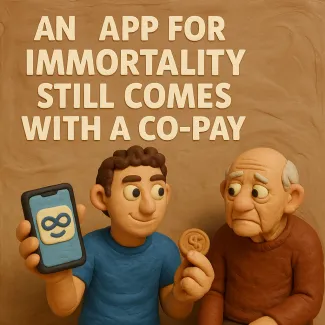
The young generation of tech bros believes in an immortality that, to me, seems to defy biology and, more importantly, physics. As a Boomer, that is not a particularly satisfying thought, but it is one that I am more comfortable with occasionally. But there is something to be learned in my semi-comfort.
“That’s what aging is, I think. Not choosing between hope and despair, but learning how to live with both in your chest at the same time.
If you’re young, you may think old people are wise, bitter, or foolish. The truth is, we’re all of the above.
And more: We’re resilient—because we’ve had to be. We’ve failed, adapted, loved again. Buried people we couldn’t live without, and kept living. We’ve learned to live with regret without being owned by it. To find joy in what’s now. To sit still without feeling worthless. To wait. To listen. To love people who can no longer say our name.”
From the Free Press, Ancient Wisdom: When Darkness Comes, Don’t Flinch
Much as “all politics is local,” the same can be said for vaccinations and their scheduling. The current HHS leadership believes that we administer too many vaccinations too closely together, often citing Denmark as an example. But as this article points out, the US isn’t Denmark in so many ways.
“One of the most important considerations for a country’s approach to vaccines is also one of the most obvious: which diseases its people need to be protected from. The US, for instance, recommends the hepatitis A vaccine for babies because cases of the contagious liver disease continue to be more common here than in many other high-income countries. And conversely, this country doesn’t recommend some vaccine doses that other nations do. The U.K., for example, routinely vaccinates against meningococcal disease far earlier, and with more overall shots, than the US does—starting in infancy, rather than in adolescence—because meningitis rates have been higher there for years.”
From The Atlantic, The Obvious Reason the US. Should Not Vaccinate Like Denmark
A few months ago, I wrote about what I consider problematic: sports betting aided and abetted by our smartphones. I have provided the “gist,” but After Babel gets into the meat of the issue.
“The harms from this technologically-enhanced version of gambling are already spreading. Left unaddressed, a generation of young people — especially young men and boys — are at risk of losing their money, dignity, and livelihood, all without ever setting foot in a casino.”
From After Babel, Smartphone Gambling is a Disaster
Some physicians feel that using the term cancer for some very indolent, non-life-threatening forms has a chilling effect on patients. It does, in the sense that it identifies an individual as being different. As a physician and writer, I was drawn to this piece on how we speak of cancer.
“Cancer was no longer a shameful obscenity but a rallying cry. Shattering the silence was undoubtedly progress. But with this shift came new metaphors – and new expectations. No longer an unspeakable fate, cancer became a battle to be fought, with patients cast as warriors, urged to ‘Fight Like Hell’. Drive through any major city in the United States, and you’ll pass billboards with slogans: ‘We Fight for You’; ‘Your Battle Begins Here.’ Cancer centres recruit patients, urging them to enlist. Public health campaigns preach constant vigilance against a lurking enemy needing to be stamped out before it takes root. What was once too fearsome to name became a call to action.”
From Aeon, The power of the ‘C’ word

Chuck Dinerstein, MD, MBA
Director of Medicine
Charles Dinerstein, MD, MBA, is the Medical Director of the American Council on Science and Health. A vascular surgeon with more than 25 years of clinical experience, he brings a physician's understanding of medical decision-making, an appreciation for scientific uncertainty, and a broader perspective on healthcare economics and policy to his writing.