This opinion piece does not reflect the views of ACSH.
###
Vaping is dangerous. Then again, so is oxygen. While we need it to live, 100% oxygen can cause blindness in premature babies. Sunlight is also necessary for life. Then again, it causes cancer. Aspirin can be a lifesaver or a killer. When assessing harm, dose is a determinant.
Another consideration for determining a product’s relative safety or social utility is balancing likely harm from optional exposures against likely benefits. As with other products, this calibration attaches to nicotine vaping (e-cigarettes) [1]. Like most exposures, vaping carries its own risks and benefits, the full impact of which is currently difficult to establish given its relatively recent appearance. But there is enough evidence to put us all on notice of serious risks and no benefits to the non-smoker, especially non-smoking youth.
Vaping Kills
In March 2023, Solomon Zorn started suffering from air hunger and shortness of breath. Three months later, he was dead from bronchiolitis obliterans. Nicknamed “popcorn lungs”, the disease occurs when the tiny air sacs in the lungs become too scarred to oxygenate the body adequately, and is usually caused by occupational exposures. In Solomon’s case, the exposure was to diacetyl aldehyde, a condensing agent found in vaping products or added to e-flavorings like vanilla, maple, and coconut. In short, vaping killed him.
Solomon was 17.
While vaping may be defensible as an adjuvant to smoking cessation programs for adults, the harm reduction argument collapses when teens become hooked on bubblegum-flavored vapes. Here, we confront a different calculus: not vaping vs. smoking, but vaping vs no nicotine at all. Preserving vaping availability for smokers who need it ignores the need to protect teens who want it. And current measures to prevent kids from accessing vapes are demonstrably not working.
Harm By Any Other Name
The dangers of smoking are well known, especially lung cancer, cardiovascular disease, and addiction. In the last three years, research has suggested that these same dangers also plague vaping, including atherosclerosis, stroke, and heart attacks. Early research and case studies report a link between vaping and irregular heart rhythm.
While vaping may not deliver the multitude of lethal compounds found in burning cigarettes, its heating process transports its own toxic baggage. In 2019, a vape-containing chemical called vitamin E acetate was attributed to 68 deaths. Flavored vapes with their popcorn-lung-causing diacetyl acetate are especially dangerous. Harvard researchers found that 39 of 51 e-cigarette brands contained the diacetyl that killed Solomon Zorn, along with two similarly harmful chemicals— pentanedione and acetoin. Roughly 92 percent of all e-cigarettes tested contained at least one of the three chemicals.
New research is delivering more bad news. In addition to formaldehyde and acetaldehyde, one new study found high levels of heavy metals in vapes, including lead (a neurotoxin), nickel, and antimony, the latter two linked to lung cancer. Another new study demonstrated vaping’s negative effects on fertility, not something a young person should be risking.
Too Soon to Tell
As to chronic vaping’s lung cancer risks – it’s too soon to tell, despite assurances otherwise. Lung cancer is a long-latency disease, meaning that it takes between ten and thirty years after the first exposure until clinical signs present. Vaping appeared in 2006, with Juul surfacing in 2015. That means we need to wait roughly twenty years before we see the first complete epidemiological studies of vaping’s carcinogenic effects.
 Vaping Addiction in Kids
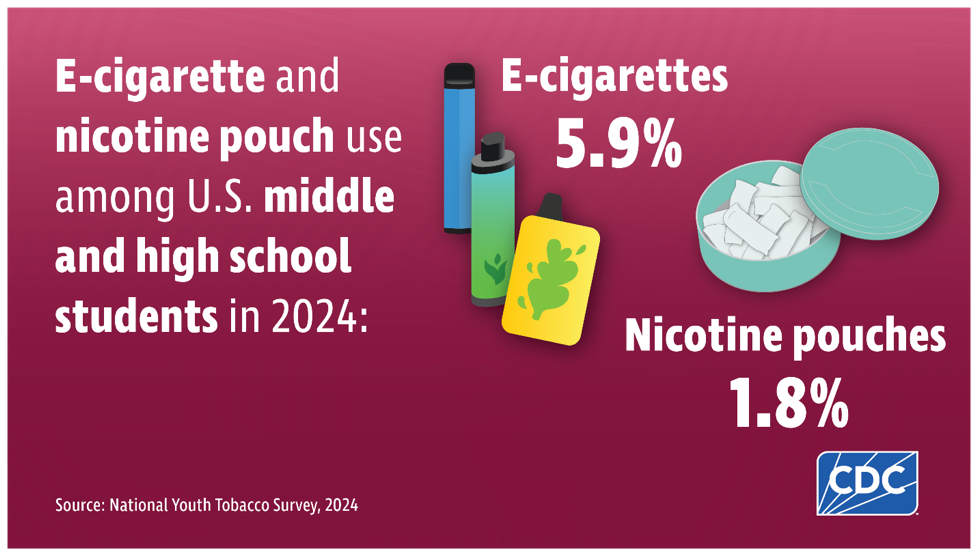
Of pressing present concern is the addictive effects of vaping [2], especially in youth. CDC statistics report that eight percent of all high school students and 3.5% of middle schoolers vape, with use increasing as the children age.
That’s 1.6 million young folks vaping in 2024, with the vast majority (over 87%) using flavored e-cigarettes. Some states outdo the national average. Oklahoma reported that 21.8% of their high school students identified as current e-cigarette users.
According to the CDC, most students want to quit, but it’s not that easy. Just like regular cigarettes, the electronic version is addictive. At least one study demonstrated that in young people, vaping is more addictive than smoking. This is not surprising since some vapes have nearly double the nicotine level as cigarettes. Dr. Pamela Ling, the director of the U.C.S.F. Center for Tobacco Control Research and Education, reports that teens sleep with vapes tucked under their pillows and reach for them first thing in the morning.
Other serious concerns include potential long-term effects on brain development and behavior as nicotine exposure disrupts critical brain development, affecting attention, learning, mood, and impulse control.
Although vapes are intended as a smoking mitigation measure, this is not the case in teens. Quite the contrary: One study reports that “electronic cigarette (e-cigarette) use is associated with cigarette initiation among adolescents.” Other studies confirmed this finding, suggesting “that vaping is leading youth into nicotine use and nicotine addiction, not away from it.”
“Less than 8% of adolescents who use e-cigarettes do so for combustible cigarette cessation, in contrast to 85% of adults.… Most adolescents … aren’t even aware of the presence of nicotine in vapes, let alone its dangers. In a recent survey, [63%] did not know that nicotine is present in JUUL products. 19% believed that smoke from e-cigarettes was only water, and 23% believed that e-cigarettes were not a tobacco product….”
Tasty treats:
Vaping under age 21 is illegal, but children still procure it; prices have dropped, and the range of youth-appealing flavors has ballooned. And even though flavored vapes are not FDA approved, loopholes exist, notably disposable brands (like cotton candy and gummy bear) and mentholated versions, which easily find their way to the young consumer, often via “social sources,” the internet, or directly from a retailer.
Illegal vapes (unauthorized by the FDA) are marketed to attract children, configured in colorful backpacks or candies, tasty treats, or child-friendly toys. Currently, more than 7,000 e-cigarette flavors are available, some featuring tantalizing flavors such as bubblegum, custard, and donuts. The FDA has even received requests, subsequently denied, to approve child-friendly products named “Jimmy The Juice Man,” “Strawberry Astronaut”, and “Suicide Bunny Season.” Recent animal studies suggest that vapes with even more mundane flavors, like vanilla or cherry, are addictive, even without the nicotine.
Notwithstanding these dangers, Juul has just secured an impressive legal victory. “Last week, after a five-year delay, the Food and Drug Administration … authorized the marketing of Juul’s e-cigarettes,” finding its benefits outweigh the dangers, at least to the smoking adult. To be sure, Juul has removed its flavored products and is now only authorized to market tobacco and menthol varieties. And recently, the Supreme Court sustained the FDA's authority to block fruity and dessert-flavored varieties.
The biggest problem seems to be the flavored disposable vapes flooding the market, courtesy of China, with more than 86 percent of e-cigarettes on the market being illegal -- and the ease with which minors purchase vapes in several states.
Things to Be Done
As of May, ten states and the District of Columbia had taken definitive and proactive steps to curtail delivery of vaping products to children and teens. Federally, the legal age for sale is 21; however, some states permit sale to those over 18. While the federal law supersedes state provisions, enforcement may be limited to focusing on the 18-year-old benchmark, leaving another loophole.
Some states, like North Carolina, have introduced legislation raising the minimum age from 18 to 21, and seek to establish a permitting system for tobacco sales similar to that required for the purchase of alcoholic beverages. Last month, North Carolina joined a few other states banning vape pens, curtailing the sale of some illegal products.
I’m not sure that’s enough. There is a reason the FDA hasn't approved most flavored vaping products – there’s no evidence the benefits outweigh the dangers, especially in youth. Rather than trading one addiction for another, we need more innovative science, tighter oversight, better laws, and a cultural reset that makes nicotine obsolete. The choice isn’t between vaping and smoking; it’s between repeating the past or daring to imagine a future without either.
[1] A battery-operated device vaporizes an “e-liquid” containing nicotine, flavorings, and other chemicals (some of which are potentially dangerous, like acetaldehyde, glyoxal, and acrolein, and have not undergone any safety review for inhalation exposure) to create an inhalable aerosol, which users then inhale or “vape”.
[2] Addiction occurs when the brain gets a “shot” of nicotine. In cigarettes, the delivery mechanism occurs from tobacco combustion, in vapes, via heating of nicotine-based e-liquid. In both cases, the smoker inhales, and the nicotine is shot through to the brain’s reward circuits in seconds.

Barbara Pfeffer Billauer JD MA (Occ. Health) PhD
Professor Barbara Pfeffer Billauer is an internationally recognized scholar of public health law, bioethics, and the laws of medical care, focusing on the integration of science and law and its impact on day-to-day policy and legal outcomes. She has lectured and published extensively, in scholarly journals and law reviews, and has written and edited seven books for lay and academic audiences.