“The state of New York, acting through the Ulster County Clerk, should not be permitted to escape the constitutional obligation under the Full Faith and Credit Clause.”
- Texas Attorney General Ken Paxton
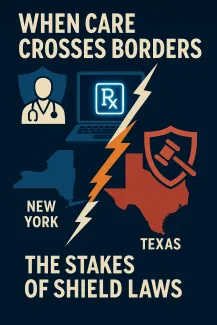
In February 2024, he sued Dr. Margaret Carpenter, a New York physician, for mailing abortion pills to a Texas woman, winning a $113,000 default judgment and an injunction in a Texas court. When Paxton tried to enforce that judgment in New York last May, Ulster County Clerk Taylor Bruck blocked it under New York’s shield law. Paxton responded by suing Bruck in state court, while New York’s Attorney General Letitia James countered that Texas “cannot commandeer New York’s courts to enforce its punitive abortion laws.” The clash illustrates how shield laws operate both as a legal defense for providers and as a flashpoint in battles over state sovereignty, medical access, and constitutional limits.
This standoff sets the stage for understanding what shield laws are and why they matter beyond abortion.
The Rise and Promise of Shield Laws
At their core, shield laws are designed to give clinicians space to act in daunting, even impossible circumstances without the paralyzing fear of litigation or prosecution. These statutory protections have appeared in many forms over time:
- Patient Safety Organizations shielding internal hospital or medical board quality-improvement discussions from discovery in malpractice lawsuits.
- Good Samaritan Laws protecting health professionals from liability when they provide care during declared public health emergencies or disasters and at “roadside” accidents.
- Whistleblower Protections allowing health care workers to report unsafe or unethical practices without fear of retaliation.
The COVID pandemic employed shields to protect doctors and hospitals working with limited ventilators, overwhelmed ICUs, and constantly shifting guidance. At the same time, the current New York–Texas controversy results from shields coming after the Supreme Court’s Dobbs decision, designed to protect providers who prescribe or mail abortion medications legally in one state but risk punishment from another. In both instances, the shield is a legal tool preserving care in the face of medical or political uncertainty. However, these shields raise a core dilemma: how do we protect clinicians who act in good faith under extraordinary circumstances without undermining accountability or patient rights?
A Fork in the Road
In 2005, because of the weaknesses exposed by Hurricane Katrina, Congress passed the Public Readiness and Emergency Preparedness Act (PREP). The law allows the Secretary of Health and Human Services to grant liability immunity to health professionals, manufacturers, and others for the use of vaccines, drugs, or devices during a declared public health emergency. The federal government relied on PREP during the COVID-19 pandemic.
New York enacted its own shield law, the Emergency or Disaster Treatment Protection Act, broadly immunizing hospitals, nursing homes, and clinicians for good-faith COVID-related care. Texas created a similar limited liability with its Pandemic Liability Protection Act. Lawsuits in both states focused on how to balance immunity and accountability within a single jurisdiction.
With Dobbs ending federal constitutional protection for abortions, eliminated federal constitutional protection for abortion, however, the conflict shifted from inside states to between them. Texas, a “Ban” state, restricted medication abortion and telehealth, while “access” states like New York passed shield laws protecting in-state providers who care for out-of-state patients remotely, including prescribing and mailing mifepristone. New York’s statute blocks enforcement of foreign subpoenas or judgments, limits extradition, and shields providers’ licenses and insurance.
Texas has sought to test those boundaries, pursuing civil actions and private enforcement against out-of-state prescribers who mail pills to Texas residents. The dispute now turns on state sovereignty: can a ban state punish conduct that was lawful in an access state, and can an access state lawfully refuse to enforce the ban state’s judgment?
This tension between state authority and cross-border medicine leads directly into the larger constitutional question: how far can federalism bend before it breaks?
Federalism on Trial: State Sovereignty and the Courts
The controversy is about federalism: the balance of power between the federal government and the states in setting health care rules, complicated by the borderless reach of telehealth. How best to protect providers acting in good faith while still maintaining societal accountability looks very different under COVID-19 or post-Dobbs interstate abortion telehealth.
During the pandemic, overwhelmed hospitals and nursing homes faced impossible choices. Clinicians triaging scarce ventilators or staff could not realistically practice medicine under constant threat of lawsuits. Shield laws promised space for good-faith action. But families who lost loved ones in New York’s nursing home debacle argued that broad immunity concealed more profound failings—chronic understaffing, poor infection control, and cost-cutting—that had nothing to do with the virus itself. However, the debate stayed within the state’s borders, where legislatures and courts had to decide how much immunity was fair to grant their providers, weighing compassion for clinicians against justice for patients.
Telehealth abortion services after Dobbs push the conflict beyond borders. A New York doctor prescribing mifepristone by video consult acts legally under New York law, with FDA approval behind her. Yet from Texas’s perspective, the very same act violates its abortion ban. Shield laws in states like New York block Texas from enforcing its judgments, protecting providers but leaving ban-state policymakers, and patients or their families without legal recourse. The result is a clash over whether one state can impose its rules on another, raising constitutional questions about the Full Faith and Credit Clause, extraterritorial jurisdiction, and the limits of sovereignty in an age when medicine can cross borders with the click of a mouse.
Given these stakes, it is unlikely the conflict will remain confined to state courts; the Supreme Court will eventually have to decide how far shield laws can stretch against the constitutional demand for interstate recognition. [1]
An Unfinished Experiment in Protecting Care
Shield laws sit at the fault line where science, medicine, and law collide. They are not tidy solutions but improvised tools, born in crisis and contention. COVID-19’s shield laws were a tool to keep providers at the bedside rather than in the courtroom. Digital health technologies have collapsed geography, and in the borderless world of telehealth, they can transform a laptop in New York into an arena for Texas’s most punitive laws. Telehealth abortion’s shield laws are less about care and more about jurisdiction across invisible state borders.
Shield laws, in all their variety, are reminders that medicine, one of our most human of behaviors, does not unfold in a vacuum, and is always entangled with politics, courts, and culture. The temptation is to reach for simple answers: immunity everywhere, or accountability at all costs. But the truth is messier, and far more urgent. These laws are experiments in drawing the line between compassion and justice, between the autonomy of states and the shared fabric of a nation. We should resist the easy reflex, whether to condemn or to canonize them. The answer will not be fixed, but found in the ongoing negotiation between science, medicine, and the society they serve.
[1] Telehealth requires that a physician have a medical license in the state of residence for the patient, in this instance, Texas. So I am wondering, as a physician who knows enough law to be dangerous to himself rather than helpful, whether this physician was practicing in the State of Texas, irrespective of where the digital keystrokes took place.

Chuck Dinerstein, MD, MBA
Director of Medicine
Dr. Charles Dinerstein, M.D., MBA, FACS is Director of Medicine at the American Council on Science and Health. He has over 25 years of experience as a vascular surgeon.