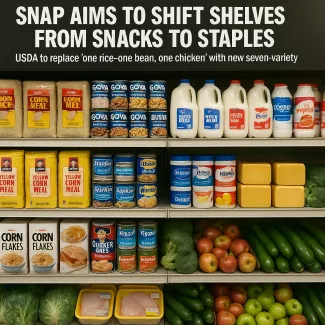
SNAP, the Supplemental Nutritional Assistance Program, serves approximately 42 million people in 22 million households, accounting for about 12.5% of our total population. New policy is being directed at the SNAP work requirement [1] and the products available for purchase by SNAP recipients. The USDA has just released updated rules for retailer SNAP eligibility, outlining the required items and their minimum quantities. While ambitious on paper, questions remain about whether these changes will be implemented, let alone how effectively they will be enforced.
The thrust of the rulemaking is to both increase the breadth of nutritional foods available and make it easier to enforce these stocking requirements. There are approximately 250,000 establishments that accept SNAP benefits. The majority, 80% of food stamp redemptions, come from supermarkets and “superstores,” such as Walmart and Target. While convenience stores represent the largest number of outlets, accounting for 44% of the quarter million, they make up only 5% of redemptions. So, the impact of these new rules will be muted at best. Still, how a store qualifies for SNAP participation reveals why variety standards matter.
The Road Paved With Good Intentions
To qualify as a SNAP retailer, a food store must either demonstrate that at least 50% of its sales come from staple foods or show that it carries a required breadth of staple items. Specialty shops, such as butchers or bakeries, usually qualify under the first rule, while most supermarkets and general food stores qualify under the second.
SNAP divides staple foods into four core categories—the building blocks of balanced meals:
- Protein: meat, poultry, or fish, whether fresh, frozen, or canned.
- Dairy: milk, yogurt, cheese, and related products.
- Grains: bread, rice, pasta, cereals, and flours.
- Fruits and vegetables: fresh, frozen, or canned produce.
SNAP stocking standards aim to ensure that families can purchase the basic building blocks needed to prepare real meals at home. They emphasize raw staples, grains, flours, beans, peas, and lentils, rather than relying on processed, multi-ingredient products. Under the current regulations, those choices are fairly limited
- Only “3 × 4” is required: Stores need only three varieties in each of four staple groups, with perishables required in just two groups. That adds up to as few as 12 items in total.
- “Ingredient loophole: USDA’s current “variety” test is ingredient, not product-based, so anything that shares the same main ingredient—no matter the cut, color, flavor, or brand—gets lumped into the same variety bucket. Three cans of pinto beans can satisfy the entire “bean” requirement, or several packs of chicken nuggets can meet the protein quota—leaving little diversity.
- Accessory-food loophole: Snack items, such as jerky sticks or protein bars, count toward the quota even though they’re not staples or ingredients, encouraging small stores to stock easy, high-margin snacks instead of fresh or minimally processed staples, thereby squeezing out healthier choices.
- Few Perishables: Fresh items are only required in two categories, so retailers often stock shelf-stable produce and dairy but avoid fresh proteins or whole-grain breads. Shoppers often see a limited selection of fresh meats, yogurts, and whole-grain breads—foods that spoil more quickly but are essential for a well-rounded, healthy diet.
In practice, this system often leaves SNAP shoppers in low-income areas, who are primarily served by convenience stores, with a bare-bones pantry instead of genuine choice.
The proposed rules significantly raise the bar—expanding the minimum from 12 items to 28 and tightening definitions to ensure true variety
- “3 × 4” becomes “7 × 4”: every SNAP retailer would have to stock seven distinct varieties in each staple group—protein, dairy, grains, and produce. The shelf of white bread, corn flakes, and oatmeal would give way to a variety of options, including rice, quinoa, oats, corn tortillas, pasta, and more.
- Removes the ingredient loophole by splitting big buckets into sub-groups. Beans are now categorized by type (dry, canned, or mixed), so a bag of black beans and a can of chickpeas represent different varieties. Protein options expand beyond just chicken.
- Closes the accessory-food loophole: Snack bars, most jerky sticks, and cheese/fruit spreads are formally re-labeled “accessory foods,”things we tend to snack on, sweeten with, or use to complement a meal rather than form its foundation, so they no longer count toward staple quotas. A store that previously met its protein target with beef, turkey, and pork jerky must replace them with more traditional staples, such as canned tuna, eggs, or raw nuts, thereby broadening the healthy protein options on the shelf.
- More fresh items: Perishables must appear in at least three categories, not just two—so stores must add fresh proteins or grains alongside produce and dairy.
In USDA’s own survey of small retailers, only 52 % stocked enough dairy and 63 % enough protein to meet the future seven-variety standard—evidence that many stores are already thin on these categories today.
SNAP rules are being refined to strike a balance between nutrition and choice. The USDA is proposing updates to SNAP’s variety framework to expand the definition of distinct staple foods in the protein, dairy, and grain categories. The goal is to provide households using SNAP with greater access to diverse, nutritious building blocks for home cooking, while reducing unnecessary complexity for retailers.
- Protein has long been the trickiest category for small-format stores to meet. The proposed framework categorizes proteins into seven groupings, now including nuts, legumes, and plant-based proteins—broadening affordable, fiber-rich options.
- Dairy’s new categories reflect what most families actually buy, rather than by the mammal (cow, goat, or sheep) producing the dairy product. The focus is on everyday choices, such as milk, yogurt, and cheese, with room for plant-based substitutes.
- Grains now focus on raw grains and flour as core staples, recognizing their role as versatile ingredients for cooking and baking. All forms of bread (bagels, tortillas, loaves) count as one variety, as do breakfast cereals and foods.
- Fruits and Vegetables are already diverse, but pre-cut produce now counts as staples, while deli-prepared salads do not.
A Nutritional Aside
Nothing is being taken away—people can still buy snack bars, jerky, or fruit spreads with SNAP benefits. The change simply tightens how stores qualify as SNAP retailers. These changes aim to make SNAP stores look less like “just enough” pantries and more like real sources of variety for home cooking.
The proposal doesn’t ban ultra-processed foods (UPFs). What it does is tighten the criteria for which items “count” when retailers prove they stock enough staple foods. Because many UPFs are now classified as accessory foods (so they no longer help a store pass the test), while the quota for minimally processed staples jumps from 12 to 28, shelf space is nudged away from UPFs and toward beans, raw grains, fresh meat, milk, and produce. Shoppers can still buy soda or candy with SNAP, but stores get no regulatory credit for carrying them.
Paving the Road
The idea of stricter retailer requirements is not new. What is little mentioned is that these expanded retailer requirements were part of the 2014 Agricultural Act, or Farm Bill. The USDA spent two years developing regulations to clarify what constitutes a variety. Moments before they were to take effect, now three years since the 2014 enabling legislation, Congress did a “do-over,” barring the USDA from enforcing the new provision and requiring a rewrite to the variety definitions. In 2019, USDA tried again, but its compromise drew criticism from both nutrition advocates and industry. The rules were never finalized, and today’s proposal—nearly a decade later—represents another attempt to balance competing pressures from Congress, advocates, and food retailers.
The long stall comes down to a mix of politics, practicality, and pushback. Congress, worried about the burden on small stores, repeatedly blocked enforcement through budget riders. USDA’s 2019 attempt at compromise alienated advocates by weakening nutrition standards while failing to provide clear regulatory text. At the same time, industry groups pushed for flexibility to avoid stocking requirements they saw as costly or unrealistic. The result has been nearly a decade of gridlock—caught between the Farm Bill’s intent to improve access to healthy staples and the political and logistical realities of regulating diverse food retailers.
If history is any guide, regulation alone won’t turn a corner bodega into a bastion of fresh produce. Without enforcement muscle, incentives for small retailers, and parallel investments in nutrition education, Congress’s decade-old mandate risks another loop through the policy grinder. The new rule is a necessary nudge toward healthier plates. Still, its real power will depend on whether lawmakers fund compliance, watchdogs demand transparency, and communities insist that access to good food is more than a line item. MAHA warriors will once again face the question of whether the words used to woo their votes will become acts and deeds or remain smoke and mirrors.
[1] As Pew Charities reports, “most Americans ages 16 to 59 who aren’t disabled must register with their state SNAP agency or employment office; meet any work, job search, or job training requirements set by their state; accept a suitable job if one is offered to them; and work at least 30 hours a week. Failure to comply with those rules can disqualify people from getting SNAP benefits.”
Source: Proposed Rule - Updated Staple Food Stocking Standards for Retailers in SNAP USDA Food and Nutrition Service

Chuck Dinerstein, MD, MBA
Director of Medicine
Dr. Charles Dinerstein, M.D., MBA, FACS is Director of Medicine at the American Council on Science and Health. He has over 25 years of experience as a vascular surgeon.