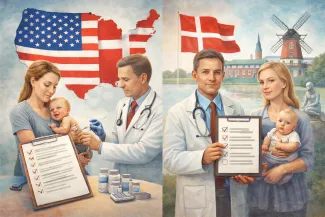
Lost in the Christmas and end-of-year frenzy was a plan by Secretary Kennedy to announce that we were moving childhood vaccinations to the Danish schedule, a model that includes fewer routine vaccines than the US schedule. While Politico notes the political speculation of why it was pulled at the last moment, each end of the divisive political spectrum had its reasons. The right pushed the reduction in vaccine-preventable diseases from the US 18 to the Danish 10, while frequently mentioning that the US requires 72 childhood “jabs” vs. the Danish 30. Buried and not mentioned is that, in this instance, childhood continues until age 18. On the left, the argument was “the plan to recommend the Danish schedule was not rigorous and science-based.” However, it is both science-based and modified by the Danes’ healthcare system and infection risks; modifications that those same US individuals cite when requiring a childhood hepatitis B vaccine.
As Yuval Noah Harari observes, “Another problem with any attempt to represent reality is that reality contains many viewpoints.” That tension—between evidence, interpretation, and values—runs through every debate about vaccine policy.
It began with a Presidential memorandum directing Secretary Kennedy and the Acting Director of the CDC to:
- Review best practices from peer, developed countries, and the scientific evidence supporting those recommendations.
Determine whether those practices are superior to current US guidance, and, if so, update the schedule accordingly—while preserving access to vaccines already available to Americans.
The model most discussed appears to be the vaccination schedule advocated by the FDA’s Acting Director of the Center for Drug Evaluation and Research, Tracy Beth Høeg, MD, PhD, adopted by the Danes, which involves significantly fewer vaccines. [1] As KFF, formerly the Kaiser Family Foundation, notes, each country has its own unique set of circumstances, shaped by “health delivery systems, insurance coverage, public health system capacity, and national priorities,” as well as the incidence and severity of the illnesses under consideration. They capture, unlike other media reporting, Denmark’s best practices:
“Denmark is not basing its schedule on a different scientific reading of the efficacy of the vaccines in question. Denmark’s health authority has emphasized recommending vaccines that reduce children’s risk of death or serious harm.”
To understand how that prioritization works in practice, it helps to examine how Danish health authorities define their goals.
How Denmark Decides Which Vaccines to Recommend
For that, we turn to Statens Serum Institut (SSI), the Danish government agency “whose main duty is to ensure preparedness against infectious diseases and biological threats as well as control of congenital disorders.”
SSI emphasizes that Denmark’s childhood vaccination program serves two goals: protecting individual children from disease and reducing community spread to protect those who cannot be vaccinated. Both individual benefit and population-level protection are explicitly considered in deciding which vaccines belong on the schedule.
Denmark evaluates childhood vaccines using a defined set of criteria that determine both need and timing:
- The disease matters: It must be common and/or severe enough to justify vaccinating healthy children. This is especially important and carries “significant weight” in vaccine coverage.
- Strong evidence in children: The vaccine must be thoroughly tested in large groups of children to confirm its safety and effectiveness.
- Benefits outweigh risks: Clear scientific evidence must show that disease prevention and health benefits outweigh any side effects.
- Public acceptance: Parents need to trust and accept both the vaccine and the overall vaccination program.
- Fits the program safely: The vaccine must work well alongside other vaccines, without harmful interactions or unintended ecological effects (such as one pathogen simply being replaced by another).
- Good value for society: The health benefits must justify the financial cost.
Importantly, none of these criteria is purely objective; each involves value judgments about risk, cost, and acceptable trade-offs. While Secretary Kennedy has framed reducing the number of vaccines primarily in terms of safety concerns, Danish researchers emphasize a different rationale. As SSI vaccine safety researcher Anders Hviid has explained, Denmark omits certain vaccines not because of safety worries, but because the diseases they prevent are not considered sufficiently burdensome to justify universal vaccination in that context.
“It omits shots for some diseases from the childhood schedule because they do not pose enough of a problem there to make the vaccines cost-effective, not because of concerns about safety.”
- Anders Hviid, Research on Vaccine Safety and Effectiveness SSI
Different Jabs for Different Folks
A STAT analysis illustrates how these differing priorities play out across specific vaccines.
- RSV: A leading cause of infant hospitalization in the US, RSV is considered manageable in Denmark. US policy prioritizes prevention, with medications and maternal vaccination reducing hospitalizations by roughly 55–80%.
- Rotavirus: Denmark declined vaccination, judging severe outcomes rare given universal access to care. In the US, where access is uneven and parental leave is limited, prevention proved more impactful—hospitalizations fell 85–95% after vaccination.
- Varicella (chickenpox): Denmark does not routinely vaccinate, resulting in about 63,000 annual cases and measurable hospitalizations and productivity losses. Before vaccination, the US saw thousands of hospitalizations and roughly 100 deaths annually; comparable Danish rates applied to the US population would translate into far higher absolute harm.
- Hepatitis B: Denmark relies on near-universal prenatal care and targeted screening, vaccinating only infants born to infected mothers. In the US, gaps in prenatal care mean screening misses cases, making universal newborn vaccination a critical safety net that has reduced infections by about 95%.
- Influenza: The US vaccinates all children annually to reduce community spread, while Denmark discontinued its program due to low uptake.
- Meningococcal disease: Though rare and severe, its lower incidence in Denmark makes universal vaccination less cost-effective under a universal healthcare model.
Denmark relies on strong, near-universal healthcare access to manage infections after they occur. The United States, facing greater access gaps and higher disease burden, chooses broad prevention through vaccination, especially when diseases are severe, unpredictable, or disproportionately harmful to children.
Context Matters More Than Labels
As Brian Potter has noted, any production process—including a vaccine schedule—is embedded in a broader context of resources, assumptions, and relationships. Understanding that context is essential to an evidence-based schedule that earns public trust is a priority shared by both Danish and US public health systems.
Unfortunately, moving that decision-making process to our shores requires time and thoughtful effort, two qualities that HHS under Secretary Kennedy has not demonstrated in any of his signature initiatives. Instead of a transparent and open discussion of the six pillars of the Danish model and who they should or should not apply to, I am afraid we will be asked to simply adopt the Danish schedule without considering why any infection might be different for an American population.
One of the most important differences lies in healthcare and social policy. Denmark’s universal coverage and paid parental and caregiver leave make it easier for families to manage childhood illness at home. In the US, the economic cost of caring for a sick child—lost wages or job insecurity—is often treated as an “externality,” largely invisible in health policy calculations but deeply consequential for parents.
There is also the issue of our societal obligations. The Danish model seems to comport well with the American idea of medical freedom: my decision to vaccinate is wholly independent of your choice and its consequences. Of course, during the pandemic, the Danes chose to vaccinate children for COVID because they were carriers. Once they became less of a concern, they ended the recommendation. Once the facts changed, so did their opinion and policy.
Denmark As A Mirror, Not A Mold
At its best, the Danish approach forces policymakers to make trade-offs explicit—among disease burden, severity, safety evidence, program fit, cost-effectiveness, and public acceptance. It treats the vaccine schedule as a living public-health tool, grounded in evidence and shaped by real-world conditions. Denmark’s “best practice” is not simply fewer vaccines, but a schedule optimized for a healthcare system designed to manage the consequences when preventable infections still occur.
The United States is not Denmark. We have different disease patterns, gaps in prenatal and primary care access, and a weaker social safety net for families who miss work when children get sick. We also have a different civic culture, one that often treats vaccination as a private consumer choice rather than a shared commitment to protecting the vulnerable.
If we want a vaccine schedule that is both science-based and trusted, the lesson from Denmark is not what to copy, but how to decide. That means building a rigorous, public, and iterative process that weighs evidence and context honestly and makes its reasoning visible to parents, clinicians, and critics alike. It also requires acknowledging that “best evidence” is never free of value judgments and aligning recommendations with the realities of American life—balancing individual autonomy with the unavoidable truth that infectious disease is never purely an individual matter.
We may not end up with Denmark’s schedule. But we could end up with a schedule that is truly ours, scientifically sound, transparent in its trade-offs, and far more likely to earn the trust it needs to protect children.
[1] You can find her complete presentation to the CDC here. Fun fact: she is a dual citizen of Denmark and the US.

Chuck Dinerstein, MD, MBA
Director of Medicine
Charles Dinerstein, MD, MBA, is the Medical Director of the American Council on Science and Health. A vascular surgeon with more than 25 years of clinical experience, he brings a physician's understanding of medical decision-making, an appreciation for scientific uncertainty, and a broader perspective on healthcare economics and policy to his writing.