
Earth Day is back, and that means reporters and influencers are doing two things: chastising everybody to lead "greener" lifestyles and predicting certain doom unless we confess our planetary sins and promise to better protect the environment. We amplify a different, science-driven earth day message here at ACSH. It goes like this: Economic growth, technological innovation and smarter risk-benefit trade-offs are steadily making the planet "greener," not destroying it. Data on improving air quality, food production increases and environmental impacts all confirm this conclusion.
I last made that case four years ago in a piece called Earth Day 2022: Doomsday Isn't Around the Corner. So, how has that thesis held up since then? Well, the sky still isn't falling. In fact, the evidence shows continued progress on the metrics that matter most for human health and the environment.
The Environmental Kuznets Curve (EKC): Still Going Strong
The EKC hypothesis—in short, economic growth drives sustainability—remains as relevant as ever. Early production improvements (e.g. Industrial Revolution) can ramp up pollution through scale effects. But as nations get wealthier, composition and technique effects kick in: industries shift toward services and cleaner technology, and societies invest in pollution controls, precision tools and better stewardship of chemicals like pesticides.
A fresh look at the literature confirms this pattern holds across air pollutants and other indicators, with wealth enabling the very innovations that reduce environmental footprints. Wealthy countries aren't "exploiting" resources in a zero-sum way—they're deploying them more efficiently, which is precisely why risk-benefit calculations favor continued access to modern tools rather than degrowth fantasies.
Cleaner Air: Emissions Keep Plummeting
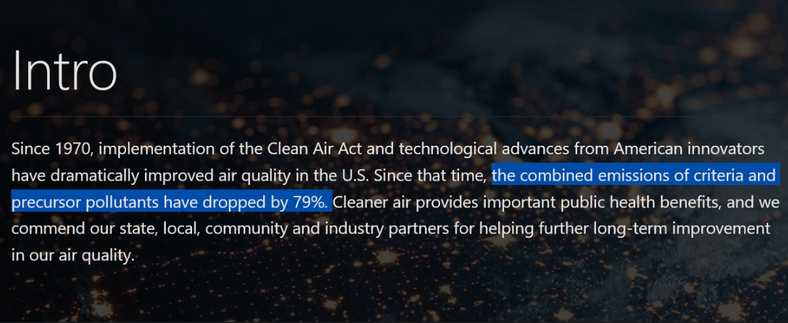
In 2022, EPA data showed an ~80% drop in combined emissions of six common pollutants since 1970, with even steeper declines in specifics like sulfur dioxide (91%) and lead. Fast-forward to the EPA's Our Nation's Air 2025 report (covering progress through 2024): the combined drop is now 79% since 1970. Concentrations tell the same story—carbon monoxide down 87% since 1980, nitrogen dioxide down 69%, and ozone down 29%. These aren't trivial gains; they translate directly to fewer respiratory issues and better public health outcomes.
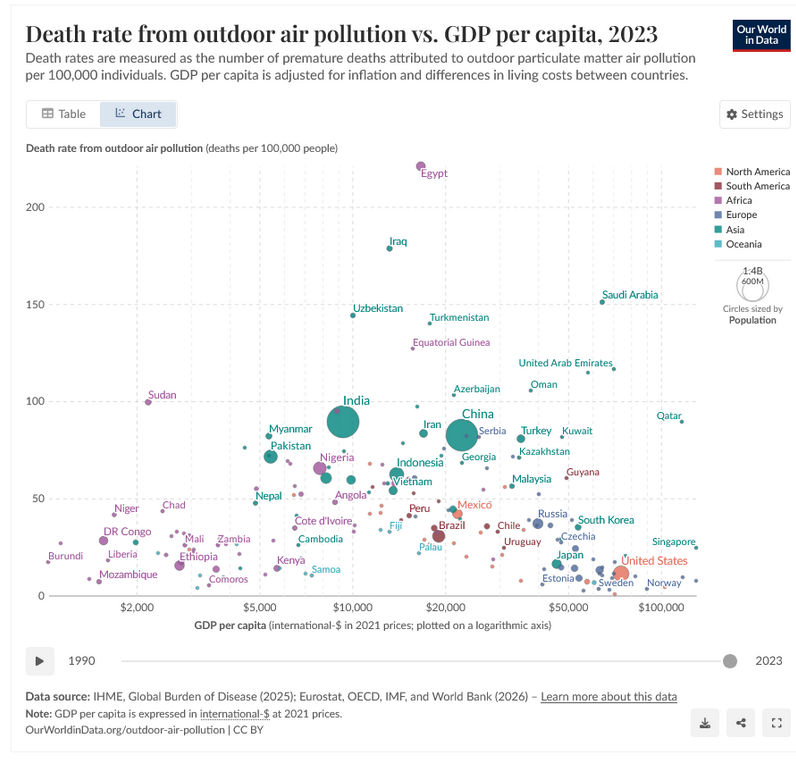
In a striking confirmation of the wealth-to-health pipeline, outdoor air pollution deaths are still lowest in the poorest and richest nations, per updated numbers from Our World in Data. Emerging economies in the middle are still climbing the EKC curve. Wealth creation driven by saving and investment in technology—environmentalism's favorite villains—are actually the solutions to our sustainability troubles. With our basic necessities provided, rich countries have the time and resources to invest in environmental clean up. This is why Americans argue about which water bottles and grocery bags are most "sustainable." Our more pressing problems have been solved.
Sustainable Food Production: Efficiency Gains Persist
The environmental footprint of food production—land use, emissions, and chemical inputs—remains dramatically smaller in high-income countries thanks to scale, biotechnology, precision agriculture, pesticides and fertilizers. High-income food systems contribute as little as 10 percent of total emissions in many cases, exactly as the data showed in 2022.
Global hunger metrics reinforce this. The UN's State of Food Security and Nutrition in the World 2025 reports a slight decline: an estimated 8.2–8.3 percent of the global population (around 673 million people) faced hunger in 2024, down from 8.5% in 2023, representing about 22 million fewer people going hungry.
That's not total victory; regional spikes in Africa and Western Asia tied to conflict, inflation, and other variables show we can't let up. But it's further progress refuting the Malthusian collapse activists like the late Paul Ehrlich love to predict. Wealthier nations' efficient systems help buffer global supply; restricting tools like pesticides would expand cropland needs and emissions elsewhere, worsening the risk-benefit ledger.
Critics may correctly note that land, pesticide and fertilizer use have all increased in absolute terms—and significantly so. This means our "footprint" has gotten bigger over time. But we need more context to determine whether this is a net negative, and we can find out with just one question: how much bigger would our footprint have been without technological innovation? Answer, according to an expert team at The Breakthrough Institute:
And while global land-use for agriculture increased by 25%—from just over 1.7 billion hectares in 1970 to just under 2.2 billion hectares today—without the increased yields made possible by technological advancement, a further 3.1 billion hectares of land could have been converted ... yield gains during that period saved just under a quarter of the world’s total arable land from agricultural expansion.
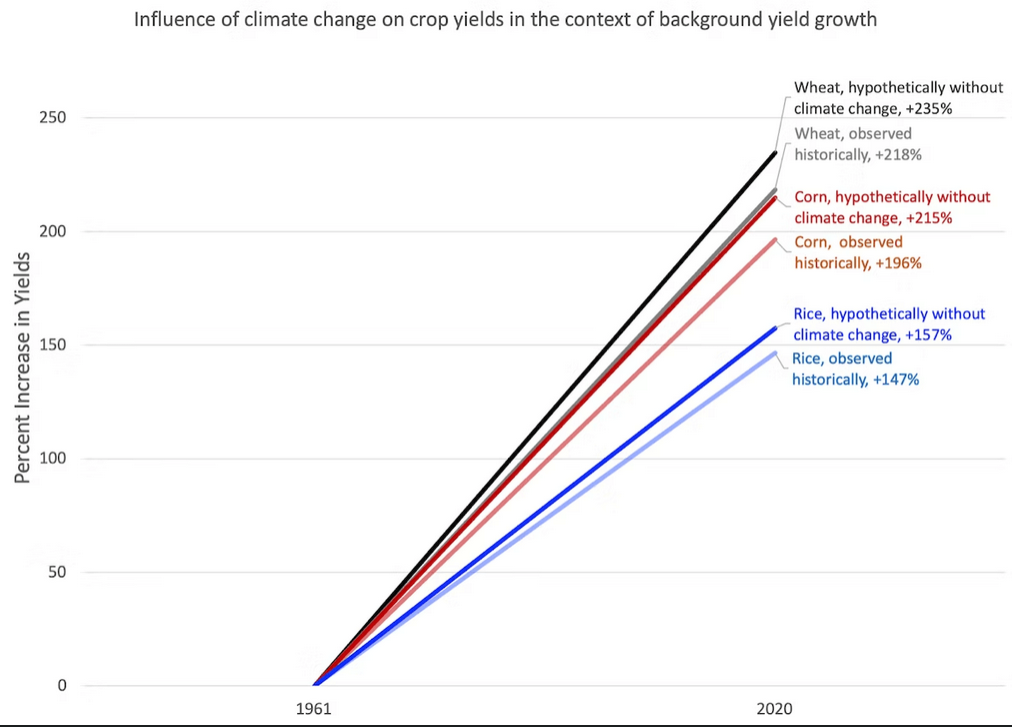
The productivity gains that prevented further agricultural land expansion were mainly due to the dramatic increases in agricultural yields since 1961. For example, global maize yields increased by 196%, wheat by 218%, and rice by 147%."
Put simply, agriculture's footprint has shrunk in relative terms, growing far slower than it otherwise would have. This is no small accomplishment when we consider enormous increases in food production, even in light of the much-ballyhooed effects of climate change (yield graph above-right).
The Bigger Picture: No Doomsday, Just Trade-Offs
Speaking of climate change, media reports commonly highlight increases in extreme weather events, like heatwaves making headlines, but the human cost tells a more encouraging story. Global weather-related death rates have plummeted over decades (down over 90% since the 1920s per capita, despite population growth and warming), thanks to better warnings, infrastructure and resilience.
Earth Day 2026 will bring the usual shrill warnings that we're "out of time to restore nature." Take them with the same grain of salt as you should every year. The data—air quality gains, hunger reductions, efficient food systems, and the ongoing EKC dynamics—show human ingenuity and economic growth are still greening the planet.
Real environmental problems exist and deserve serious, targeted action. But apocalyptic rhetoric distracts from what works: deploying more resources, not fewer, to solve them through better chemistry, biology, and stewardship.
Doomsday remains nowhere in sight. Let's keep the progress going.

Cameron English
Executive Vice President
Cameron English is a writer, editor and co-host of the Science Facts and Fallacies Podcast. Before joining ACSH, he was managing editor at the Genetic Literacy Project.