For many years, the medical establishment has argued, and in my view correctly, that addiction is a legitimate neurobiological condition that may often require long-term pharmacologic treatment, including with an opioid such as buprenorphine or methadone.
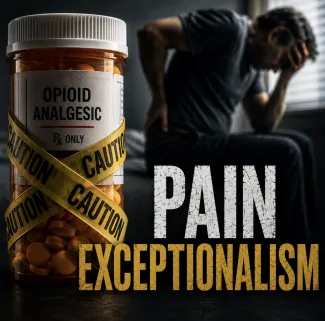
This is not, in itself, a controversial stance. However, when the subject turns to pain, whether acute or chronic, many of the same institutions abruptly change their tone and, more importantly, their mindset. Pharmacologic intervention is no longer treated as potentially necessary, but as inherently suspect. Behavioral and rehabilitative programs are elevated into preferred alternatives, and when those approaches fail, the failure is often transferred to the patient rather than the model itself. The result is a glaring double standard in medicine, one increasingly willing to treat one form of nervous-system dysfunction pharmacologically while treating another as though doing so were ethically compromised from the outset. The contradiction can be named: pain exceptionalism.
The double standard in question cannot be dismissed as a minor inconsistency in clinical emphasis or application. Rather, it reflects a deeper conceptual and philosophical confusion at the foundation of modern pain care. If medicine is willing, and indeed obligated, to recognize that one disorder involving the brain and central nervous system may justify pharmacologic treatment, then it cannot consistently claim that another brain and central nervous system disorder is systemically and uniquely disqualified from similar consideration without offering a serious and measured scientific justification. Yet this justification is seldom, if ever, given. Instead, pain is quietly moved into a separate and now morally charged category, one in which medication is approached less as a therapeutic tool than as a reputational and political liability. The consequence of this shift is that pain patients are not merely being treated differently. They are being subjected to a different ontology and epistemology of suffering itself.
One of the most striking features of this new framework is that pain is often described as a disorder of the brain when institutions wish to emphasize neuroplasticity, central sensitization, and the role of cognition and behavior in modulating suffering. In those moments, pain is supposedly treated as fully real, fully biological, and deeply embedded in the nervous system. However, when patients seek pharmacologic relief, the philosophy becomes entirely different, and the condition is suddenly approached as uniquely dangerous to treat through medication, as though the mere fact of pain’s subjectivity has rendered it less scientifically legitimate than other disorders of the same organ system. This is not a coherent scientific standard. It is a shaky epistemology and, perhaps even worse, a morally selective one. It therefore raises a profound question: why is pain treated as biologically real enough to psychologize and even moralize, but not biologically legitimate enough to medicate?
A devastating counterexample to this confusion can be found in conditions such as congenital insensitivity to pain. A person with such a condition does not fail to feel pain because they have adopted the wrong mindset, catastrophized their symptoms, or resisted behavioral therapy or any other psychogenic modality. They fail to feel pain because the biological mechanisms by which pain is generated are altered. This singular fact should be enough to settle at least one point with crystalline clarity: pain is not reducible to narrative, coping style, or a psychological interpretation layered over neutral sensation. It is a real neurobiological phenomenon. Once that is admitted, however, it becomes much more difficult to justify a medical culture that speaks about pain in scientific language when doing so supports behavioral interventions, yet retreats into moral suspicion when the question of analgesic pharmacology arises. Indeed, one could argue that it is the institutions themselves whose narratives and mindsets now require behavioral correction on a medical and cultural scale.
This is where we need to be careful with the language of multimodal care, as it often conceals more than it reveals. In principle, there is nothing wrong with, and often much to recommend, combining physical therapy, psychological support, rehabilitation, and medication. There is nothing controversial about such an approach. In fact, it is fully consistent with a genuinely science-based model: use whatever is most appropriate for the individual patient. However, in contemporary pain care, multimodal language too often functions as a euphemism for pharmacologic exclusion. Behavioral and other modalities are not simply added as supplemental support. They are increasingly used to displace pharmacologic care entirely, and when they fail, as too much is often being asked of these supplemental modalities, the institution retreats into the cowardly posture of abandoning further recourse and condemning the patient to unnecessary suffering under the veil of exhausted options. This is not comprehensive care. It is not even what would properly be called care in most other clinical contexts. It is systemic therapeutic narrowing disguised as fashionable sophistication.
The practical result, and more importantly the human cost, of pain exceptionalism is not theoretical confusion alone, but patient abandonment. Patients are increasingly sent through behavioral programs, physical therapy regimens, mindfulness frameworks, and other models that may at best offer partial support, but often fail to provide meaningful analgesia. As already noted, when these approaches do not work, the conclusion institutions too often draw is not that the model was insufficient, but that the patient has reached the arbitrary end of legitimate treatment. If we were dealing with nearly any other area of medicine, such a pattern would be recognized as a serious failure of care. In the modern practice of pain medicine, it is increasingly the standard of care. The consequences cannot be understated. The patient is left suffering, the institution retains its moral self-righteousness, and the therapeutic burden is shifted onto the person least capable of bearing it. A person struggling with addiction would not typically be denied pharmacologic intervention. A person with diabetes would not be denied pharmacologic intervention. A person with depression would not ordinarily be denied pharmacologic intervention. Yet pain patients increasingly are, and most perversely, they are told it is for their own good.
The most troubling aspect of this framework is that it often presents itself as enlightened, progressive, and evidence-based. Institutions become self-congratulatory for moving beyond so-called biomedical models, for emphasizing function over relief, and for reducing reliance on medications deemed politically and morally dangerous. However, a medical framework does not become more scientific simply because it is newer, more behaviorally inflected, or more fashionable at the institutional level. If anything, a model becomes regressive and less scientific when it begins with an a priori moral suspicion of one class of treatment and then builds its entire therapeutic philosophy around avoiding it. At that point, this ceases to be science. It ceases to be medicine. It becomes ideology. And once ideology hardens, it becomes dogma, then orthodoxy, and the ultimate victim of orthodoxy is truth itself.
Pain exceptionalism has created a medical culture in which the illusion of ethical seriousness functions as a thin pretense for refusing actual sober therapeutic consideration. Institutions can speak the patronizing, and arguably paternalistic, language of compassion, resilience, coping, and functional restoration while simultaneously leaving patients in severe and unnecessary pain. This allows them to preserve public prestige, avoid regulatory scrutiny, and align themselves with the dominant moral narrative of the post-opioid era, all while claiming to practice restraint and responsibility. Prudence is not a virtue when it becomes a pretext for abandonment and unnecessary suffering. Responsibility is not a virtue when it is weaponized against what is arguably one of the most stigmatized patient populations and one of the most moralized forms of suffering. In this grotesque caricature of the art and science of medicine, institutional self-protection and prestige cynically masquerade as patient care.
The defenders of this system often reply that pain is uniquely difficult, that long-term opioid therapy carries real risks, and that medicine must practice caution. None of this is controversial, nor is it seriously contested. Pain is complex, but so is cancer. Long-term pharmacologic treatment can involve risk, but so can any long-term pharmacologic intervention. No serious critic, including myself, needs to deny these obvious truisms. But complexity is not a warrant for contradiction, and risk is not a justification for categorical and systematic moral suspicion. Every serious area of medicine involves trade-offs, uncertainty, and the possibility of harm. That phenomenon is not unique to pain care. What is unique is the extent to which so-called pain medicine has allowed those realities to harden into an ontological imperative, one that justifies retreat into conceptual incoherence and the systematic narrowing of legitimate treatment options.
What pain medicine needs now is not more moral theater. It already has an overdose of that. It does not need more fashionable, New Age-adjacent euphemisms, nor more institutional self-protection disguised under the cowardly pretension of prudence. It needs a serious return to scientific as well as humane standards. This means treating pain as what it is: a real neurobiological phenomenon that deserves the same intellectual consistency, pharmacologic realism, and individualized therapeutic respect granted to any other disorder of the nervous system. It also means rejecting the selective logic by which one form of suffering is treated with compassion and medication while another is treated with suspicion and behavioral condescension. Until this contradiction is confronted directly, modern pain care will remain an artifice rather than a science-based discipline: a morally catastrophizing, intellectually inconsistent, and centrally sensitized regime of patient abandonment. That system deserves to be named for what it is: pain exceptionalism.

BJ Saylor
L.B. Joshua Saylor holds a B.A. in Mathematics and is currently pursuing an M.S. in Mathematics. Writing as both an independent scholar and a chronic pain patient, BJ focuses on medicine, pain policy, scientific reasoning, and the critique of pseudoscientific and anti-scientific narratives that distort patient care.