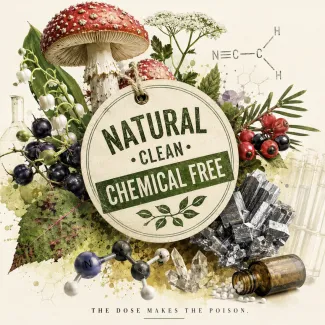
Chemophobia is one of the most pervasive and fashionable phobias of the modern era, despite the central irony that chemicals are not only ubiquitous in every facet of life but also constitute life as we know it.
The origin of this cultural contradiction is multifaceted. One of its central causes is marketing, but a more profound problem is ignorance — not only ignorance of what science says, but of what science is. Even more concerning is a broader and growing cultural apathy toward science, and at worst, a politicized and philosophical antipathy toward it.
Chemophobia depends on treating the word “chemical” as if it were synonymous with harm or danger. However, danger is not determined by whether a substance is synthetic, organic, polysyllabic, or otherwise not immediately legible to the public. Toxicity depends on dosage, exposure, route, context, and biological effect. A substance can be benign at one dose and dangerous at another; beneficial in one context and detrimental in another. The scientific question is not, “Is this a chemical?” but, “What is it, how much is present, how are people exposed to it, and what evidence of harm or risk exists?”
This confusion is why catchphrases such as “chemical-free,” “clean,” “non-toxic,” and “natural” have such commercial and rhetorical force. They do not merely describe products with dubious accuracy; they coddle consumer expectations and elevate these choices beyond branding into moral and intellectual superiority. The language is effective because it treats chemicals as contamination and nature as innocent and pure.
Yet nature is not innocent or pure. Arsenic is natural. Cyanide is natural. Venom, allergens, pathogens, and radiation are products of nature’s laboratory. Conversely, synthetic substances can be lifesaving, carefully controlled, and safer than many things found in nature’s formulary. The relevant distinction is never natural versus synthetic, but evidence versus assumption.
Another reason chemophobia flourishes is that detection is often conflated with danger. Modern analytical chemistry has become so advanced that it can identify substances at extraordinarily small concentrations, sometimes at levels so minute they are biologically innocuous. But the public is often told only that a chemical was detected in food, water, cosmetics, air, packaging, or the human body, without any meaningful context about dose, exposure, or comparative risk. The result is a type of editorial journalism and undisciplined activism in which mere presence becomes proof of threat. But finding a substance is not synonymous with finding harm. Detection in and of itself is not toxicity. Data without proportionality fuels histrionic panic.
Chemophobia is not scientific caution or prudence. Science asks for evidence, mechanism, dosage, exposure, and proportionality. Chemophobia asks for emotional resonance and moral purity. It gives the public the illusion of control while, ironically, making people less capable of understanding the world they actually inhabit.
We do not need a culture that fears chemistry or science. We need one that understands both, at least at a conceptual level. The task is not to escape or vilify chemicals. The first is impossible, and the second is moral pleading. The task is to think rationally about them, with evidence rather than catchphrases, toxicology rather than marketing, and proportionality and nuance rather than moral panic.
Chemophobia is not merely a failure of scientific understanding. It is a continuing celebration of the worst aspects of an anti-science worldview.

BJ Saylor
L.B. Joshua Saylor holds a B.A. in Mathematics and is currently pursuing an M.S. in Mathematics. Writing as both an independent scholar and a chronic pain patient, BJ focuses on medicine, pain policy, scientific reasoning, and the critique of pseudoscientific and anti-scientific narratives that distort patient care.