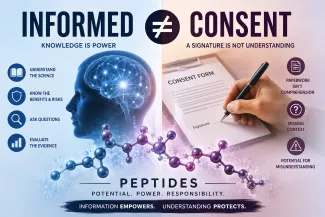
John Stossel recently used the peptide controversy to defend the broader principle of medical freedom. He acknowledges that peptides may be dangerous, contaminated, overhyped, or poorly understood, but says those risks do not automatically justify government prohibition. In his view, medical freedom means the right to make informed, risky choices about one’s own body. In a phrase, my body, my choice.
The contrary opinion, epitomized by the FDA and other regulatory agencies, falls somewhere between paternalism and regulatory protection. Autonomy matters, but only when paired with informed consent: people need to know what they are taking, whether it is pure, what the risks are, and whether claims are evidence-based. In a phrase, “father knows best.” [1]
While the FDA is tasked with ascertaining and communicating purity, risks, and benefits, regulatory inertia and the thumb-on-the-scale influence of special interests make its work problematic. As Drs. Bloom and Singer have long argued for the Iron Law of Prohibition, which holds that prohibition does not delineate good from bad or black from white but instead moves the market into the gray.
Leave aside, for the moment, whether the FDA is too slow, too cautious, or too easily captured. Leave aside peptides. The deeper question raised by Stossel’s argument is not whether the FDA gets every decision right. It is what we mean when we say an adult has given informed consent.
The phrase informed consent fuses two historically distinct legal ideas: the older concept of bodily autonomy (consent) and the more recent legal belief in the adequate disclosure of “material facts” (informed).
Consent Begins With Bodily Autonomy
The second word of that phrase is the easiest place to begin. If we view medicolegal opinion as reflective of our societal view, the earliest case law involves battery or trespass – the unauthorized “touching” of an individual by a physician. Importantly, while the physician may have acted properly, what we now call the standard of care, the care was still unlawful because it had not been authorized.
Schloendorff v. Society of New York Hospital involved a patient who consented to an examination under anesthesia but did not consent to surgery. In the context of Stossel’s version of medical freedom, Justice Cardozo’s famous formulation remains central:
“Every human being of adult years and sound mind has a right to determine what shall be done with his own body.”
That is the strongest version of Stossel’s argument: a competent adult owns the decision about what happens to his or her body.
If taking a peptide were purely an act of self-experimentation, consent withers becoming the easy part. A competent adult choosing a risk for his own perceived benefit has, in the narrow bodily-autonomy sense, consented. But two loose threads remain. First, legal disputes over consent often arise only after a bad outcome, when someone must assign responsibility. Second, some medical choices impose risks beyond the individual. Vaccination is the obvious example: refusal may be framed by one person as an exercise of personal autonomy and by another as exposure to a preventable risk.
Once the patient said “yes,” litigation and subsequent case law asked whether that “yes” was meaningful.
Informed: When Yes Is Meaningful
Initially, the courts considered the patient's ability to make a decision, whether their decision-making was limited by age or by general mental comprehension. But as medical care became more technically complex, the courts next considered, in obtaining consent from those competent to decide, whether the physician disclosed enough information about risks, alternatives, and consequences.
Natanson v. Kline involved a woman undergoing radiation therapy after breast cancer surgery who later claimed she had not been adequately warned of the risks. Separately (Salgo v. Stanford University), a patient who underwent an arteriogram and was left paralyzed; he, too, argued that the physicians had not adequately disclosed the risks of the procedure.
In both cases, the courts held that physicians must disclose the nature of the proposed treatment and its probable risks so patients can make informed choices. Salgo is especially important because it introduced the term “informed consent,” marking the transition from mere permission to permission grounded in material disclosure. Later courts would push the standard further: disclosure had to be meaningful to the patient, not merely satisfactory to the physician.
With unauthorized peptides, the disclosure question does not disappear; it migrates. When a product is advertised, supplied, prescribed, labeled, or sold for profit, disclosure may involve several actors: clinicians, prescribers, manufacturers, marketers, and regulators. That is precisely why medical freedom advocates so often find themselves arguing not only with doctors, but with the FDA.
Consider any of the many companies, such as Him or Ro, and manufacturers, such as Lilly, that provide GLP-1s “directly” to consumers. However streamlined the transaction may appear, a physician still legally prescribes the medication, and the duty to disclose remains where it has traditionally been, with the prescribing clinician. Gray-market peptide sellers try to avoid that duty by labeling products “for research purposes only,” pretending that substances plainly intended for human use are not being sold to patients at all. Unpasteurized milk sellers perform a similar dance when they label milk “for pets.” The nod and wink are treated as liability shields.
Peptides, as well as other experimental medications championed as a “right to try,” raise a harder question we have not answered. Should we treat the self-experimenter as a “sovereign chooser” or as a vulnerable consumer in a market with distorted information?
For life-extending drugs in terminal illness, especially when no meaningful alternatives remain, the case for medical freedom is at its strongest. When evidence is ambiguous but the disease is advancing and time is disappearing, we may be more willing to side with the desperate patient. Janis Joplin put it memorably: “Freedom’s just another word for nothing left to lose.”
But those arguments are harder to make for peptides used for optimization, anti-aging, bodybuilding, weight loss, or vague wellness. Here, the duty of disclosure becomes a greater hurdle. Stossel rightly decries the FDA’s regulatory inertia, but his argument puts his thumb on the scale in favor of consent.
“My question: In a “free country,” why do bureaucrats have the right to tell us what we may and may not put in our own bodies?
Don’t we own our bodies?
It should be our choice.
… There should be 1,000 experiments instead of our one-size-must-fit-all FDA.”
The FDA’s thumb rests on the other half of the phrase: informed action. Drug law prohibits adulterated or misbranded products in interstate commerce. Unapproved peptides are almost by definition vulnerable to that charge because there is no reliable oversight of ingredients, purity, dosage, claims, or short- and long-term adverse consequences.
For regulators, that makes this less like autonomous self-experimentation and more like exposure to an unreliable product market. Further, the downstream consequences may become public health issues. A personal misadventure may quickly become a public cost, borne by insurers, hospitals, public health programs, and the rest of us through higher premiums and taxes.
The Right to Refuse Is Not the Right to Buy
Several other cases point to a greater protection of the right of refusal than to the demand for medical intervention or medications. The strongest argument made for medical freedom was Cruzan v Missouri Department of Health. Nancy Cruzan, who was in a persistent vegetative state after a car accident. Her parents sought to remove her feeding tube, arguing that she would not have wanted continued life-sustaining treatment. The Court recognized that a competent person has a constitutionally protected liberty interest in refusing unwanted medical treatment, including life-sustaining treatment.
But the Court drew a different line in United States v. Rutherford. Terminally ill patients sought access to Laetrile, an unapproved drug, but the Supreme Court held that the FDA’s new-drug approval requirements still applied. Desperate need and voluntary acceptance of risk did not create a right to obtain an unapproved product through interstate commerce.
The Court set another limit in Washington v. Glucksberg, rejecting a constitutional right to physician-assisted suicide. It was unwilling to define medical autonomy broadly enough to include a right to enlist a physician in ending one’s life, emphasizing the state’s interests in preserving life and regulating the medical profession.
Here is the hinge. Refusing treatment is framed as a matter of bodily integrity; demanding access to an unapproved product implicates third-party suppliers, physicians, labeling, safety evidence, professional regulation, and interstate commerce.
If I knowingly accept the risk, why may the government still regulate the transaction?
If I create my own peptides, the state has little role. We are dealing with self-experimentation, and the liability falls on me. If I receive peptides in a local, non-commercial transaction unrelated to an interstate supply chain, I can at least make a plausible argument that the state has no role. But that is not the peptide market Stossel is defending. The substance is usually imported, shipped, advertised, purchased online, labeled with a wink, and sold by people who benefit from the transaction while trying to avoid the obligations that normally accompany selling drugs to human beings.
Medical freedom is real, but it is not a solvent that dissolves every other public obligation. A competent adult may refuse treatment because refusal protects bodily integrity. Demanding access to an unapproved product is different because it necessarily pulls in suppliers, prescribers, manufacturers, labels, evidence, commerce, and the public costs of private misadventure.
Stossel is right to distrust regulatory inertia, and the FDA has earned criticism when caution becomes paralysis. But he weakens his case by treating “consent” as if it were the whole of “informed consent.” The law and common sense have never been so simple. We are not merely arguing about who owns the body. We are arguing about who owns the risk once that body becomes the customer in a poorly lit marketplace.
[1] Is it a conspiratorial coincidence that Robert Young played the father in Father Knows Best and Marcus Welby, the kindly omniscient general practitioner?

Chuck Dinerstein, MD, MBA
Director of Medicine
Dr. Charles Dinerstein, M.D., MBA, FACS is Director of Medicine at the American Council on Science and Health. He has over 25 years of experience as a vascular surgeon.