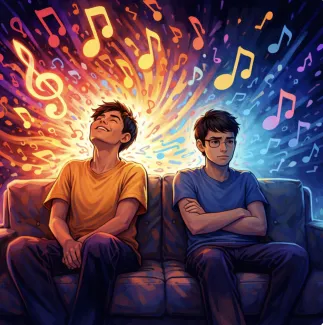
Some people love Mahler; others swear by Mozart. Some are enraptured by Frank Sinatra, while others would rather play Snoop Dogg all day. To say that musical tastes vary widely is quite an understatement.
But some people won’t like any of them — and it isn’t simply a matter of taste. For reasons that are still being worked out, music just doesn’t trigger much pleasure for them. A new review in the journal Trends in Cognitive Sciences offers an explanation for this phenomenon, which is called musical anhedonia.
Matters of taste and no flavor at all
Music, food, and wine are just a few of the many things in life where personal taste governs what we enjoy. But our reaction to music is different — and more complex. Our response to it isn’t just a matter of liking one composer over another — it depends on how sound is perceived and processed, and on how tightly that processing is linked to the brain’s reward system. In other words, two people can hear the same passage of music, but one person’s brain experiences it as pleasure while the other’s barely registers anything rewarding at all.
Part of the answer can be explained by neuroscience, specifically a concept known as reward sensitivity. When neuroscientists talk about reward sensitivity, they mean how strongly a person responds to things that are normally pleasurable — food, money, sex, social interaction, and, for most of us, music. In the review, Ernest Mas-Herrero and colleagues argue that reward sensitivity isn’t always controlled by one global dial set to “high” or “low.” Instead, it can be stimulus-specific.
The review is about music — and rightfully so, because our response to music offers a fascinating demonstration that reward sensitivity can be stimulus-specific: some people perceive music normally, yet get little pleasure from it.
The review suggests the issue may lie not in hearing or in the reward system alone, but in the link between them — a weaker connection between auditory processing and reward networks. So the music gets processed, but the pleasure signal doesn’t really kick in. It’s like tasting something and recognizing the flavor perfectly… without getting the “mmm” part.
But there are people who have extra and unusual responses to music. Here are some:
Perfect Pitch
On the other end of the spectrum is a rare group of people with perfect pitch. Only one in 10,000 people [1] has it, and it has a large genetic component. I am (or at least was) one of them. [2]
The term is widely misunderstood, even among musicians. Contrary to popular belief, perfect pitch —the ability to identify notes without seeing them being played, or hearing a reference tone — is completely different from relative pitch, aka, a "good ear." This ability to tell if a note is even slightly off is far more common. Without a good ear, a seat in the New York Philharmonic would be a poor career choice.
People with perfect pitch do not necessarily have good relative pitch, but they usually do. Piano tuners must have good relative pitch, but very few have perfect pitch.
The following is a bit weird. The two abilities do not even come from the same region of the brain. Although the consensus is that you are either born with or without perfect pitch — it cannot be learned — there is some controversy about this. And even those born with this innate ability must be exposed to music early in life, or it will not develop. Perfect pitch can be said to be partially genetic and partly learned.
Synesthesia
Technically, synesthesia is an unusual condition in which stimulation of one sense also activates a different sense. This is often experienced by musicians when they hear different notes and simultaneously visualize them in different colors. Some musicians with this ability include Leonard Bernstein, Billy Joel, Duke Ellington, and Kanye West. Another is my favorite pianist, Hélène Grimaud (see video at the end), who uses this "sixth sense" to help her memorize music scores.
Special treat! The following video shows Ms. Grimaud playing the second movement of Rachmaninoff's Second Piano Concerto, IMO the greatest musical composition of all time. [2] It is extraordinary. Go ahead. Treat yourselves.
NOTES:
[1] This number is widely used, but others claim that perfect pitch is more common. Beats me.
[2] Those who have this strange ability will begin to lose it at about age 40. At this point, people with perfect pitch will still be able to identify a note out of the blue, but it will be a half-note off — something that is universally disturbing to those of us who were accustomed to getting it right. I guess this could be called "imperfect perfect pitch."
[3] I am not alone. Rachmaninoff's Piano Concerto No. 2 was voted #1 in 2025 by listeners of Britain's Classic FM Hall of Fame. For the third year in a row.

Josh Bloom
Dr. Jonathan (Josh) Bloom, ACSH's Director of Chemical and Pharmaceutical Sciences, earned his Ph.D. at the University of Virginia and completed postdoctoral training at the University of Pennsylvania. During his 20-plus years in drug discovery at Wyeth, his research group discovered the antibiotic Tygacil®, approved in 2005. He holds 25 issued patents and has authored 35 academic papers. Since joining ACSH in 2010, he has written more than 2,000 articles and dozens of op-eds for major newspapers, including The Wall Street Journal and Chicago Tribune.