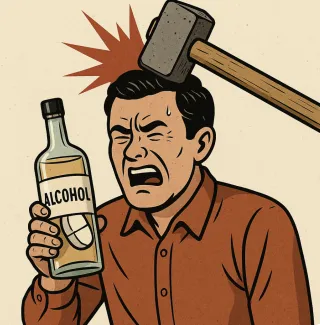
There are good prescription drugs, bad ones, and then there is Antabuse (generic name disulfiram). It is both. Antabuse works, but you'd better give it plenty of respect.
As the name implies, Antabuse is used to prevent alcoholics who want to stop drinking from doing so again. It sure works for that, but so does killing a mosquito by stalking it with a hand grenade. Effective? Yes. Subtle? Not so much. Yet, when subtlety doesn't work, you might need the hand grenade. Sometimes alcoholism requires that the grenade be used. Disulfiram (Antabuse) has one job: make drinking so miserable you won’t try it twice — and it delivers.
Anyone who has taken the drug and has even one sip of alcohol within the next few days (1), will find that life is going to be mighty unpleasant, since things you never consumed, perhaps a small marsupial or a used eBay bassoon, will be flying out of your mouth. Think: The Exorcist (minus the spinning head).
Biochemistry time (shudder)
The reason you’ll get so sick from Antabuse also helps explain why some people of Asian descent can’t tolerate alcohol. A subgroup has a genetic variant that reduces the activity of an enzyme called aldehyde dehydrogenase (ALDH2). This condition, sometimes called “Asian Flush," prevents them from fully metabolizing alcohol. As a result, acetaldehyde — a toxic intermediate—builds up in the body, causing symptoms like facial flushing, nausea, and rapid heartbeat. Disulfiram works in a very similar way: it intentionally blocks the same enzyme, leading to an extreme version of this reaction when alcohol is consumed.
Two Steps – One is a Doozy
Step 1: Ethanol is oxidized (hydrogen atoms removed) in the liver by an enzyme called alcohol dehydrogenase, which converts the alcohol into acetaldehyde, a toxic metabolite. If the name of an enzyme contains "dehydrogenase," then it's a sure bet that it will promote an oxidation (hydrogen atoms are removed). The yellow arrow ethanol (left) depicts the hydrogen atoms that are removed during the oxidation process (3). Conversely, if part of the enzyme's name contains "hydrogenase," it will promote the opposite reaction — a reduction (hydrogen atoms are added).
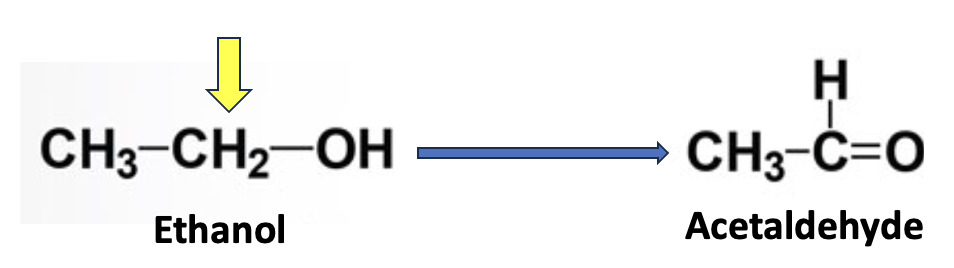
Step 2: The acetaldehyde is further metabolized, again by oxidation, by a different enzyme called acetaldehyde dehydrogenase. This enzyme serves to detoxify acetaldehyde by converting it into harmless acetic acid. Again, the yellow arrow depicts the loss of hydrogen during the reaction.

Acetaldehyde is some nasty ass stuff. Even organic chemists don't like working with it. Get some vapor in your eyes, and it will feel like you had an appointment with a deranged optometrist holding an oxygen-acetylene torch. It's not so pleasant in your nose either. Acetaldehyde toxicity is also largely responsible for the symptoms of hangovers.
It works. But...
Consuming alcohol with Antabuse will certainly make people sick, but does this help them stop drinking? Yes, it does, if used correctly. The following are some selected quotes from patients who have taken the drug. (The comments can be found on the website Drugs.com.)
For some, it works very well (4):
"Absolutely changed my life and made sobriety possible. Should be prescribed more often."
"I finally feel relieved that I have control over my craving to drink every day. I am really happy that I can go into a bar and hang out with my friends and not drink. I [have] basically been drinking since 15."
"If anything, the Antabuse works too well for me! It makes me super sensitive to any alcohol....whether it's in the hand sanitizers, nail polish removers, colognes (even on other people around me)..."
But you'd better not cheat
"I have tried this medication without success. When my cravings became too difficult I would stop taking the medication and plan my drinking for 4 to 5 days later which sometimes wasn't enough time to get the medicines out of my system and became very ill.
"[I was] witnessing one of the sickest people I've ever seen due to one drink while taking this medicine, I'm scared for him. He literally was bright red, his body was on fire and the sickness he felt was something he had never felt before and never wishes that he had drank. He was in massive pain."
And some people can't tolerate the side effects of the drug (5), even if they abstain from drinking:
"I never knew that Antabuse had any sexual side effects, until now. This is a concern to me. Drowsiness, tiredness, tingling in my feet, are further side effects."
What about alternative drugs?
There are other medications used to treat alcoholism. They are generally much easier to take but often less immediate (and possibly less effective) than Antabuse. Naltrexone (Revia, Vivitrol) is one of the most widely used—it works by blocking the brain’s reward response to alcohol, so drinking just doesn’t feel as good. That helps reduce cravings and heavy drinking, but it doesn’t stop someone from drinking altogether, and it can’t be used in people on opioids or with serious liver problems. Acamprosate (Campral) is helpful for people who have already quit and want to stay sober—it works by calming the brain's chemistry after detox. The downside? It has to be taken three times a day and doesn’t do much to help with cravings. Then there are off-label options like topiramate (Topamax) and gabapentin (Neurontin). Topiramate can cut down on drinking but often causes brain fog, weird tingling, or trouble with memory. Gabapentin can help with anxiety and sleep during early recovery, but it can make you feel loopy and, in some cases, be misused. (And it's a big fat joke when used as an opioid substitute.) Finally, the weight loss drugs (GLP-1 agonists) such as Wegovy and Ozempic not only suppress appetite but also seem to have potential in reducing alcohol cravings.
So while these meds have their place, especially when used with therapy, they often require consistent use and don’t pack the immediate behavioral punch that Antabuse does. Sometimes you need the sledge hammer.
NOTES:
(1) Even after two weeks, Antabuse can still make you sick after drinking, although many people may get away with drinking about four days after the last dose of the drug. This is not an experiment you want to run.
(2) The Asians who are not able to metabolize alcohol completely but still drink get what is called the "Asian Flush" - one of the effects that drinkers who are taking Antabuse suffer. It is caused by acetaldehyde. See Alcohol Is Racist: Unhappy New Year For Some
(3) It’s not quite that simple. The enzyme helps speed up the reaction, but it can’t do the job on its own — it needs a helper called a coenzyme. Coenzymes are molecules that work in conjunction with enzymes to facilitate chemical reactions. In this case, the helper is NAD⁺ (short for nicotinamide adenine dinucleotide). NAD⁺ plays a key role in what’s called a redox reaction, where electrons are transferred from one molecule to another. As it helps with the reaction, NAD⁺ picks up electrons and turns into NADH, its "charged-up" form. This back-and-forth between NAD⁺ and NADH is a very big deal — it’s how your body turns food into energy and keeps countless other processes running smoothly.
(4) Some people are so sensitive to alcohol while on Antabuse that they must avoid ketchup, hot sauces, some types of vinegar, mouthwashes, perfume, hand sanitizers...
(5) Side effects from the drug include skin rash, acne, headache, drowsiness, tiredness, impotence, metallic taste or garlic-like taste in the mouth, weakness, loss of appetite, upset stomach, vomiting, yellowness of the skin or eyes, and dark urine. Source: MedLine Plus

Josh Bloom
Dr. Jonathan (Josh) Bloom, ACSH's Director of Chemical and Pharmaceutical Sciences, earned his Ph.D. at the University of Virginia and completed postdoctoral training at the University of Pennsylvania. During his 20-plus years in drug discovery at Wyeth, his research group discovered the antibiotic Tygacil®, approved in 2005. He holds 25 issued patents and has authored 35 academic papers. Since joining ACSH in 2010, he has written more than 2,000 articles and dozens of op-eds for major newspapers, including The Wall Street Journal and Chicago Tribune.