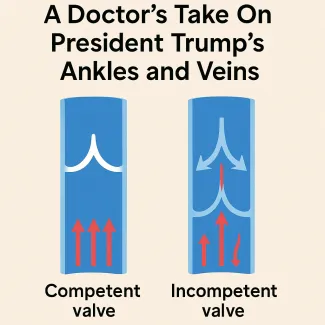
It is not every day that the President has a medical condition for which I have both training and experience, so now is my chance to dish.
According to his press secretary, Karoline Leavitt, President Trump has chronic venous insufficiency in his legs, resulting in the swelling of his ankles that the closely observing press has noted. Two venous systems in our legs drain blood back to the heart: the superficial veins, which are commonly visible on the skin, and the deep veins that carry the bulk of the blood upwards in addition that are a series of “perforating” veins that connect the superficial and deep systems through small holes in the leg’s connective tissue, the fascia.
Venous circulation
The veins must often work against gravity, and unlike arterial circulation, there is no heart to provide the pumping action that moves the blood forward. The deep veins in the leg have what we describe as a venous pump – an entanglement of veins within our calf muscles that are constantly squeezed and relaxed as the muscle contracts. This is the motive force. The directionality of the blood is provided by a series of one-way valves, built into both the deep and superficial veins, that allow the blood to move centrally. However, when the blood begins to fall due to gravity, the veins shut, providing a step-wise circulation against gravity. The perforator veins also have valves that direct the blood from the superficial to the deep system and then join the step-wise rise back to the heart.
Venous valvular incompetence
When the valves in the veins are damaged, there is impairment to venous flow. Chronic venous insufficiency of the superficial veins, commonly referred to as varicose veins, results in protruding veins as the valves are destroyed and blood fills the venous segment below. Venous valves are delicate; they can withstand only slight pressure, allowing stagnant columns of blood to, over time, damage the next valve, and the process of venous valvular insufficiency progresses down the leg. Stagnant blood is more likely to form a clot, and elevated venous pressures result in less tissue drainage, leading to clinically apparent swelling.
The same valvular insufficiency can occur in the deep veins, where episodic but significantly increased pressures from the muscles squeezing the venous pump can accelerate the breakdown of other veins, leading to clinically apparent swelling. Additionally, these pressures can affect the perforating veins, leading to increased pressure on the skin. The increased pressure can cause blood to seep out of the veins, which is subsequently reabsorbed, leaving an iron deposit and resulting in typical skin discoloration – think of it as an area of rust. That increased pressure on the skin may also result in the loss of circulation within the tiny capillaries, leading to ulcerations.
Leavitt has not provided us with enough information to say whether the President’s venous issues are due to the deep, superficial, or both venous systems. However, his physicians will be able to determine this from the ultrasound examination.
Treatment is primarily cosmetic or for symptomatic relief of swelling and ulcerations. The general recommendations include leg elevation whenever possible, compression stockings, and proper skin care. Surgical intervention has advanced significantly since my initial training, and today, most superficial varices are treated with sclerosing agents or endovascular techniques that aim to cause the superficial vein walls to adhere to one another, thereby closing the vein. Deep venous surgery has a less successful track record, and we are still working to develop techniques for repairing venous valves. Wound care, including the use of compression garments, various wound preparations, and hyperbaric oxygen therapy, is used with varying success for venous ulcers. Ironically, some of these wound preparations and hyperbaric oxygen treatments are among the Administration’s targets for improper and false billing.
The one other fact from Leavitt’s release that I find interesting is the President’s use of aspirin for cardiovascular disease prevention. In this case, he is not adhering to the guidelines promoted by the US Preventive Services Task Force, whose most recent meeting was cancelled by Secretary Kennedy and is rumored to be under scrutiny for change, much like the newly established Advisory Committee on Immunization Practices (ACIP). While she is correct in stating that aspirin might well cause the skin discoloration noted on the President’s hands, it is no longer recommended for the prevention of a cardiac event. It remains a treatment recommendation for individuals who have already suffered a cardiac event; the distinction is that the downside risks of a daily aspirin, which are quite small, still outweigh the potential benefit in those who have not had a cardiac event.

Chuck Dinerstein, MD, MBA
Director of Medicine
Charles Dinerstein, MD, MBA, is the Medical Director of the American Council on Science and Health. A vascular surgeon with more than 25 years of clinical experience, he brings a physician's understanding of medical decision-making, an appreciation for scientific uncertainty, and a broader perspective on healthcare economics and policy to his writing.