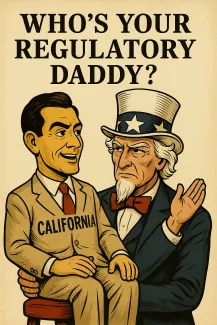
State’s rights. For those with a direct memory of history or book learning, it raises images of government officials blocking access to schools in the fight over integration. Today, it may conjure up memories of mandates enforced or denied. Should our food policy be national or local, such as at the state level? More importantly, should a state with large markets, such as California, set standards that strongly nudge companies to comply nationally? After all, that Prop 65 label is everywhere.
“Though RFK Jr. has the power to enact monumental change, much of MAHA’s actual successes at reforming the American diet haven’t come from Washington. While states pass law after law cracking down on food, Kennedy’s own biggest action to date has been relatively modest: a campaign pressuring food companies to voluntarily remove synthetic food dyes from their products. The states are out-MAHAing the MAHA king, much to his pleasure.”
From The Atlantic, The States Are Going Full RFK Jr.
Some individuals find the definition of GDP too cumbersome, and there is considerable debate on social media about whether GDP is a good reflection of our current economic condition. Other indices are available. The Economist, by way of EconLife, offers one we can all bite into, the BMI or The Big Mac Index
One of today’s great concerns is homelessness, not just for those without any resources, but for a growing plurality of younger Americans who cannot afford more than living with friends or family or in exceedingly small places. A lack of affordable housing is a slow-growing crisis, and the urban planning paradigms of my parents, exemplified by the “LeFrak cities” of New York, no longer apply.
“Culture is more powerful than policy, and anyone who makes the latter needs to recognize that. How people behave will always determine which ideas can work and which cannot, what can be built and what can’t. That’s why successful urban solutions in one city may fail elsewhere, making it difficult to extract universal planning principles. That’s why you have to get to know a place.
For instance, I’ve come to the conclusion that one of the secret sauces that makes a city livable is localized distribution. This is where the spaces you need in order to live a good life—grocery stores, parks, restaurants, subway stations—are evenly distributed geographically, rather than all clustered in certain areas.”
From the Free Press, How to Build the Perfect City
Still in a mood for a bit of urban planning? Consider one of the great shapers of our built environment, the car. Not only how they move us about, but where we store them when they are not needed.
“The motorcar is one of the defining features of modernity. Society was transformed by the internal combustion engine and its utopian promises for society. Cars made distant places accessible for the first time, creating fast, long-distance personal transport that was never before thought possible. Like all technologies, this came at a cost. The biggest problems were for our cities, which had to contend with noise pollution, air pollution, and the loss of streets and neighbourhoods. The car shaped the form that cities – indeed societies – took in the 20th century.
…Cars and their paraphernalia determine where we walk, what we look at, and how much time and money we spend in a given place. A different problem, though, is easily missed. Once these thousands of cars have got to their destination in densely packed cities, where do you put them?”
From Aeon, Cars beneath the ground

Chuck Dinerstein, MD, MBA
Director of Medicine
Charles Dinerstein, MD, MBA, is the Medical Director of the American Council on Science and Health. A vascular surgeon with more than 25 years of clinical experience, he brings a physician's understanding of medical decision-making, an appreciation for scientific uncertainty, and a broader perspective on healthcare economics and policy to his writing.