The Power of Disgust
Fight or flight has little to no value when the predator is upon you. A survival advantage comes from anticipation, the earliest perception of a threat. As social creatures, the way we perceive and respond to threats has been widely researched. Consider, for example, the role of disgust in eating. One study found that a greater range of foods deemed disgusting, termed “disgust sensitivity,” correlated with a greater perception of risk in general.
Research also shows that individuals with higher food disgust sensitivity are more likely to judge questionable food as unsafe and tend to engage in more protective hygiene behaviors such as handwashing or avoiding foods past their expiration date. And this extends to more than food, as another study found,
“With increasing food disgust sensitivity, participants reported higher levels of fear related to COVID-19, higher frequencies for preventive or protective behaviour and higher frequencies for shopping and stocking behaviour that aims to reduce exposure to the virus.”
But what if this early warning system is activated not just by food, but by sight alone?
This subconscious pattern of avoiding perceived sources of illness is part of what psychologists term the behavioral immune system, a set of responses designed to prevent infection before it occurs. A fascinating new study uncovers a mind-body connection elicited by the potential contact with an approaching “infectious avatar,” prompting more than an emotional response, moving us away, but initiating an acute immunologic response. Fear of an imminent infectious “predator” triggers both fight-and flight. Before jumping in, this is an exploratory study, a thought experiment backed up with data.
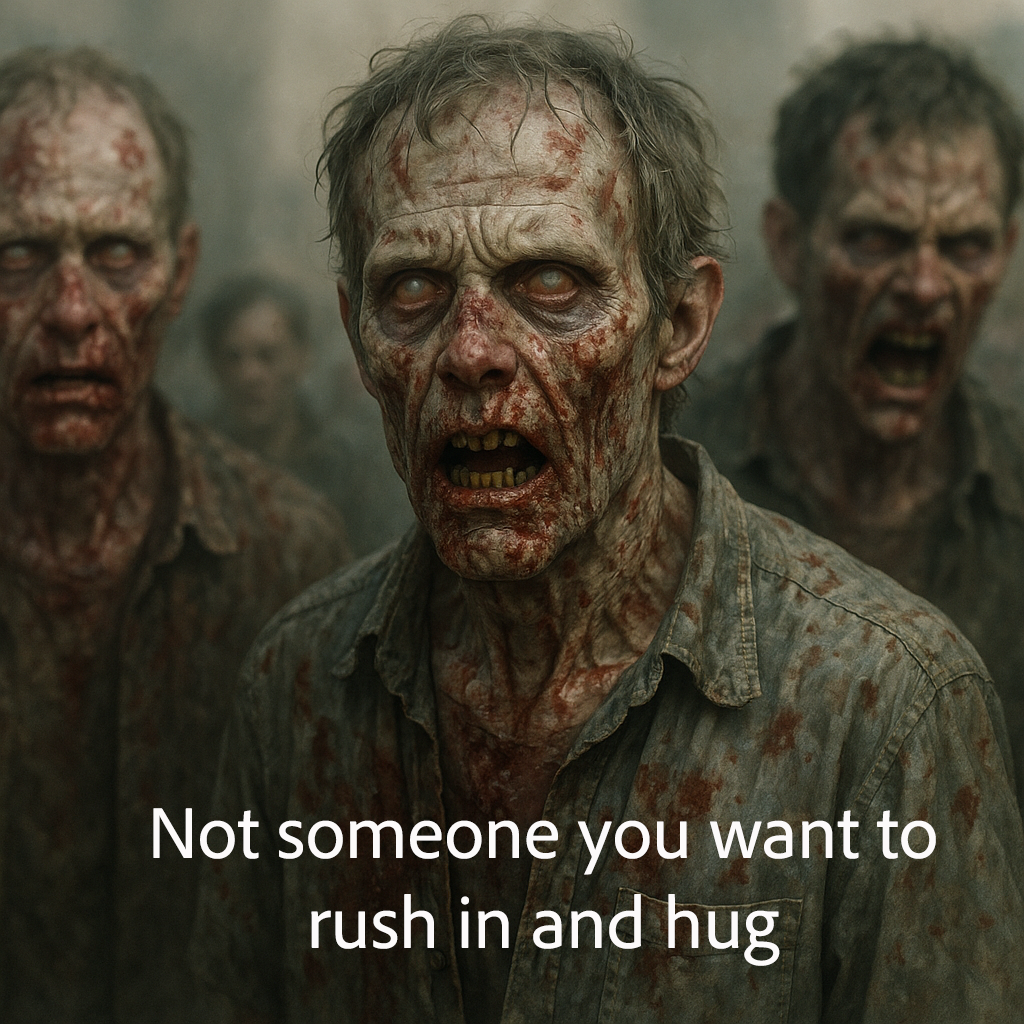
Influenza’s ability to infect relies, in part, on its being an invisible infection with no outward signs. Measles is partly stealth, being highly contagious before any visible signs are present to alert you, but reveals its infectious nature, remaining infectious for several days after its characteristic rash appears. Individuals with Ebola, like Zombies, show clear signs once infected and contagious.
A Mind-Body Connection
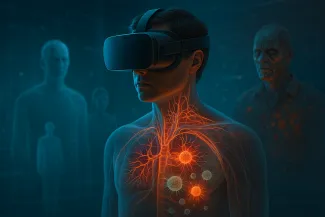
To uncover a physiologic mechanism linking our fear or disgust of an infection to an immune response, the researchers carried out an initial series of experiments using a virtual reality system where participants saw one of three avatars moving from a distance into their personal space. One avatar was neutral, another threatening, and the third, clearly infectious. The researchers measured a range of responses using EEG and functional MRI, as well as blood sampling. So, what did they find?
From our brain’s point of view, we all live in a bubble, the peripersonal space (PPS). Within that personalized distance, we pay particular attention to incoming stimuli. Based on a measure of how quickly participants responded, the researchers found that the PPS expanded far more rapidly to the infectious avatar than to the threatening one. Our brain anticipates potential contact with a harmful pathogen long before it occurs and responds more quickly than it does to physical threats.
The Alarm Bells Ring
Seeing the threat activates a set of interconnected regions termed the salience network, which helps prioritize incoming stimuli and determines whether to pay more or less attention. The network detects changes in your environment, your body (such as an increased heart rate or breathing), or your emotional state, helping to summarize and coordinate how the brain shifts between different networks of actions, like those that expand our personal space. As measured by EEG and functional MRI, the infectious avatar activated the salience network while the threatening avatar was less provocative.
The activation of the salience network, along with the pathways involved in PPS, subsequently influenced the bridge between our nervous and endocrine systems, specifically the hypothalamus. The hypothalamic-pituitary-adrenal (HPA) axis influences a range of messenger molecules, including cortisol and eicosanoids, which are involved in inflammatory and immune responses.
Virtual Viruses, Real Immune Responses
In the second phase of the study, new participants had their blood sampled after exposure to first a neutral and then an infectious avatar. As a control, researchers used blood samples from healthy individuals undergoing influenza vaccination to mimic pathogen exposure. Prior research has identified a relatively new group of immune “first responders,” the innate lymphoid cells (ILCs) that the HPA influences. ILCs are non-specific immediate responders to infections, launching a rapid defense before more focused T or B cells get involved. ILCs help maintain the barrier integrity of mucosal surfaces, which are the most likely entry points for pathogens. A second group of first responders, natural killer cells, which, like ILCs, are non-specific and immediate, were also measured. Virtual and real infections induced a similar strong response in ILCs, whereas neutral and fearful avatars did not. Infectious avatars did not influence natural killer cells.
As the researchers write,
“ILCs react to infections not only when they are detected in the body but also when they are processed as a potential threat approaching the body.”
The sight of a potential infection primed the body’s defenses as if a real pathogen had been detected.
A False Alarm is the Correct Response
To explain this evolutionary design, the researchers invoke the metaphor of a smoke detector: in the face of potential danger, it is far better to react to a false alarm than to overlook a real threat. In high-risk environments, the cost of a false positive is minimal compared to the potential consequences of a false negative. This favors an exquisitely sensitive system — one that triggers at the faintest trace of smoke or the mere suggestion of a pathogen. Like the smoke detector, our immune system errs on the side of caution, activating innate lymphoid cell (ILC) responses even before a pathogen is actually present.
One theory of consciousness suggests that we are fundamentally prediction machines, constantly forecasting the immediate future to stay one step ahead of danger. This study presents compelling evidence of such foresight in action: a predictive biological pathway primed for infectious threats. However, the implications go beyond infection. If a virtual avatar can elicit a real immune response, what might our constant exposure to visual, emotional, or informational signals of catastrophe and harm be doing to our bodies? The mind-body connection is not merely metaphorical; it is deeply embedded in our biology.
If perception alone triggers our immune defenses, what happens in an age of constant alerts, warnings, and doomscrolling? Feel free to comment below.
Source: Neural Anticipation Of Virtual Infection Triggers An Immune Response Nature Neuroscience DOI: 10.1038/s41593-025-02008-y

Chuck Dinerstein, MD, MBA
Director of Medicine
Dr. Charles Dinerstein, M.D., MBA, FACS is Director of Medicine at the American Council on Science and Health. He has over 25 years of experience as a vascular surgeon.