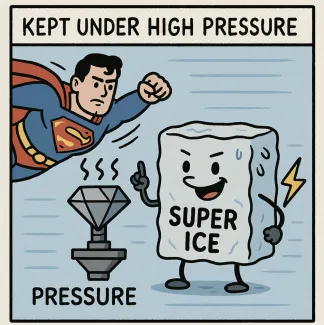
There are many types of ice.
- The typical stuff that is found in Buffalo between June 23rd and June 22nd the following year.
- There is dry ice, but it's not frozen water; it's frozen CO2, which doesn't melt; it sublimates.
- There are about a dozen manmade forms of ice that exist only under high pressures and low temperatures — the kinds of conditions you’d find deep inside planets or high-pressure labs on Earth.
- There's Vanilla Ice, but he's as stale as an open bag of Fig Newtons from 1978.
And, sticking with the pop music motif, BTO recorded "You ain't seen nothing yet" in 1974. I'm not sure how stutterers thought about this.
But scientists keep pushing it harder, colder, and stranger, and a group from Koreapulled off another trick.
Crazy S### Ice, aka Super Ice or Hot Ice
A multidisciplinary group of scientists, as noted in [1], took it one step further. They created a form of ice that isn't even cold. Provided that it is kept under insanely high pressure.
How high? It's a mere 1.6 gigapascals, which, just in case you don't know, is 16,000 times the air pressure at sea level —something your corpse would experience if it were standing tens of miles deep inside the Earth’s crust. At that pressure, even sturdy metals would deform, and water assumes a mighty strange form.
How did they do this??
It's nothing that Bob Vila, even in his glory days, could have done.
The researchers used a diamond anvil cell, which is exactly what it sounds like — two tiny, sharp-tipped diamonds pressing a microscopic droplet of water until the molecules scream for mercy. Then they blasted it with one of the most powerful instruments ever built: the European X-ray Free-Electron Laser (XFEL), near Hamburg, Germany.

The world's first diamond anvil cell, in the National Institute of Standards and Technology (NIST) in Gaithersburg, Maryland, 1958. Image: Wikipedia.
An XFEL is the lab equivalent of Zeus throwing lightning bolts at the molecular level. It produces bursts of X-rays so bright and so short—just quadrillionths of a second—that it can catch atoms in motion. Think of it as a strobe light for quantum weirdness.
When the researchers combined extreme pressure with those lightning-fast X-rays, water stopped acting like water. The oxygen remained atoms frozen in a rigid crystal lattice, but the hydrogen atoms, normally locked in place by their covalent bonds to oxygen, broke loose and ran around like little madmen, carrying an electric charge. The result is a solid that conducts electricity.
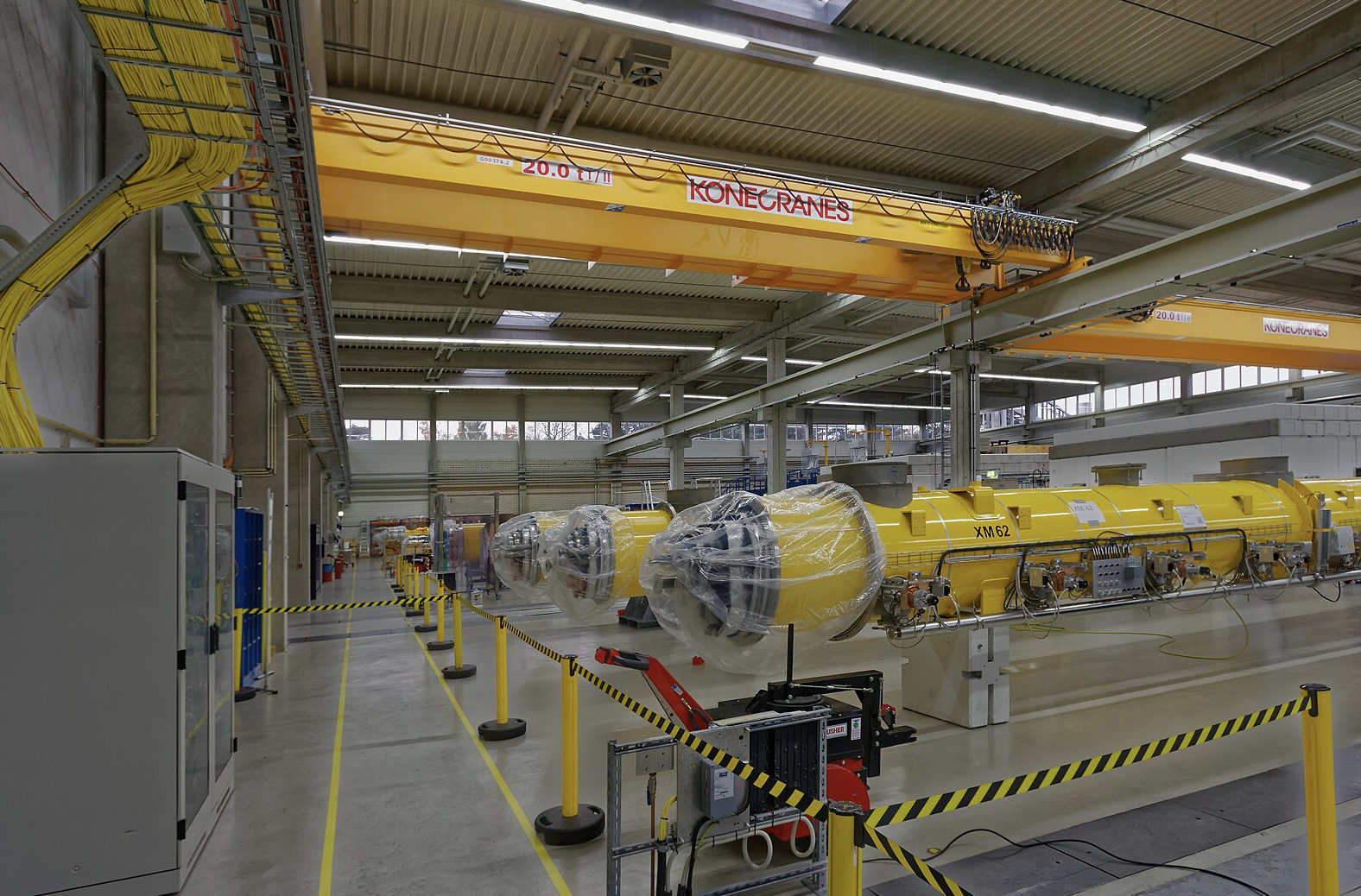
A slightly newer X-ray Free-Electron Laser. Photo: Wikimedia Commons
Isn't this simply ionization?
Close, but not the same. Ionization means ripping electrons away from atoms or molecules so that what’s left is a soup of charged particles — positive ions and negative anions.
You’ve actually seen a much gentler version of ionization at work in everyday chemistry. When salt dissolves in water, the sodium and chloride ions separate and drift freely, each carrying a charge. That’s ionization too, but in a liquid solution rather than a gas or plasma — and it’s why salt water conducts electricity so well.
The primary difference is that in “super ice,” the protons don’t actually leave their oxygens behind—they hop from one to another through a shared cloud of electrons, a kind of protonic orgy where everyone’s swapping partners at incredible speed, while keeping everything neutral. Could this be a Real Housewives spin-off?
Exit Bravo. Return to Science Channel.
The XFEL may look the size of a toaster, but that's because you're not seeing most of it. It's a type of particle accelerator, a monster of a machine. It looks small in photos, but that’s an illusion. The working part stretches for almost two miles underneath the German countryside, packed with magnets and superconducting cavities that push electrons to nearly the speed of light. (This leads me to wonder what RFK Jr. might say, since he thinks wf-Fi causes brain tumors.)
When those electrons zigzag through a series of alternating magnetic fields, they release bursts of X-rays so bright and so short that they make ordinary lasers look like flashlights. Each pulse lasts only a few quadrillionths of a second, enough to capture atoms in mid-motion.
Not quite ready for eBay
What makes this worth publishing in Nature Materials isn’t fireworks or the promise of a quick payoff. These experiments demonstrate how water behaves at pressures like those inside Uranus and Neptune—something that, until now, lived only in computer models. Seeing Ice XXI appear, even for a blink, helps explain why those planets have such weird magnetic fields and why they leak more heat than they should.
So what does it mean for us? Not much yet. No one’s building a refrigerator that needs a diamond anvil and a particle accelerator. But understanding how matter behaves when it’s pushed to the edge has a habit of paying off later. The same physics could one day shape new high-pressure materials, fusion tech, or ways to study exoplanets without leaving home. For now, it’s just cool basic science. Not half bad.
NOTE:
[1] Author information. The study was led by Geun Woo Lee at the Korea Research Institute of Standards and Science (KRISS), with collaborators from the University of Rochester in New York, the European X-ray Free-Electron Laser (XFEL) in Germany, and the Max Planck Institute for Structure and Dynamics of Matter in Hamburg. The team also included scientists from the Korea Advanced Institute of Science and Technology (KAIST) and the Center for High Pressure Science and Technology Advanced Research (HPSTAR) in China. The work was published in Nature Materials in October 2025.

Josh Bloom
Dr. Jonathan (Josh) Bloom, ACSH's Director of Chemical and Pharmaceutical Sciences, earned his Ph.D. at the University of Virginia and completed postdoctoral training at the University of Pennsylvania. During his 20-plus years in drug discovery at Wyeth, his research group discovered the antibiotic Tygacil®, approved in 2005. He holds 25 issued patents and has authored 35 academic papers. Since joining ACSH in 2010, he has written more than 2,000 articles and dozens of op-eds for major newspapers, including The Wall Street Journal and Chicago Tribune.