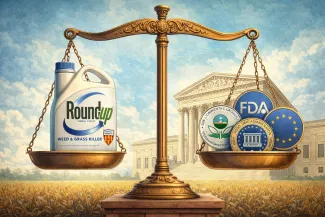
Glyphosate is one of the most widely used herbicides worldwide. Because it kills weeds cheaply and effectively, food availability increases, and costs decrease. Glyphosate, the active ingredient in Roundup, manufactured by Monsanto, has been determined to be safe by the EPA, the FDA, and the European Commission, subject to certain conditions. [1]
“A ‘Probable Carcinogen’ Label Sparks a Legal Avalanche”
In 2015, the International Agency for Research on Cancer (IARC), an intergovernmental agency of the World Health Organization, issued a report labeling glyphosate a “probable carcinogen.” Their report initiated an avalanche of lawsuits, beginning seven years ago with a California jury verdict of $289 million. Most cases claim Roundup exposure caused Non-Hodgkin’s Lymphoma and allege that had there been an adequate warning, they would not have used the product. The Roundup litigation has evolved into one of the most significant product liability lawsuits for US Bayer, which acquired Monsanto in 2018 and spent approximately $11 billion to settle 130,000 claims. But 61,000 cases remain, and more are contemplated.
According to Forbes, in 2017, a scandalous amount of ”hanky panky” improperly influenced the IARC finding. Indeed, most of the valid scientific evidence supports the claim that Roundup/glyphosate is not causally related to the cancers claimed. [2]
However, it seemed that reliance on scientific findings and pointed cross-examination of the plaintiffs’ statistical experts was missing in the early cases. Bayer did not primarily rely on the scientific aspect of causation in its defense; instead, it focused on a legal defense. More specifically, they argued that because the EPA approved the product and the labelling, they had no further duty to warn the public. That approach did not seem to find favor with state courts or juries, and the early cases resulted in findings favoring the plaintiffs.
Bayer Puts Science Back into the Defense
However, once emphasis shifted to scientific evidence on causation, Bayer prevailed in numerous cases. For example, the Illinois Appellate Court affirmed Monsanto’s trial win in a Cook County Roundup case, rejecting plaintiffs’ efforts to overturn a September 2023 defense verdict. In another favorable finding, the 9th Circuit rejected a general causation expert’s testimony and granted judgment in favor of Bayer, with broader ramifications. It seems that when Bayer focused on the scientific evidence and the lack of causal proof, they prevailed
But they’ve had some damaging verdicts, too, including a $2.1 billion award, which has renewed legal and financial pressure on Bayer. As the plaintiffs are re-opening the floodgates, rather than focusing on scientific evidence, which must be litigated on a case-by-case basis, Bayer is again reasserting its legal argument for across-the-board protection for an EPA-approved product, claiming the EPA’s approval of the product and warning label preempts (or bars) state court claims [3].
Thus far, this argument has generated mixed results: the Third Circuit ruled in Bayer’s favor, while the Ninth and Eleventh Circuits ruled in favor of the plaintiffs, allowing such claims to proceed, reasoning that state tort law can supplement federal regulation by providing additional consumer protections.
Monsanto Co. v. Durnell - The Preemption Fight Heads to Washington
Bayer has now brought the matter to the Supreme Court, seeking a determination that compliance with EPA regulations preempts state court claims. A few weeks ago, the Supreme Court agreed to hear the case amid the widening circuit split on the (legal) question, a common precursor to Supreme Court review. We can expect a briefing and oral argument during the 2025–2026 term, with a decision by summer 2026.
The issue before the Court is whether federal labeling laws supersede state labeling laws. Bayer contends that EPA-approved labeling preempts state failure-to-warn claims, a staple of state negligence and products liability actions that have driven years of costly lawsuits. The plaintiffs’ bar frames Bayer’s contention as a deprivation of the injured's rights.
There are solid reasons to support Bayer’s approach, which claims that state law claims dismantle the uniform regulatory framework established by FIFRA, creating a confusing, inconsistent patchwork of legal obligations, a matter of regulatory coherence and constitutional balance. Without Supreme Court intervention, businesses will face incompatible federal and state standards, especially in product labeling, where consistency is essential.
Moreover, a patchwork of inconsistent state decisions would generate a marketing, financial, and insurance nightmare, as the product with differing labels in some states and not others would confuse, rather than protect, consumers and lead to inconsistent results
At the legislative level, some states, such as Iowa and Idaho, have enacted laws that effectively immunize pesticide manufacturers from certain forms of liability, provided the EPA approves their products. Following the 2.1 billion dollar verdict, Georgia enacted similar legislation.
“The Act expressly aligns Georgia's pesticide labeling and warning requirements with federal standards, preempting any state law or common law duty to warn that would impose requirements beyond those established by the EPA.”
Critics argue the legislation favors corporate interests over public health by limiting legal recourse for individuals allegedly injured from exposure to products like Roundup. But the law does not provide blanket protection. The limitations would not apply if the “manufacturer knowingly withheld, concealed, misrepresented, or destroyed material information” in gaining EPA approval. Senator Cory Booker has countered the state-by-state legislative approach by introducing the Pesticide Injury Accountability Act, which aims to strip away those state-level protections to create a federal right of action for those harmed by pesticides.
The federal government supports Bayer’s approach:
“In a brief filed at the court, U.S. Solicitor General D. John Sauer bolstered Bayer’s effort to limit the lawsuits and potentially avert billions of dollars in damages, saying the company was correct that the federal law governing pesticides preempts lawsuits that make claims over the products under state law.”
The preemption doctrine raised by Bayer is neither novel nor extreme. Most pharmaceutical cases preempt state negligence and product liability/failure-to-warn claims. Should a manufacturer wish to change the label, even to make it more explicit and add more concerns, in most cases, they must first obtain FDA approval. The enabling legislation, which designates the FDA to approve products for use after safety and efficacy review, specifically provides this protection from most state claims, known as the FDA preemption doctrine. The legal theory is predicated on Congressional intent to designate the FDA as the national clearinghouse for determining drug safety and appropriate risk warnings, with the Constitution’s Supremacy Clause placing federal law over state law in this case.
The same reasoning should apply to situations where the EPA, which regulates pesticide/herbicide exposures, has approved a product and its labeling. The fly in that ointment is that the legislation designating EPA’s duties does not provide the same explicit protection as FDA-approved drugs and medical devices. Some people distinguish the FDA's schema and its preemption doctrine, enacted to promote pharmaceutical and medical device manufacturing as a social good, fearing that product liability suits might hamper the development of new products. This concern may not apply to pesticides. However, nowhere in the FDA legislation or its history is there any reference to that presumed goal.
Further, the FDA monitors pesticides when residues affect food, suggesting that the federal government has reserved for itself the sole right and responsibility to oversee safe exposure to various products under federal legislation.
As the Supreme Court addresses Bayer’s petition, the Roundup litigation may finally reach a decisive crossroads. At stake is not simply the future of one company’s liability, but the broader question of whether scientifically grounded federal regulation can be overridden by state juries applying inconsistent warning standards. If EPA-approved labeling is insufficient to shield manufacturers from massive tort exposure, then regulatory compliance becomes meaningless, and product safety will be determined more by litigation strategy and courtroom dynamics. The Court’s decision could either restore coherence to national pesticide regulation or cement a system where even widely vetted products remain perpetually vulnerable to legal ruin, regardless of what the science shows.
[1] Certain trace amounts of pesticides, or pesticide chemical residues, may remain in or on some crops after they’re harvested. The FDA’s role is to ensure that pesticide chemical residues do not exceed the limits established by the Environmental Protection Agency.
[2] In July 2024, an Australian judge didactically reviewed all the scientific evidence with the guidance of an impartial court-appointed expert and concluded that there was no valid and reliable scientific evidence linking glyphosate to the cancers claimed, and dismissed a class action by 24,000 plaintiffs. No similar judicial review has been performed in the US, and the case garnered little notice here. In December 2025, a paper claiming no causal relationship was retracted by Nature following complaints from two historians of science. That retraction does not impinge on the large epidemiological study primarily relied on by Judge Lee in concluding no causal relationship existed.
[3] Specifically, Bayer … contends “that it was legally prohibited from adding such a warning. Under the Federal Insecticide, Fungicide, and Rodenticide Act (FIFRA), the EPA must review and approve all pesticide labeling. The EPA has repeatedly declined to require a cancer warning for glyphosate—and has in fact rejected such efforts.”

Barbara Pfeffer Billauer JD MA (Occ. Health) PhD
Professor Barbara Pfeffer Billauer is an internationally recognized scholar of public health law, bioethics, and the laws of medical care, focusing on the integration of science and law and its impact on day-to-day policy and legal outcomes. She has lectured and published extensively, in scholarly journals and law reviews, and has written and edited seven books for lay and academic audiences.