A Regulatory Reversal
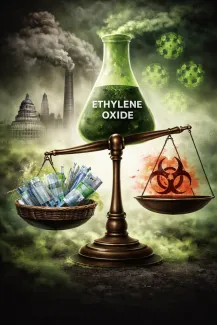
On March 13, 2026, the EPA proposed repealing the Biden-era 2024 final rule for Ethylene Oxide Commercial Sterilizer Facilities. This rule was designed to cut emissions from facilities using ethylene oxide to sterilize medical devices, including heart valves, pacemakers, surgical kits, and ventilators, by addressing cancer risks to nearby communities. The EPA said that the 2024 rule “actively threatens facilities ability to sterilize equipment and jeopardize one of American’s only options for a secure domestic supply chain of essential medical equipment.”
Ethylene oxide is produced by plants, soil, manure, fires, and most notably, within the human body. It is present in urban air at levels between 0.1 and 0.2 parts per billion (ppb), and in the human body at levels corresponding to continuous exposure to 0.56 to 4.5 ppb in air. Its primary use is to sterilize over 20 billion medical devices each year.
The initial news coverage, such as in the NY Times article, emphasizes the idea that the EPA is relaxing standards on a toxic, cancer-causing gas; ethylene oxide is a more complex health issue that doesn't fit neatly into headlines.
A Legal Issue Over EPA Authority
As I wrote previously, the Biden Administration imposed restrictions on 88 commercial sterilization facilities that use ethylene oxide as a sterilizer. The EPA identified that 23 of these facilities pose high cancer risks to nearby communities and ordered the installation of technologies within two years to reduce ethylene oxide emissions by over 90 percent, costing hundreds of millions of dollars.
The Trump EPA is challenging the 2024 rule with legal arguments, claiming that the Biden Administration exceeded its statutory authority because the Clean Air Act limits the EPA to conducting only one residual risk review for rules established under its authority. The risk review for ethylene oxide was completed in 2006, and since the Biden EPA conducted a second, “discretionary” risk review in 2024, the ethylene oxide rule is considered legally unauthorized and should be repealed.
A residual risk review is an EPA assessment of remaining health and environmental risks from facilities after they have implemented technology-based emission standards. In 2006, the residual risk review found no residual risk. In 2016, EPA’s Integrated Risk Information System (IRIS) calculated new, significantly lower cancer risk values [1], and the Biden EPA used these lower values to determine there was a residual risk from ethylene oxide and set risk-based emission standards.
The Trump EPA proposed rule would remove the risk-based emission standards for ethylene oxide established by the Biden EPA, which served as the foundation for the subsequent ruling, while suggesting changes to other requirements, including replacing specific monitoring systems and aeration room vents with more flexible standards.
Besides challenging the legality of the 2024 rule, the EPA argues that it poses a significant risk to the U.S. medical device supply chain. Ethylene oxide sterilizes about 50% of all U.S. medical devices, and currently, many of them have no acceptable alternatives. The Biden Administration had to establish a presidential exemption process from its own rule because some facilities could not meet the standards by the deadline, and closing these facilities would pose a serious threat to American lives.
Although I don’t know how the courts will decide the legal arguments, the Trump Administration has a solid scientific case.
The Cancer Risk: What the Science Actually Shows
The toxicity of ethylene oxide has been extensively studied, mainly among workers in medical sterilization facilities, exposed to much higher levels of ethylene oxide than the general public. In a study of 18,235 ethylene oxide workers, there was no evidence of increased cancer deaths, although there was a slight rise in some blood cancers in men and some indications of increased breast cancer. This prompted researchers to focus on the link between ethylene oxide and blood cancers as well as breast cancer, with most studies not finding an association. A meta-analysis did “not support the conclusion that exposure to EO is associated with an increased risk of blood cancers or breast cancer.” Other studies “suggest that ETO is associated with breast cancer, but a causal interpretation is weakened.”
Although most human studies have not found an association, animal studies show changes in DNA structure in cells (mutagenicity) and an increase in tumors after exposure to ethylene oxide. This evidence was sufficient for EPA’s 2016 IRIS to update its cancer classification from “probably carcinogenic to humans” to “carcinogenic to humans.” The calculated cancer risk values have been controversial from the start because they were lower than the amount of ethylene oxide produced within the human body.
When Risk Models Disagree
The EPA’s proposed rule invites public comments on new information regarding ethylene oxide toxicity, including the 2020 Texas Commission on Environmental Quality's alternative cancer risk assessment for ethylene oxide, which indicated a cancer risk that was 4,000 times lower than the EPA’s estimate.
As I have written, both the Texas and EPA assessments used human data from the National Institute of Occupational Safety and Health (NIOSH) but with different models [2]. Which is the better model? The only way to answer this question is to test the models with actual NIOSH data. The Texas model more accurately predicted cancer risk than the EPA’s model. Hopefully, during the public comment process, the Texas model will receive closer examination because it presents a scientifically sound alternative.
Balancing Public Health and Medical Supply
The Trump Administration’s challenge to the 2024 rule may ultimately hinge on legal debates about the EPA’s authority, but the scientific disagreement over cancer risk modeling is just as important. Evidence shows that alternative methods, like the Texas assessment, might better reflect the available human data and deliver more accurate risk predictions. As regulators review the rule, the main issue should not be just about weakening protections or defending industry, but about ensuring risk assessments are scientifically credible while maintaining the reliable sterilization of medical equipment that modern healthcare depends on.
[1] Cancer risk values: numbers derived from models that estimate the increase in cancer rates in the general population based on levels of ethylene oxide exposure.
[2] The EPA used the Supra-Linear Model, while Texas utilized the Cox Proportional Hazards Model.

Susan Goldhaber MPH
Susan Goldhaber, M.P.H., is an environmental toxicologist with over 40 years’ experience working at Federal and State agencies and in the private sector, with an emphasis on issues concerning chemicals in drinking water, air, and hazardous waste. Her current focus is on translating scientific data into usable information for the public.