I was raised by my parents under the guidance of the OG of pediatric expertise and parental advice, Dr. Benjamin Spock. My wife and I, in turn, found comfort in the advice of our generation’s pediatrician, Dr. Barry Brazelton. Today, in the fractionated world of social media, there is a bounty of lived experience and non-expertise to choose from. I occasionally dip into the work of Emily Oster, a mother and economist who applies evidence-based decision analysis to parenting.
The Evolution of Feeding Advice
Between 6 and 23 months of age, infants are weaned from breast milk and/or formula, and supplemental foods are introduced into their diet. Guidance from multiple pediatric organizations, including the American Academy of Pediatrics, notes that breast milk or infant formula alone is inadequate to meet the growing nutritional needs of this age group.
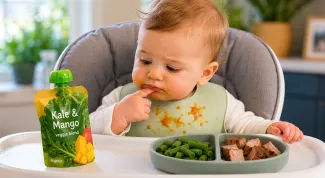
The food industry has played a large role in producing ready-to-eat processed infant foods—those bizarre combinations, at least to the adult palate, packaged as purees. Studies from the mid-2010s indicate that about half of US infants consume these commercially prepared foods. This use of processed foods is termed complementary feeding (CF).
As you might anticipate, in recent years, there has been a trend toward alternative, natural feeding approaches, known as baby-led weaning (BLW). In contrast to CF, babies eat appropriately cut-up table food appropriately, limit commercial products, and are allowed to self-feed rather than “parent-led spoon feeding.” It is estimated that between 20% and 40% of weaning is baby-led rather than complementary.
Social Media and the Great Weaning Debate
Unsurprisingly, social media has generated a polarizing cultural debate pitting the “Baby-Led” against the “Purées.” In one corner, Gill Rapley, who coined the term “Baby-Led” and wrote about the philosophic underpinnings of the movement, favors letting infants self-feed appropriately sized adult food. Jenny Best, the social media’s “Spock-Brazelton,” has built an ecosystem, Solid Starts, that serves as a primary source on Instagram and TikTok.
The Purées follow a more “historical” textural progression, spoon-feeding their young increasingly thicker mashes that eventually reach table food. The Purées are championed by two contrasting groups. Big Food advocates, through legacy brands like Gerber and modern direct-to-consumer services like Little Spoon, offer a range of convenient, nutritionally complete milestone products for the little one’s “journey” to adult food. They are aided in their efforts by moms on social media who emphasize how the chaos and uncertainty of raising an infant can be reduced with squeeze-and-go products.
Social media algorithms play their silent role. There are videos of infants coughing or gagging on large pieces of food, fueling or normalizing safety risks, depending on your baby-weaning camp. There are also aesthetic considerations, with social media feeds depicting meticulously curated toddler meals. Of course, algorithms thrive on tribal absolutes, allowing the “Baby-Led” to be accused of reckless, trendy behavior, while the Purées are stifling infant autonomy and delaying the development of motor skills.
It's Not Your Mother's Baby Food
Commercially prepared complementary foods are no longer single-ingredient purées of peas, apples, or carrots. Today’s baby and their more adventurous parents have combinations that combine fruit and grains, fruit and vegetables, vegetable-forward, protein-inclusive, and, of course, nods to parental cultures, e.g., Latin, Hispanic, and Asian. Not to be left out, the nutritionally aware baby can also get Mediterranean-inspired purées and those rich in healthy fats.
Infants are getting exposed to the parental bait and switch with some bitter vegetables, I’m looking at you, kale, and beets, which are paired with familiar fruit. This does not completely mask the bitterness, but it is helpful in the long-term acceptance of vegetables. This includes beet and blueberry, along with some novel, at least for infants, spice combinations, like pear and cardamom, or sweet potato and turmeric. Marketing increases the features and developmental goals, along with the nod to palatability.
Do Feeding Methods Affect Nutrition and Growth?
With the rise of “Baby-Led” weaning, a new hill in the social media culture war has been raised: whether BLW infants are obtaining the necessary nutrients and following a good “trajectory” for growth compared to their Purée counterparts.
A recent study sought to answer that concern using a “convenience” subgroup of infants and parents already enrolled in the Maternal and Infant Nutrition Trial [1], comparing energy, macro, and micronutrient intake and growth outcomes between the two feeding approaches.
Parents and caregivers recorded 3-day dietary records for infants at ages 5, 9, and 12 months, along with the infants' weights. Breast milk intake was quantified by weighing the infant before and after feeding. Baby-led weaning was defined as an infant receiving 10% or less of their energy from commercially prepared, pureed, spoon-fed foods. Of the 144 participants, roughly a third were BLW. The moms were predominantly non-Hispanic White, held bachelor’s degrees, and had family incomes exceeding $100,000. There were no significant differences in demographics between BLW and CW infants.
Of the 144 participants, 52 (36%) were classified as following BLW, and 92 (64%) were classified as following CW. The sample participants were 85% non-Hispanic White, with 85% of mothers having a bachelor’s degree or higher, and 78% having gross family income ≥$100,000/year. Fifty-three percent of infants were exclusively breastfed at age 5 months (baseline). No significant differences between BLW and CW were detected by study arm or by baseline demographics.
The Bottom Line
Let’s begin with the good news: in the conundrum between baby-led and complementary food weaning, it doesn’t make a difference; both approaches support healthy growth. Here are the details:
- Baby-led weaning and traditional spoon-feeding produced similar growth and weight gain during infancy.
- Babies ate about the same amount of food overall. The feeding style didn't affect total calorie intake.
- By 12 months, the diets looked remarkably similar. Early differences in fat and carbohydrate intake had mostly disappeared.
- Iron deserves special attention. More than one-third of infants, whether baby-led or spoon-fed, weren't getting enough iron, making iron-rich foods an important priority during weaning. Sorry, kids, tofu, spinach, and kale are still on the plate.
- Paradox alert! Babies following baby-led weaning tended to consume more sodium at 9 months, likely because they were eating more family foods. By 12 months, however, both groups were consuming more sodium than recommended.
Dr. Spock urged parents to avoid a rigid schedule and use their child’s interests, a measure of “developmental readiness,” to guide feeding. Writing to parents that they “know more than you think you do,” he suggested that parents decide what foods are offered and children decide whether and how much to eat. Principles reflected in the American Academy of Pediatrics guidance as “responsive feeding.”
Dr. Brazelton viewed feeding as more of a conversation between parent and child, with the child as an increasingly active participant. His reassurance that children are remarkably good at regulating their own intake when adults provide healthy choices echoes Dr. Spock.
Dr. Oster would look at the evidence just presented and know that whatever path she took was good for the baby.
Spock trusted parental instincts. Brazelton trusted the baby's developmental cues. Oster trusts the data. Interestingly, all three arrive at a similar practical conclusion: there is no single "correct" way to go from breast/bottle to adult food. What matters most is providing nutritious, developmentally appropriate foods, paying attention to the child's cues, and avoiding the trap of thinking that one feeding philosophy is a magic formula.
[1] The study was designed to measure the effects of different protein-rich foods on growth and gut microbiota in infants, with all infants provided with complementary foods or receiving grocery store vouchers.
Source: Associations Between Complementary Feeding Approach, Dietary Intake, and Growth: A Secondary Analysis of the Maternal and Infant Nutrition Trial. Journal of the Academy of Nutrition and Dietetics. DOI: 10.1016/j.jand.2026.156376

Chuck Dinerstein, MD, MBA
Director of Medicine
Charles Dinerstein, MD, MBA, is the Medical Director of the American Council on Science and Health. A vascular surgeon with more than 25 years of clinical experience, he brings a physician's understanding of medical decision-making, an appreciation for scientific uncertainty, and a broader perspective on healthcare economics and policy to his writing.