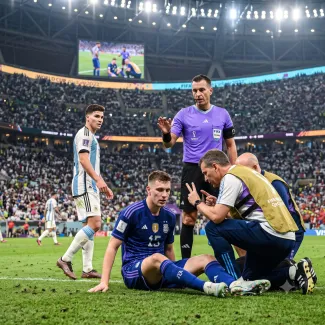
It is the World Cup final. The ball is played toward the byline; a midfielder gets there first, but before he can break into the penalty area, two defenders collide with him hard. He takes a blow to the head, falls, and stays down for a few moments. He gets up looking dazed and dizzy — but no one seems overly concerned. After all, it's the World Cup final. He plays another fifteen minutes before being substituted. His team wins, becomes world champion, and he celebrates with his teammates. Yet he has no memory of the victory, the match, or the celebration.
This isn't fiction. The player was Christoph Kramer, a defensive midfielder on Germany's 2014 World Cup-winning team. After colliding with Argentine defender Ezequiel Garay, Kramer suffered a concussion, a traumatic brain injury caused by a direct impact to the head, neck, or body that transmits force to the brain. He stayed on the pitch until he approached referee Nicola Rizzoli and asked whether the match was truly the final. Alarm bells rang, and he was substituted soon after. Days later, Kramer revealed he remembered nothing of the match, the title, or the celebrations.
Kramer is far from an isolated case. A study in Sports Medicine and Health Science tracked Brazil's top two divisions and the São Paulo State Championship from 2016 to 2019 — 3,828 matches, over 126,000 hours of play — and recorded 299 cranio-maxillofacial injuries, 87 of them concussions: an incidence of 0.69 cases per 1,000 hours. Defensive midfielders and goalkeepers were hit hardest, and about 13% of cases recurred.
Most soccer concussions cause transient symptoms, such as headache, dizziness, confusion, nausea, and memory lapses. Soccer's incidence is lower than rugby's, ice hockey's, snowboarding's, or American football's, but the consequences can still be severe. That reality pushed FIFA to create a Concussion Protocol for Medical Staff, guiding team physicians in evaluating head injuries and deciding whether a player should keep playing, plus a permanent concussion substitution that allows teams to make an extra swap for a suspected concussion, regardless of how many changes they've already used.
Against this backdrop, the central question is whether medicine and football have moved far enough to recognize concussions quickly and consistently. It is worth examining both FIFA's guidance and, especially, a new international consensus statement published in JAMA Neurology. The two serve different purposes. The FIFA document covers the entire process, from the moment of impact to a player's return to training days or weeks later. The JAMA Neurology consensus statement, by contrast, focuses on the few seconds a physician has during a match to decide whether a player can safely continue.
Football's Own Rulebook
For over a decade, every soccer fan has seen a goalkeeper wearing a padded headguard, almost as recognizable as Petr Čech himself. Few know why he wore it. In an October 2006 match, Reading's Stephen Hunt struck Čech's head with his knee, causing a depressed skull fracture. Čech underwent emergency surgery, missed months of play, and returned wearing the headguard that defined his image until he retired in 2019.
Even after an injury that serious, which was a structural skull fracture rather than a concussion, it took FIFA years to publish a specific protocol for recognizing concussions on the pitch. That delay matters because it left room for players like Kramer to keep playing despite clear warning signs, even though he had no memory of where he was. Today, FIFA's guidance is unambiguous: any suspicion of concussion means immediate removal for evaluation.
FIFA, like medicine, defines concussion as an injury from a direct impact to the head, face, or neck, or a blow elsewhere that transmits enough force to the brain. It can cause underlying neuropathological changes, but its signs mostly reflect temporary brain dysfunction rather than structural damage.
Loss of consciousness is not required for diagnosis. Other symptoms, such as headache and confusion, can appear immediately, within hours, or within days. That is why FIFA requires every team to maintain an Emergency Action Plan, including preseason baseline testing, a standardized protocol, and follow-up care. It is also why the main sideline assessment tool, the Sport Concussion Assessment Tool (SCAT), evaluates symptoms, orientation, memory, attention, balance, and neurological function.
Video review often catches what medical staff misses in real time, which is why FIFA also recommends dedicated concussion spotters who watch only for head impacts.
Even after emergencies are excluded, the approach remains conservative: any deterioration or lingering suspicion warrants immediate removal for a full workup. Evaluation continues after a player leaves the pitch: FIFA recommends monitoring for 72 hours and repeating assessments until concussion is ruled out or the athlete is cleared for a gradual return under FIFA's graduated return-to-play program — stages of increasing intensity, contact only in the final ones, each lasting at least 24 hours, with any returning symptom sending the player back to square one.
The protocol’s most important line may be its simplest: only the treating physician decides when a player returns — not the player, the coach, the club, the fans, or the stakes of the match. That principle leads directly to the next question: what does a physician need in those few seconds on the pitch? On the sport's biggest stages, that principle gets tested more than most fans realize.
The Three-Minute Test
The new consensus statement in JAMA Neurology tackles a persistent gap: soccer lacked a standardized, sport-specific tool for assessing a player with a suspected concussion during the game. That gap matters because the central problem is not diagnosis after the fact, but fast recognition in the field. The Sport Concussion Assessment Tool (SCAT) remains the primary instrument for sports concussions, but it was designed for multiple sports, and several of its components require ten to fifteen minutes off the field, time team physicians rarely have during a live match.
To close that gap, FIFA convened an 18-member committee from 14 countries representing all six continental confederations. Guided by a systematic review, the committee conducted surveys of nearly 60 team physicians and physiotherapists, who rated more than 100 assessment items. The result was the Football-Specific Standardized On-Pitch Concussion Assessment Protocol (FOCUS). Tested in simulated scenarios and a professional league before publication, it requires a median of just two minutes and fifty-two seconds to make a medical determination.
This is exactly the kind of tool that might have changed what happened to Gabriel Brazão, a Brazilian goalkeeper who collided with an opponent's knee less than a year ago, kept playing through a growing hematoma, and eventually left the field by ambulance. His case shows why a faster, soccer-specific assessment matters. But first, how does FOCUS work?
Inside the Focus Protocol
FOCUS consists of four stages, beginning with a history check that identifies factors increasing suspicion even before the physician reaches the player, including previous concussions, earlier head impacts in the same match, anticoagulant use, or a dangerous injury mechanism. While none confirms a concussion on its own, each lowers the threshold for concern.
Next comes an initial sideline assessment of the player's orientation, memory, speech, balance, coordination, and eye movements, followed by a short running test involving a sprint and directional changes. Any abnormal finding results in immediate removal. Physical signs such as seizure or abnormal posturing, altered consciousness, signs of a skull fracture or neck instability, vomiting, or abnormal pupils are red flags that immediately end both the assessment and the player's participation. An on-field evaluation and a final sideline reassessment follow the initial assessment.
FOCUS was never intended to diagnose a concussion; its purpose is to answer a simple question: Is it safe for this player to continue? If the answer is anything other than a clear yes, the player is removed for further evaluation.
This philosophy also reflects how signs of concussion differ across sports. Remaining motionless after a collision is a strong indicator in rugby, but in soccer, it may simply reflect gamesmanship or a chance to recover. Accordingly, FOCUS treats it as a reason for caution rather than automatic removal. Likewise, it replaces the detailed Glasgow Coma Scale with a faster tool better suited to sideline assessment, evaluating the level of consciousness across five categories: alert, confusion, voice, pain, and unresponsive.
Soccer also presents a challenge that many contact sports do not: teams are limited to five substitutions. FIFA introduced permanent concussion substitutions to reduce the pressure to keep potentially injured players on the field. An International Football Association Board (IFAB) trial conducted between 2021 and 2024 found that 19% of players later diagnosed with concussion initially returned to play before being removed. It also showed that on-field head injury assessments at the 2022 World Cup lasted an average of just 56 seconds — far shorter than FOCUS's nearly three-minute pilot time — suggesting there is room for a more thorough evaluation without meaningfully disrupting the match.
FOCUS also has important limitations. It relies primarily on expert consensus; there has been no clinical validation, it contains no dedicated cognitive test, and it addresses only the on-field decision. Subsequent management is governed by FIFA's broader concussion protocol. Even so, it represents an important advance. Real-world implementation and validation studies are now underway.
An Expanding Hematoma
Which brings us back to Gabriel Brazão. In September 2025, the Santos goalkeeper collided with Atlético Mineiro's Igor Gomes and developed a large collection of blood outside of blood vessels (hematoma) in the front of his head, near the site of impact. He remained on the field, leaving only after becoming dizzy, and was ultimately taken away by ambulance.
According to Santos' medical staff, the decision followed FIFA protocol: Brazão remained conscious and oriented, with no double vision or vomiting, and the hematoma alone did not justify removal. He was substituted only after dizziness appeared. Regardless of how that decision is interpreted, the episode illustrates an uncomfortable reality: recognizing a concussion is far more difficult than recognizing most sports injuries.
That is the dilemma every team physician faces in a sport where one substitution can change a match. The decision must be made within minutes, under pressure from the crowd, coaching staff, teammates, and the player himself. Protocols like FOCUS cannot eliminate that pressure, but they can help ensure the decision remains a medical one.
Christoph Kramer does not remember winning a World Cup. Petr Čech underwent brain surgery before returning to soccer. Gabriel Brazão left the field in an ambulance after trying to continue playing. Concussions may be less common in soccer than in many other contact sports, but they remain a significant challenge. The greatest mistake is not removing a player who could have continued, but allowing one to stay on the field when he should have gone.

Mauro Proença
Mauro Proença is a nutrition graduate student with a postgraduate degree in Clinical Nutrition from the University of São Paulo (USP), Brazil.