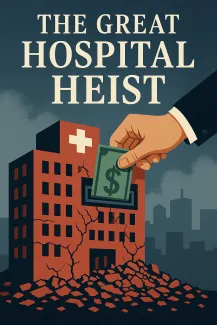
The Numbers Behind the Collapse
While some private equity investments have brought short-term efficiencies or capital to struggling facilities, the broader systemic patterns raise concern. Several weeks ago, the Private Equity Stakeholder Project, an industry watchdog, released a report on bankruptcies associated with private equity. Among the concerning findings:
- While private equity (PE) is involved in roughly 6.5% of our various markets, it is associated with 11% of all corporate bankruptcies.
- Private equity-backed companies accounted for 21% of all healthcare bankruptcies in 2024
- Private equity-backed companies accounted for 7 of the eight largest, defined as liabilities over $500 million, healthcare bankruptcies in 2024. That is 88%. For context, PE is involved in 56% of large liability bankruptcies across all markets.
Most of us might think twice, if not more, before involving ourselves with private equity financing. How can these, as described by Tom Wolff, “Masters of the Universe,” continue to remain in business? They stay because, in the process of bankrupting the companies they finance, they generate large profits, and few of us have the economic background to understand how the PE firms operate. It is a grift of exploitation, not an ethical business practice.
We are the same people who ambiguously nodded our heads over terms like derivatives and tranches that resulted in the financial crisis of 2008. In addition to learning that they were “too big to fail,” financial institutions discovered that they no longer needed to put their interests at risk. Instead, they have turned to rolling up fragmented marketplaces in the name of efficiency, while serving their interests, not those of the market.
From Mom-and-Pop to Market Consolidation
Medical care was essentially a cottage industry of “mom-and-pop” private practices, punctuated by free-standing hospitals until roughly the 1980s. Then, with the ascendency of health maintenance organizations and other aggregations of payers, provider consolidation, to maintain bargaining power with these new aggregates, took off.
According to the Kaiser Family Foundation, consolidation has accelerated significantly in this century, with over 1,500 hospital mergers and 400 health-system mergers. As a result, today, 10 systems control 22% of hospital-based patient care. The largest, HCA Healthcare, has greater revenue than Netflix. The effects of these consolidations are mixed, although the standard economic analysis suggests that it results in higher costs to patients, closure of some poorly performing facilities, such as rural hospitals, and a mixed impact on labor costs or wages.
How Private Equity Takes Over
Private equity firms are invested in a range of medical enterprises, including nursing homes, hospitals, home care services, and physician practices in emergency care, mental health, dermatology, and ophthalmology. They “roll up” the numerous remaining “cottage industry” practices and small groups intending to achieve economies of scale, primarily in back office administrative work, to lower costs. While their involvement is relatively small, it is substantial.
“In a quarter of the metropolitan statistical areas (MSAs), PE-backed companies own more than 30 percent of the physician practices. In about 13 percent of the MSAs, PE-backed companies control over half of the physician practices.”
Typical PE firm investments are short-term, lasting between four and seven years. This short time horizon was popularized by “Neutron Jack” Welch, the former CEO of GE, whose sole focus on quarterly earnings, to which his salary was tied, resulted in taking GE to financial heights but also made it far less resilient, leaving it unable to withstand the 2008 financial crisis.
The Financial Engineering Toolbox
While there is nothing inherently wrong with PE involvement in healthcare, it is some of their financial leveraging strategies that are concerning. Among them:
- PE firms often finance the purchase of healthy companies primarily with borrowed money, a leveraged buyout. That debt is transferred to the newly purchased company, leaving it with a high debt burden (considering payments on principal and interest). If the company can sustain a sufficient cash flow, the debt burden is sustainable. But a greater debt load makes a company less resilient.
- Another tactic is to refinance the company, taking out large loans consistent with the newly acquired company's cash flow. Rather than reinvesting the money into the company, they pay themselves a special dividend. This extracts the cash value of the company without the need for its sale; and it can be done quickly, providing an immediate return on their investment. Like the leveraged buyout, it puts a company in a weaker financial standing.
- PE firms also can strip assets from their acquisitions. A classic example is selling the building that contains the hospital to themselves through a shell corporation, and then having the hospital lease it back. The cash from the sale can be used to cover debt or, more commonly, to pay another special dividend to investors.
- PE also employs more traditional methods to generate profits, reducing expenditures by increasing efficiency and eliminating waste. While in many instances, there are definite legitimate efficiencies in aggregating the fragmented healthcare market, primarily in background operations involving administration and billing, there is an art to not cutting “too close to the bone,” and PE firms are financially incentivized to overlook downstream consequences. This explains problematic behavior, including providing unnecessary and often high-margin tests and procedures, as well as exaggerating population health risks and upcoding diagnostic information.
These maneuvers may thrill investors, but for those relying on these institutions, patients and providers, they can prove harmful. While all of these techniques show shareholder profit, they can, as evidenced by those bankruptcies, harm long-term interests. When a company is overburdened by debt and underinvested in its core operations, its resilience to economic shocks is severely reduced.
The closure of a business through bankruptcy has a significant impact on its employees. However, it affects patients, not only disrupting the immediate provision of medical services but also creating a ripple effect undermining the long-term health infrastructure of a region. Patients may face challenges such as limited access, longer wait times, and reduced quality of care, while communities experience broader economic and social repercussions.
In January, the Senate Budget Committee released its Bipartisan Report on a year-long investigation into the role of private equity in healthcare. They concluded,
“In sum, the findings of the investigation call into question the compatibility of private equity’s profit-driven model with the essential role hospitals play in public health. The consequences of this ownership model—reduced services, compromised patient care, and even complete hospital closures—potentially pose a threat to the nation’s health care infrastructure, particularly in underserved and rural areas. … The American public deserves more when it comes to health care.”
A Model Designed to Fail Others First
Private equity's tactics aren't a bug—they're a feature of the business model. The motivational façade of “efficiency” masks a grift that extracts value with limited regard for long-term viability and without any culpability. Bankruptcies do more than shutter businesses; they unravel regional health infrastructure. Patients face reduced access and quality of care, while communities endure economic and social aftershocks. It's time to ask whether this form of financial engineering is healthcare reform.

Chuck Dinerstein, MD, MBA
Director of Medicine
Charles Dinerstein, MD, MBA, is the Medical Director of the American Council on Science and Health. A vascular surgeon with more than 25 years of clinical experience, he brings a physician's understanding of medical decision-making, an appreciation for scientific uncertainty, and a broader perspective on healthcare economics and policy to his writing.