Nutrition trends come and go, but some myths and half-truths stubbornly persist—often because they’re profitable for those pushing the dodgy advice. So let’s lean on solid research to dig into the evidence behind five big nutrition myths—starting with those “outdated” dietary guidelines everyone loves to hate....
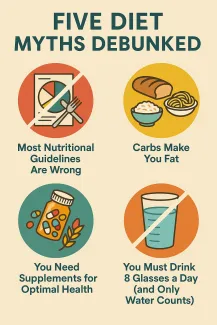
Myth 1: Most Nutritional Guidelines Are Wrong
Stuck in the 80s low-fat era, too carb-heavy, soft on sugar, or secretly written by Big Food—these are the accusations wellness influencers love to throw at the US MyPlate dietary guidelines (the same can be said for the UK Eatwell Guide and similar frameworks worldwide).
The Reality: Guidelines aren’t flawless, but they’re consistent across countries and were built on systematic reviews of thousands of studies. Lobbying happens, but guideline panels are bound by rigorous peer review. Core advice from governments aligns broadly with that of independent bodies like the American Heart Association and dietetic associations worldwide.
More to the point, when people actually follow dietary guidelines, health improves. One meta-analysis found that the highest adherence to the American 2015–2020 dietary guidelines was associated with an18% lower risk of death from all causes compared to the lowest adherence. Following guidelines is also associated with lower odds of high 10-year cardiovascular disease risk and a reduced predicted heart age in American adults.
The “low-fat dogma” is a favorite target, but it’s a stretch to blame today’s chronic disease burden on advice that was neither extreme nor widely followed by the American public. Back in the 1980s, it was recommended that fat intake should be capped at 30% of energy intake—hardly radical. By 2005, this was raised to 35% and the guidelines recommended a lower intake of 20%, recognizing fat’s essential role. Today, the guidelines reflect the evidence by focusing on fat quality: replacing some saturated fat with unsaturated sources lowers heart disease risk, while cutting all fat does not.
Bottom Line: Dietary guidelines evolve with science, and when followed, they work. Boring, maybe—but effective.
Myth 2: Carbs Make You Fat
Wellness gurus and keto fanatics love to demonize carbs—bread, pasta, and grains create love handles, they claim, and only low-carb diets can save you.
The Reality: Carbohydrates themselves don’t inherently cause weight gain—excess calories do. Low-carb diets can certainly produce short-term weight loss effectively, but evidence shows they offer no long-term advantage over more balanced diets. The 2018 DIETFITS trial compared healthy diets with 48% energy from carbs and 30% energy from carbs in overweight adults and found no significant weight loss difference (5.3 kg vs. a 6kg loss) at 12 months.
The myth also oversimplifies carbohydrates. Refined carbs, such as white bread and pastries, tend to have fewer nutrients, lower fiber content, and a softer texture, which allows blood sugar to rise more quickly. On the other hand, whole grains and other complex high fiber carbs seem to support better metabolic health and might actually help manage weight. A 2019 systematic review and meta-analysis of observational studies found that a higher whole grain intake (approximately 50 g/day) was associated with a 7–11% lower relative risk of weight gain or obesity compared to lower intake. A 2017 meta-analysis found that 30 g/day of whole grains was associated with an 8% lower risk of hypertension, with a risk reduction of up to 15% at approximately 90 g/day.
Bottom Line: Carbs aren’t the enemy. Whole, high-fibre carbohydrates are valuable foods that can help with weight management. Excess calories matter more to weight than macronutrients, and low-carb diets are not a magic solution.
Myth 3: You Need Supplements for Optimal Health
The claim that vitamin supplements are essential for avoiding deficiencies or achieving optimal health is frequently promoted by supplement companies and wellness influencers, many of whom profit directly through sponsorships or their own product ranges.
The reality: For most well-nourished adults, supplements are unnecessary. Most people can meet their nutrient needs through a balanced diet rich in fruits, vegetables, whole grains, legumes, nuts, and lean proteins. Large studies find no consistent cardiovascular benefit from multivitamin use in the general population.
Similarly, the long-term Physicians’ Health Study II, involving over 14,000 participants, reported no significant reductions in major cardiovascular events, heart attack, stroke, or mortality from daily multivitamins after over a decade of follow-up.
Supplements are also not risk-free. For example, beta-carotene supplements may increase lung cancer risk in smokers, and high doses of vitamin E have been linked to an increased risk of hemorrhagic stroke. Additionally, supplements are not regulated in the same way as drugs and are not strictly controlled by the FDA for quality, safety, or effectiveness.
Moreover, nutrients in whole foods work synergistically with fiber, phytonutrients, and other compounds, producing benefits that isolated supplements rarely match. From a public health perspective, improving diet quality has a far greater impact on long-term health than supplement use in otherwise healthy adults.
Caveat: Supplements can be essential in specific cases—pregnant women often require folic acid, older adults may need vitamin D, and individuals with restricted diets or certain medical conditions may need targeted supplementation.
Bottom Line: For the general population, supplements are rarely necessary. Better to focus on food, not pills, unless there’s a specific nutritional or medical need.
Myth 4: Gluten is the Cause of Your Belly Bloat
Gluten, a group of proteins found in wheat, rye, and barley, is often blamed for digestive discomfort and bloating. Many point to it as the culprit behind their uneasy stomach after a sandwich or too much toast.
The reality: True gluten intolerance, known as celiac disease, is a serious autoimmune condition in which gluten triggers the immune system to attack the small intestine. Symptoms go far beyond bloating and can include fatigue, anemia, and joint pain—but celiac disease affects only about 1% of the population.
Non-celiac gluten sensitivity (NGCS), a milder condition reported to affect up to 13% of people, might explain some cases of abdominal bloating—but it’s likely less common than popular reports suggest.
A study by researchers in the UK and the Netherlands found that people who believe they are gluten-sensitive often report symptoms based on expectation, rather than actual gluten consumption. Participants felt worse when they thought they were eating gluten, even if their food was gluten-free.
If wheat products regularly leave you bloated, it may simply be from overindulging (who can resist thick slices of crusty bread with butter?) or a dietary trigger unrelated to gluten. Fructans, a type of fermentable carbohydrate (FODMAP) found in foods including wheat, onions, and garlic, are a likely culprit. In a trial of 59 individuals with self-reported gluten sensitivity, fructans induced significantly more gastrointestinal symptoms than gluten or placebo. Symptoms from gluten were no worse than placebo, strongly suggesting that when symptoms are genuine, fructans—not gluten—are often the real trigger.
Bottom Line: For most people without celiac disease, gluten itself is unlikely to be the cause of bloating. Overeating bread or other wheat foods, along with FODMAPs like fructans, are far more likely culprits.
Myth 5: You Must Drink 8 Glasses a Day (and Only Water Counts)
You’ve probably heard it a thousand times: drink eight 8-ounce glasses of water a day (the so-called “8×8 rule”) for optimal health. It’s one of the most enduring pieces of diet folklore.
The reality: The 8×8 rule has surprisingly shaky origins. It’s often traced back to a 1945 US Food and Nutrition Board report recommending 2.5 liters of water daily—but the important caveat that food supplies some of this water was lost in translation, and the simplified “8 glasses” message stuck.
Today, no major health authority recommends a fixed 8-glass target, nor do they insist on plain water (much less trendy alkaline water). Coffee, tea, milk, juices, and soft drinks all count, and the old claim that caffeinated beverages dehydrate has been debunked. One study found that moderate coffee consumption (around 4 cups per day, providing roughly 250–400 mg caffeine) does not cause dehydration compared to water, in individuals who regularly consume coffee.
Rather than stress over specific hydration targets, thirst is usually a reliable guide for healthy adults. In a study comparing planned drinking to drinking to thirst, both strategies maintained hydration within 2% of baseline levels. A practical tip: pale-yellow urine typically indicates that you’re well-hydrated.
Some groups, such as older adults who may have a blunted thirst response, athletes with high sweat losses, and individuals in hot or humid climates, may need to be more mindful. For most others, the water in your meals plus drinks when you feel thirsty is plenty.
Bottom Line: The 8-glass rule is a myth with outdated roots. Hydration needs aren’t one-size-fits-all, so listen to your body, drink your favourite beverage whenever you feel thirsty—and remember water-rich foods count towards hydration too.

Angela Dowden
Angela Dowden is a British health journalist, author, and Registered Nutritionist. She has nearly 30 years’ experience bringing food, nutrition, and health science to life for international audiences through her print and online work.