
When I first interviewed Roneet Lev, M.D., an emergency department doctor and addiction specialist, back in 2022, she offered a comparison that sounded almost heretical in the age of “weed is harmless” and "opioids are killers." She has proven to be right.
“It is medically safer to take regulated and prescribed opioids such as hydrocodone or oxycodone under a doctor’s supervision than unregulated high dose THC products with various contaminants and adulterants.”
—Roneet Lev, M.D., Interview with ACSH, May 26, 2022.
Lev’s point wasn’t that opioids are safe in some broad, blank-check way. It was that regulation, dosing, and quality control matter, and some of today’s high-potency cannabis products don’t always come with those guardrails.
During that same conversation, she used a word I hadn’t heard before: “scromiting.” It’s slang—screaming plus vomiting—and it’s often used to describe the worst episodes of cannabinoid hyperemesis syndrome (CHS): cycles of relentless nausea and vomiting that can be so painful and exhausting that some people wind up in the ER.
Lev put it bluntly: just about every emergency department in America now treats cannabis-related illness every day. Whatever you think about legalization, that reality clashes with marijuana’s reputation as a “safe” and “natural” drug that can’t seriously hurt you.
What CHS is (and why it’s so weird)
The medical condition has been described in the literature since 2004, when clinicians reported a pattern of cyclical vomiting linked to chronic cannabis use. (The term “scromiting” was popularized on TikTok.) The irony here is obvious: cannabis is often used as an anti-nausea treatment, especially for chemotherapy patients, yet in some long-term heavy users, it can flip, producing the opposite effect.
The rule of thumb: if you’re trying to decide whether this is something you ever want to experience, you probably want to veto anything that includes the word hyperemesis.
Why “scromiting” is back in the news
Clinicians who treat these cases describe a gruesome pattern that’s hard to mistake. Sam Wang, M.D., a pediatric emergency medicine specialist and toxicologist at Children’s Hospital Colorado, told CNN:
“They vomit and then just continue to vomit whatever they have in their stomach, which can go on for hours… For some of our kids, this is their fifth ER visit in the past two months, with symptoms that they can’t control.”
In severe episodes, people can’t keep fluids down, can’t stop retching, and may need emergency care for dehydration and symptom control.
How does it feel?
Terrible. Some of the most vivid descriptions come from people who’ve been through it. A recent People Magazine report quoted CHS sufferers describing the experience in language that’s hard to forget:
“It is horrifying. It is the scariest thing I’ve ever gone through in my entire life.”
“You don’t wanna be that person going to the ER multiple times a week…”
“The only way I can describe it is a living hell.”
“My body was giving up on me.”
You don’t need any more to get the point: for the people who experience CHS at its worst, it can be disabling, frightening, and repetitive—something that drags them back to the ER again and again.
Is CHS actually increasing?
A reasonable skeptic will ask the obvious question: Is this syndrome really becoming more common, or are doctors just better at recognizing and coding it than they were a few years ago?
The answer is likely some of both. Awareness, diagnostic habits, and reporting criteria can absolutely move numbers. But there’s also evidence of a real upward trend in ER encounters.
A paper in JAMA Network Open reports a sharp rise in CHS-related emergency-department encounters among adolescents and young adults over the past several years, and it breaks the pattern out by policy environment. In the figure below, the authors compare state-years where recreational (adult-use) cannabis was legal and dispensaries were open with state-years where recreational cannabis wasn’t legal. The “recreational-legal” line runs higher, and both groups climb steeply starting around 2020—suggesting this isn’t confined to one type of state.
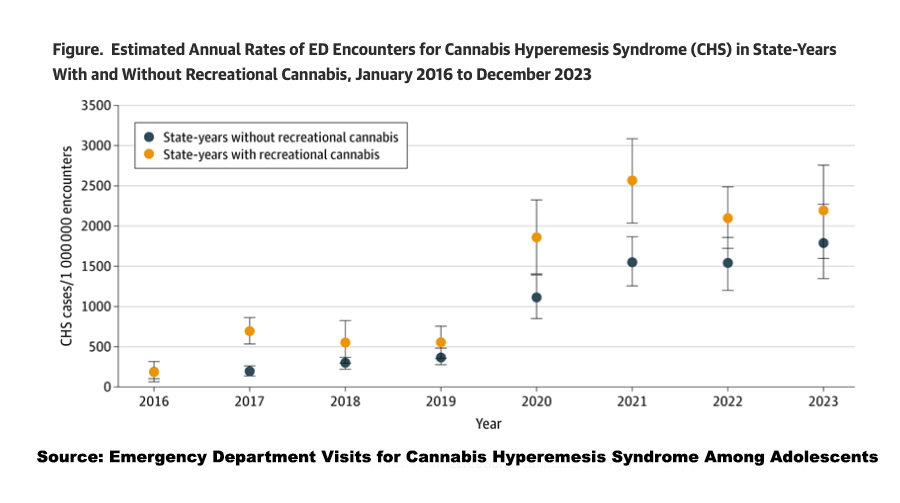
Figure 1: Yearly ER visit rates for cannabinoid hyperemesis syndrome (CHS), comparing states/years where recreational (adult-use) cannabis was legal and dispensaries were open versus states/years where recreational cannabis wasn’t legal. From 2017–2023, CHS visit rates are higher in the recreational-legal group, and both groups rise sharply starting around 2020. Error bars show uncertainty around the estimates.
At the same time, the figure alone can’t tell you why the increase is happening. Possible contributors include higher use rates, higher potency products, different consumption methods, and better recognition in clinical settings. Trend data can show direction; pinning down causation takes more work.
Not just an American issue
CHS itself isn’t “made in the USA.” Clinicians outside the United States report it too, and the syndrome is discussed in international medical literature. It is a clinical phenomenon that shows up wherever heavy cannabis use shows up, something recently reported by thr World Health Organization.
Bottom Line
The most important point isn’t the slang. It’s the mismatch between perception and reality. For many people, cannabis use is uneventful, even "healthy." But for some frequent, long-term users, it can end in a particular kind of misery: cyclical vomiting so severe it drives repeated ER visits.
If “scromiting” is useful for anything, it’s as a warning label—one that’s hard to ignore once you’ve seen what CHS looks like up close. Those who trivialize the potential downside of unfettered cannabis use do so at their own peril.

Josh Bloom
Director of Chemical and Pharmaceutical Science
Dr. Josh Bloom, the Director of Chemical and Pharmaceutical Science, comes from the world of drug discovery, where he did research for more than 20 years. He holds a Ph.D. in chemistry.