Coined in 1935 by DuPont, the aphorism “Better Living Through Chemistry” has taken on a double meaning as chemical uses have mushroomed, conferring on our world both luxury and litigation.
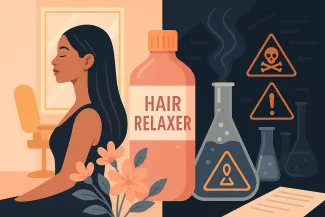
The luxury includes beauty products –chock full of chemicals regulated by the FDA, OSHA, and the EPA. Included in the beauty basket are hair relaxers (straighteners) and hair dyes, designed to achieve the Barbie-Beauty ideal of straight and preferably flaxen hair, with many such products marketed to the Black population.
In November 2022, the National Institute of Health published a paper linking hair straighteners to uterine cancer, which, unsurprisingly, heralded in a wave of lawsuits. The study reported that frequent hair straightener use (defined as four or more times a year) resulted in a doubled risk of the disease:
“Women who used chemical hair straightening products were at higher risk for uterine cancer compared to women who did not report using these products …. We estimated that 1.64% of women who never used hair straighteners would go on to develop uterine cancer by the age of 70; but for frequent users, that risk goes up to 4.05%”
Currently, over 10,000 claims are consolidated in the Northern District of Illinois, making it the fourth-largest MDL (Multi-District Litigation) in the country, primarily alleging uterine, ovarian, and endometrial cancers allegedly caused by multiple chemicals found in straighteners. Additional cases are pending in various state courts, most of which follow the Frye rule of scientific evidentiary admissibility, which favors the plaintiffs’ claim.
While many people believe the NIH study provides a “slam dunk” for plaintiffs, it is anything but. A careful review reveals serious flaws and limitations, many of which have not yet been raised.
“while the researchers found a possible link between hair straightener use and uterine cancer, they did not conclude from this study that using these products causes uterine cancer.”
The first caveat is that the study repeatedly bills itself as investigating an “association,” not causation. From a legal and scientific standpoint, representations should be confined to the limits of the study as defined by the researchers. Moreover, the associations found in the study appear to be simple correlations that can be equally and easily applied to multiple confounders. A deeper dive into the study reveals additional flaws.
The study (misleadingly dubbed the “Sister Study” and ostensibly comparing sisters to address genetic concerns) is presented as the first to evaluate links between hair products and endometrial cancer. It involved a relatively small sample size, diminishing the weight of any conclusions. Of the 33,947 women enrolled, 378 cases were noted, but only 262 were confirmed. Exposure was evaluated categorically, introducing error, since the choice of the cut-point can drastically affect the outcome [1]. Exposures were divided into three groups: never used hair straighteners, used less than 4 times a year, and used more than 4 times a year. The results compared 26 cases in the higher exposure category (7%), 12 cases in the lower exposure category (3.2%), and 332 cases in non-users.
The Latency Flaw
The study tallied cases first diagnosed in the year following the study's initiation. Since the latency period (time from first exposure to diagnosis) is usually longer than 1 year, this method of tallying does not accurately reflect exposure-related cancers, as some likely included cases were not connected to exposure. Further, the study tallied only 1 year of exposure (the year before study initiation), which further compounded the latency error and misrepresents total exposure.
Confounders: Smoking, Hormones, and Obesity
While the researchers tallied the cohorts’ exposures to confounders, they did not control for these factors. In some categories, the exposed and non-exposed groups were fairly well-matched; in others, not. Exposure categories were aggregated in reporting variables, further obfuscating results. For example,
- In the exposed group, 43% were past smokers; in the entire cohort, 35% were past smokers, yet we are not told which proportion of cases were smokers.
- 20% of the group with any exposure to straighteners used oral contraceptives for less than two years, compared to 14.7% of the entire cohort, again without segregating the history of the cases.
- 47% of the exposed group were reported as obese, compared to 26.7% of the entire cohort, again without reference to the makeup of cases v. controls.
Further, exposure to specific products or chemicals was not identified in the study, although various components of straighteners are regarded as carcinogenic and have attracted attention, including parabens, phthalates, bisphenol A, and perhaps the most pilloried: formaldehyde. [2]
Physical Activity
Lack of physical activity has been linked to increased cancer risk. Yet, that variable was deliberately removed from the study’s modelling, notwithstanding the serious discrepancy in the makeup of straightener users and non-users. In fact, higher-level straightener users reported significantly lower physical activity than lower-level users. Cases among the ever-exposed category reporting low physical activity showed a higher hazard ratio of 2.59 than among those ever-exposed with high physical activity (1.3), suggesting a protective effect of physical activity. A similar protective effect of physical activity was seen in the frequently exposed cohort.
It is quite possible that physical activity levels alone may account for the entire increase in cases between the exposed and non-exposed groups. But with physical activity removed from the model, we just don’t know.
Dose Response
A crucial consideration and one of the Hill Principles considered by courts in making a causal determination is the finding of a dose-response, i.e., finding that an increasing dose mirrors an increasing incidence of disease. The NIH study’s categorical design makes it impossible to determine whether a true dose-response was present.
In fact, usually, the initial signal of a causal connection between a substance and an effect is first noticed in an occupational context, where workers are exposed to the targeted substance at levels far higher than the general population. Indeed, the study's most telling omission is the intentional exclusion of occupational exposures. Astoundingly, the authors admit:
“We excluded 1048 women who had worked in beauty salons or barbershops to eliminate the potential impact of occupational exposure ….”
The Legal Posture
Before deciding individual cases (specific causation), the court will first determine whether these products are capable of causing cancer, or “general causation”. This will happen after a Daubert hearing, which evaluates expert witness disclosures from both sides. The deadline for these submissions is January 20.
Science Day
A novel initiative implemented by many judges in complex toxic tort matters is called Science Day. While this is a non-adversarial and non-binding proceeding, the goal is to educate the court on the complex scientific and medical issues before Daubert motions or dispositive briefs are filed. While educational, the plaintiff’s bar notes, “it is a carefully staged preview of the expert battles to come, with each side aiming to shape how the court internalizes the science.”
The MDL’s Science Day is scheduled for January 8. There is no testimony under oath, no cross-examination, and no rulings. The Judge may engage directly with the experts, asking questions to educate herself, and judges from state court actions where similar cases are pending may also attend.
Whether these cases yield justice or just another round of chemical confusion will depend less on passion than on precision. Until the science catches up with the claims, “better living through chemistry” may remain a slogan better suited to advertising than to evidence.
[1] The sisters selected for inclusion both were previously diagnosed with breast cancer, NOT endometrial cancer, hence the genetic component is not controlled for here.
[2] Interestingly, occupational exposure to formaldehyde has been studied, and the substance (while natural) is a significant polluter across multiple occupations, including mortuaries, pathologists, lab technicians, hospital housekeepers, and furniture manufacturers. Occupational exposures may have caused or contributed to the cancers found in the NIH study, although these were not considered. Further, formaldehyde is ubiquitous, and environmental exposures to its breakdown products from food, pharmaceuticals, e-cigarettes, and building materials must also be considered before any causal connection can be cemented —an omission.

Barbara Pfeffer Billauer JD MA (Occ. Health) PhD
Professor Barbara Pfeffer Billauer is an internationally recognized scholar of public health law, bioethics, and the laws of medical care, focusing on the integration of science and law and its impact on day-to-day policy and legal outcomes. She has lectured and published extensively, in scholarly journals and law reviews, and has written and edited seven books for lay and academic audiences.