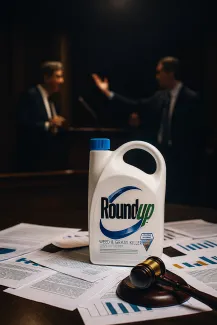
This inconsistency disrupts corporations’ handling of toxic tort lawsuits, which arise in federal courts and multiple state courts simultaneously, impacting reserves, SEC disclosures, and corporate planning. When courts conflict, only Congressional action can provide some measure of consistency. However, when attempts to standardize the regulation of pesticides through legislation were introduced, pesticide manufacturers – especially Bayer/Monsanto, the manufacturer of Roundup experienced a barrage of attacks, including false characterizations of the proposed legislation.
Before tackling the mischaracterization of the proposed law as a reckless attempt to thwart litigation and protect manufacturers, it is worth examining how we got here in the first place: That derives from a schism in the way some states and the federal courts address admissibility of scientific evidence to assure junk science stays out of the courtroom, resulting in conflicting findings in the RoundUp litigation.
State of the Cases
As of May, 61,000 Roundup cases against Monsanto/Bayer remained. These are mostly pending in a few state courts at the trial level, with 4,000 cases pending in a federal MultiDistrict Litigation in California; the results will undoubtedly be inconsistent. The divergence often hinges on the differing standards of admissibility employed by various courts.
Frye v. Daubert
Most state and federal courts follow the Daubert requisites. Under Daubert, the judge is designated as the “gatekeeper” of scientific evidence: i.e., before any evidence reaches the jury, the judge must first decide whether that evidence is reliable, relevant, and “fit”. When Daubert speaks of “reliable,” it really covers two scientific concepts:
- Validity – the method or science fits the purpose for which it is being used.
- Repeatability – the results can be reproduced.
The latter “Joiner” decision adds the requirement that experts may provide opinions based on the evidence, but those opinions must be logically tied to that evidence. Experts can no longer offer “ipse dixit” (“because I say so”) testimony.
In December 2023, the amended Federal Rules of Evidence (FRE) 702 and 203 reinforced the judge’s role as gatekeeper. These updates remind judges that they, not the jury, must decide whether the offered evidence and expert testimony rest on sound and relevant science. Judges can no longer delegate that responsibility to jurors, as they are charged with making an initial determination of whether the proffered evidence is reliable, relevant, and admissible.
The amendment was needed because, as the Fourth Circuit noted,
“some courts had abdicate[d] that duty by opening the gate indiscriminately to any proffered expert witness” and “exposing jurors to ‘dubious scientific testimony’ that [could] ultimately ‘sway’ their verdict.”
This admonition, however, did not prevent one state court judge, charged with following the Daubert standard, from doing precisely this in the Zantac litigation. In the spring of 2024, abdicating her responsibility as gatekeeper, Judge Vivian Medinilla presented all the scientific evidence to the jury, adopting a “let them decide” philosophy. Her decision would have allowed experts to testify with junk science. Not surprisingly, shortly after this decision, 92 Roundup cases were filed in Delaware. Subsequently, Judge Medinilla’s ruling was overruled by the State’s highest court, ruling that all expert testimony was inadmissible as “junk science.” However, the court left open the question of threshold dose. Perhaps, as a result, the plaintiffs’ bar has tightened its eligibility requirements for Roundup plaintiffs it will represent, insisting on a high level of exposure for new clients (although it has apparently recently reversed this position).
“In recent years, we tightened our Roundup case criteria. That meant turning away many potential clients who did not meet strict thresholds for pesticide exposure or who fell outside the statute of limitations. We required a clear and consistent history of Roundup use over several years…”
(Plaintiff’s) Lawsuit Information Center
California Rejects Roundup as Causal
In a recent 9th Circuit case, Engilis v. Monsanto, under the Daubert standard, the appellate court affirmed a summary judgment in favor of Monsanto, striking an expert witness on specific causation, i.e., finding that Roundup did not cause the particular plaintiff’s cancer.
Going further, a week ago in Bulone v. Monsanto, again under the Daubert, the 9th Circuit affirmed the trial court’s rejection of expert testimony on the issue of general causation, meaning the case could not proceed against Monsanto since there was no sound scientific evidence establishing that Roundup is even capable of causing cancer.
State Courts Using Frye
The same outcome would not be expected under the Frye standard, where the general consensus of scientific opinion drives admissibility. Judges are only involved in deciding what that consensus is, allowing the jury to assess the strength of the evidence, often after being bombarded with irrelevant and slanderous information about the manufacturers and further swayed by the horribly injured plaintiff before them.
Most states where the Round Up cases are pending rely on Frye, and it’s not accidental. Under Frye, one important, albeit deeply flawed, consensus report from the International Agency for Research on Cancer (IARC) released in 2015, can and has been admitted. That this report has since been debunked appears to carry little weight.
Indeed, the blatant partisanship, conflict of interest, and junk science embodied by the IARCreport would render it inadmissible under Daubert. For example, the head of the committee, Christian Portier, a statistician, had reportedly signed a lucrative contract to act as a litigation consultant for two law firms preparing to sue manufacturers, claiming their clients suffered cancer as a result of glyphosate exposure. Poitier played a key role in the IARC decision, resulting in a conclusion that glyphosate was “probably carcinogenic”. The designation is modified by the phrase “although based on limited evidence, namely animal and cell studies”, but this caveat is glossed over when plaintiffs’ attorneys describe (malign) the product. Additionally, the report is based on “cherry-picked results, emphasizing those studies favoring the plaintiffs’ claim and ignoring negative studies”, a cardinal rubric upon which judges following the amended 702 reject testimony and dismiss cases. The results rendered in the study are also unreliable, further disqualifying them from admissibility under Daubert.
“According to a 2016 commentary entitled in the European Journal of Cancer Prevention, Robert Tarone, a statistician who spent most of his career at the National Cancer Institute, re-examined the animal studies cited by IARC. The results could not be replicated.”
“What Tarone found is that the IARC panel highlighted certain positive results from the rodent studies … and, glaringly, ignored contradictory negative results from the same studies. He also found that an inappropriate statistical test was used, making the data look more impressive than they actually were…” - Forbes
Another exposé by Reuters confirmed findings that the glyphosate document underwent significant editing to remove null results and to strengthen positive conclusions. In 10 significant instances, “a negative conclusion about glyphosate leading to tumors was either deleted or replaced with a neutral or positive one,” noting that “the original draft found little animal evidence that glyphosate was a carcinogen.” Reuters concluded:
“It is crucial to repeat that the classification of glyphosate as probably carcinogenic to humans relied entirely upon the conclusion that there was sufficient evidence of animal carcinogenicity because the epidemiologic evidence was not strong.” [emphasis in original]
If there remains any doubt about the lack of evidence tethering Roundup to cancer, the impartial and astoundingly thorough review by Judge Michael Lee of Australia, dismissing the class action case against Monsanto, should be dispositive. After reviewing thousands of pages of epidemiological, animal, cellular, and genetic evidence, the judge concluded there simply was not enough evidence to demonstrate, more probably than not, that Roundup caused cancer. While noting there were isolated studies that did show an association, he relied on the largest epidemiological study, which conclusively showed no connection.
Notwithstanding, the plaintiffs continue to tout diversionary studies, such as the June study published by Environmental Health. This one ostensibly showed a relationship between glyphosate exposure and leukemia in baby rats to support the (now debunked) IARC report. There are several significant problems with the study, including exposures beginning during gestation, and the excess incidence found was of lymphoblastic leukemia. Lawsuits against Monsanto focus on glyphosate’s alleged causal relationship with Non-Hodgkin Lymphoma (NHL). The two are distinctly different diseases with different mechanisms of causation. Lymphomas start in the lymphatic system, while leukemia begins in the bone marrow and primarily affects blood and bone marrow cells.
The persistence of the plaintiffs’ bar despite repeated sound scientific evidence establishing no connection between glyphosate and NHL requires a solution. Bayer/Monsanto is attempting to establish a nationwide uniform system of pesticide regulation, relying on the EPA’s determination of safety, which aligns with the WHO and the European Food Safety Authority. This approach is similar to the one used for pharmaceuticals, where lawsuits are limited once the FDA has established safety.
Let’s hope they prevail.

Barbara Pfeffer Billauer JD MA (Occ. Health) PhD
Professor Barbara Pfeffer Billauer is an internationally recognized scholar of public health law, bioethics, and the laws of medical care, focusing on the integration of science and law and its impact on day-to-day policy and legal outcomes. She has lectured and published extensively, in scholarly journals and law reviews, and has written and edited seven books for lay and academic audiences.