
Q: What's the difference between Breaking Bad and Netflix's new documentary, The Plastic Detox?
A: With very few exceptions (1), Breaking Bad will give you an accurate chemistry lesson. On the other hand, the network's latest "Scary Science TV" documentary will make you think you've just seen an accurate chemistry lesson.
Walter White taught us how to make some really good s###. The Plastic Detox teaches some really good bulls###. Shall we examine?
Before we start, my personal opinion is that we make, use, and improperly discard WAY too much plastic. Its impact on the environment is horrible. When I see plastic litter on a beach, it absolutely drives me bat ### crazy. If a picture is worth a thousand words, check out these two, which I wrote about in 2017.
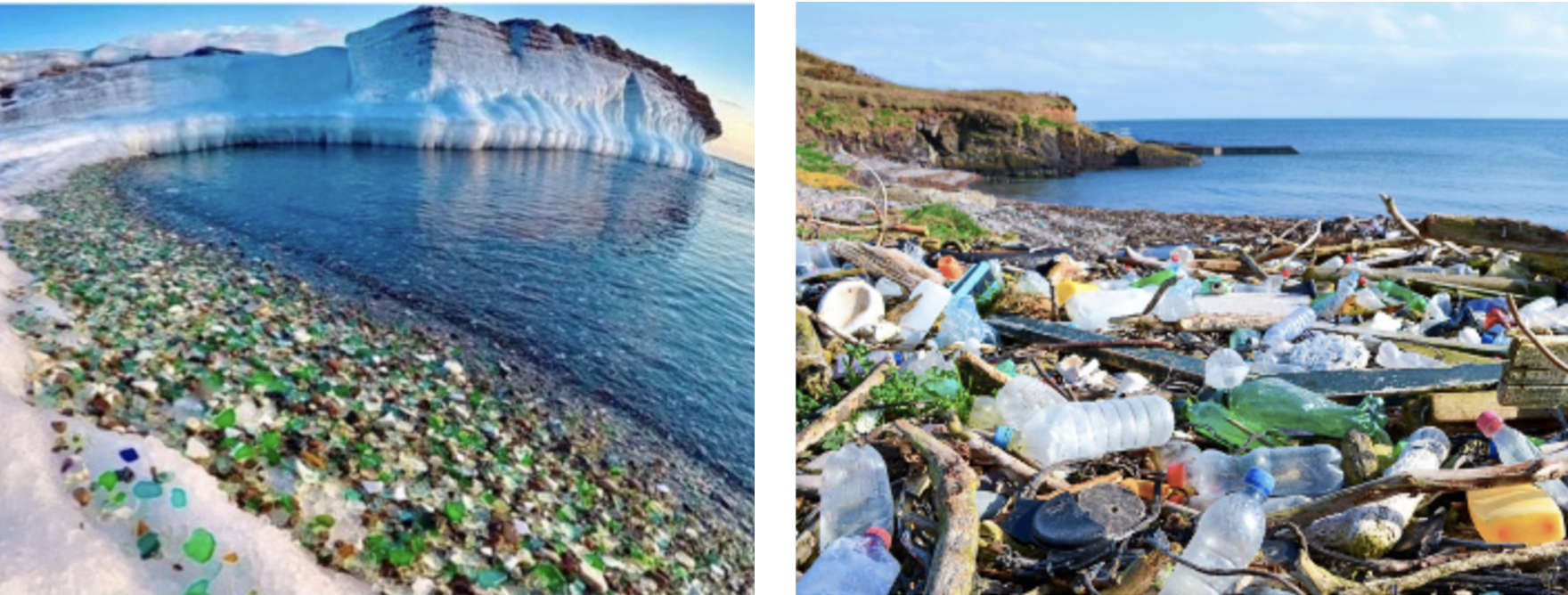
(Left) Ussuri Bay, Siberia, is "polluted" by spectacular sea glass from nearby glass factories. (Right) County Cork, Ireland, is quite a different story. Photos: The Siberian Times on Twitter, NDLA support (National Digital Learning Arena and Creative Commons
A Different Kind of Pollution: Your Mind
Netflix, which has made simplified propaganda many times before (See: Dopesick), sticks to a familiar formula in a thoroughly slanted attempt to demonize all plastics. My feelings about plastic crapping up the environment should be clear, but this and the impact on human health are two very different topics.
Especially when plastics as a whole are demonized, thanks to some questionable (and I'm being kind here) science. But a series called "Some plastics might be harmful, and some aren't" isn't exactly screaming streaming for Netflix, so when all else fails, go for the scare.
Here's the Scare, Such as it is
First, let’s give a whole bunch of credit to David Zaruk (“The Risk-Monger”), who takes on the film’s emotional storytelling, its questionable fertility “detox” experiment, and its broader political context—and absolutely hammers it. In particular, he digs into how the film mixes personal narratives with weak evidence to create a sense of certainty that isn’t there. I won’t retrace that ground here.
But I can't help including a great quote from the piece:
It’s “quite a remarkable jump” to assume that brushing your teeth with a bamboo brush and baking soda could make you fertile again.
Love this.
Instead, I’ll focus on two areas where the science matters most: what we can detect—and what those detections actually mean.
Look, and You Shall Find—Depending on How You Look
When you improve a microscope lens, the world doesn’t get dirtier—you just start seeing what was already there. Likewise, a better telescope doesn’t create new stars—it just reveals ones we couldn’t see before.
The same thing has happened in analytical chemistry.
Over the past few decades, detection limits have improved by orders of magnitude. Modern instruments can identify chemicals at parts-per-billion or even parts-per-trillion levels—amounts so small they would have been completely invisible not long ago.
Which leads to a familiar pattern:
- New technology detects something previously unseen
- Early studies report: “We found it.”
- The media translates this into: “This is dangerous.”
- Netflix turns it into a scary series—and people accept it unquestioningly.
No one makes this clearer than ACSH friend Dr. Joe Schwarcz, director of McGill University’s Office for Science and Society. Joe has stated countless times during his career that advances in analytical chemistry have made it possible to detect chemicals at extraordinarily low levels—amounts that would have been completely invisible just a few decades ago.
Stuff is in your body. Now what?
More than 500 years ago, Paracelsus nailed it: it’s not the presence of a chemical that makes it dangerous—it’s the dose.
Simple. Obvious. Foundational.
And yet, somehow, we’re still arguing about it.
Weak Binding ≠ Big Effect
Shanna Swan, an environmental and reproductive epidemiologist at the Icahn School of Medicine at Mount Sinai, featured prominently in The Plastic Detox, has been advancing concerns about endocrine-disrupting chemicals for decades—claims that have long drawn skepticism from toxicologists and chemists. The film leans heavily on her authority, as if longevity and repetition can turn speculation into established science.
One of the most frequently cited examples in this literature—including Swan’s own work on human exposure—is bisphenol A (BPA), a plastic-related chemical often presented as a prototypical “endocrine disruptor” [5].
The key question isn’t whether BPA can bind to estrogen receptors—it can. The question is how well.
And the answer is: rather poorly.
BPA vs. Estradiol: Binding Affinity
Multiple studies have shown that BPA binds to estrogen receptors hundreds to thousands of times more weakly than the body’s natural estrogen, estradiol [1–3]. In practical terms, that makes BPA a very poor competitor in a system already saturated with far more potent endogenous hormones. To have a meaningful effect, it would need to be present at far higher concentrations than are actually observed.
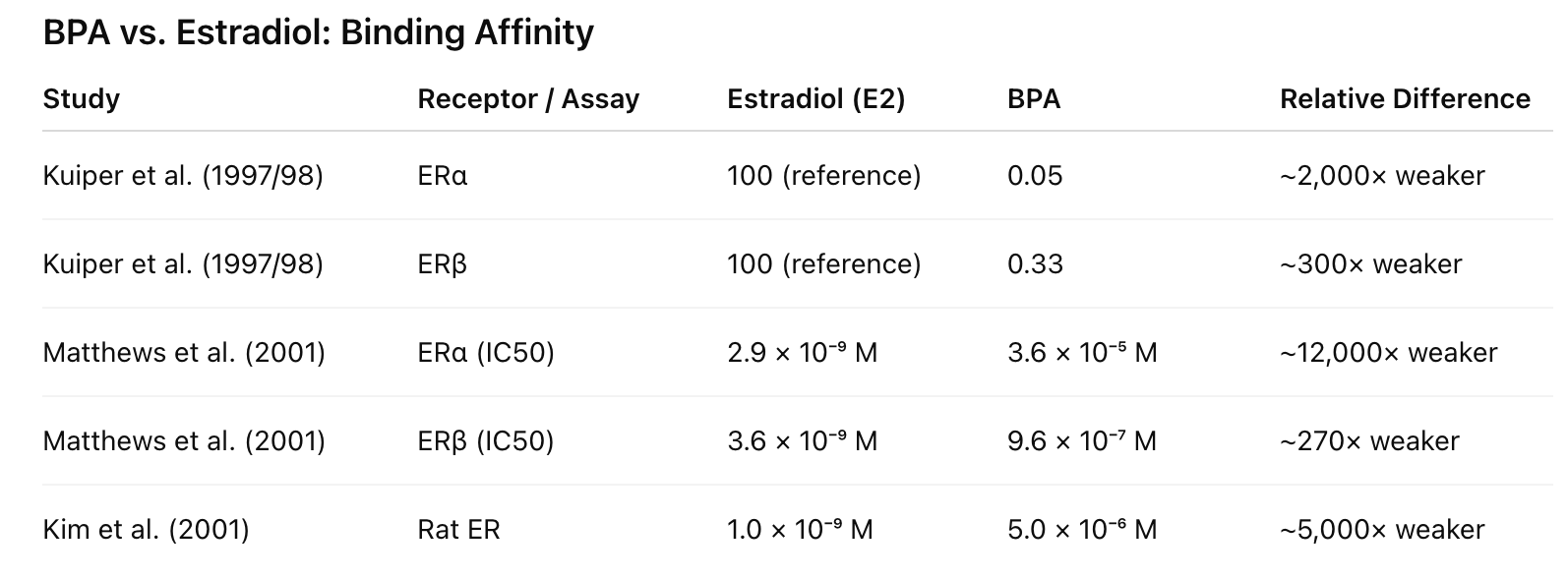
Table 1. BPA vs. estradiol binding. Values shown are representative ranges derived from published receptor-binding studies and may vary depending on assay conditions.
This is basic receptor pharmacology. Weak binding at low exposure levels is unlikely to produce meaningful biological effects—in many cases, it is indistinguishable from no effect at all.
And this isn’t just theoretical. Large-scale animal studies tell a similar story. In the FDA-led CLARITY-BPA program—a two-year study examining long-term effects across a wide range of doses—there was no consistent evidence of adverse effects at exposure levels comparable to those experienced by humans [4].
Yet The Plastic Detox treats the mere ability of BPA to interact with hormone receptors as evidence of harm—without any discussion of potency, dose, or real-world exposure.
The Bottom Line
Plastic pollution is real. It’s visible. And it’s worth fixing.
But the leap from environmental nuisance to human health crisis is not supported by the evidence presented in The Plastic Detox.
We can now detect chemicals at vanishingly small levels. Some of those chemicals can weakly interact with biological systems. That much is true.
What does not follow is that they are harming us.
Weak binding, low exposure, and a lack of consistent effects in long-term studies is not the recipe for a public health crisis. It’s the recipe for confusion—especially when detection is mistaken for danger.
The problem isn’t that plastics are harmless.
It’s that this film mistakes possibility for proof—and calls it science.
I call BS.
NOTE
(1) I found exactly two chemical errors in Breaking Bad. Wanna take a shot at them?
References
[1] Kuiper, G. G. J. M., Carlsson, B., Grandien, K., Enmark, E., Häggblad, J., Nilsson, S., & Gustafsson, J.-Å.
Comparison of the ligand binding specificity and tissue distribution of estrogen receptors α and β.
Endocrinology. 1997;138(3):863–870.
[2] Matthews, J. B., Twomey, K., & Zacharewski, T. R.
In vitro and in vivo interactions of bisphenol A and its metabolite, bisphenol A glucuronide, with estrogen receptors α and β.
Chemical Research in Toxicology. 2001;14(2):149–157.
[3] Kim, H. S., Han, S. Y., Yoo, S. D., Lee, B. M., & Park, K. L.
Potential estrogenic effects of bisphenol A estimated by in vitro and in vivo combination assays.
J Toxicol Sci. 2001;26(3):111–118.
[4] National Toxicology Program (NTP).
CLARITY-BPA Core Study: A Perinatal and Chronic Extended-Dose-Range Study of Bisphenol A in Rats.
NTP Research Report 9. 2018.
[5] Stahlhut, R. W., Welshons, W. V., & Swan, S. H.
Bisphenol A data in NHANES suggest longer than expected half-life, substantial nonfood exposure, or both.
Environmental Health Perspectives. 2009;117(5):784–789.

Josh Bloom
Dr. Jonathan (Josh) Bloom, ACSH's Director of Chemical and Pharmaceutical Sciences, earned his Ph.D. at the University of Virginia and completed postdoctoral training at the University of Pennsylvania. During his 20-plus years in drug discovery at Wyeth, his research group discovered the antibiotic Tygacil®, approved in 2005. He holds 25 issued patents and has authored 35 academic papers. Since joining ACSH in 2010, he has written more than 2,000 articles and dozens of op-eds for major newspapers, including The Wall Street Journal and Chicago Tribune.