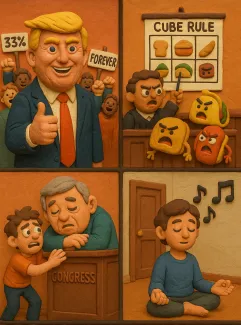
The President’s approval rating varies, but there is a hardcore 33% of our citizens who stand by the President irrespective of his actions or their results. Likewise, there is a hardcore group that opposes his every action. Are they obstinate, ignorant, or maybe something more complex?
“How do people make decisions about the right thing to do if they are not embedded in a permanent moral order? They do whatever feels right to them at the moment. MacIntyre called this “emotivism,” the idea that “all moral judgments are nothing but expressions of preference, expressions of attitude or feeling.” Emotivism feels natural within capitalist societies, because capitalism is an economic system built around individual consumer preferences.
One of the problems with living in a society with no shared moral order is that we have no way to settle arguments. We have no objective standard by which to determine that one view is right and another view is wrong. So public arguments just go on indefinitely, at greater levels of indignation and polarization. People use self-righteous words to try to get their way, but instead of engaging in moral argument, what they’re really doing is using the language of morality to enforce their own preferences.”
From David Brooks at The Atlantic, Why Do So Many People Think That Trump Is Good?
Music accompanies our lives. I personally found it helpful when working in the wood shop. On the other hand, when writing, I prefer the sound of silence.
“Near-silence is my favorite condition for writing. Silence, as Ursula Franklin said, is a space where something can happen.
Silence is not only the space in which there’s no sound, but there’s no program. Nothing is there so that whatever is essentially unprogrammable can happen. How does anything new happen? In a world where everything is scheduled, everything is listed, everything is programmed, the first thing one needs is space… You have to be open. It doesn’t mean something enormous will happen, but nothing can happen until you clear that space… Nobody has time to even receive anything that is actually new, including their own thoughts...”
From Austin Kleon, The 7 types of deadline music
There is a saying, “talk is cheap…. Until you hire an attorney.” While this is not a current legal issue, is there a consensus on the definition of a sandwich?
“Clarifying sandwich classification, the Cube Rule tells us that there are nine categories for foods with “starch.” Where a food belongs depends on where the “starch” is placed. If it is just under the food, then it’s “toast.” On the top and the bottom? A sandwich. On the right, left, and bottom? A taco.”
From EconLife, What Is a Sandwich?
As a boomer, perhaps I am about to be considered a traitor to my generation, but it is high time that we exited the podium and turned the reins of power over to the next generation.
“Our political system, especially at the federal level, is largely run by the elderly. The current president is 78. His predecessor, famously, left office at 82. Congress is older than ever, with a quarter of its members over 70. The age of the federal judiciary is a record 69 years old. Senior moments from Joe Biden, Mitch McConnell, and the late Dianne Feinstein have lodged in the public consciousness and rattled civic trust.
The discourse here is well-worn, but it frequently misses a crucial point: Some of the same forces that have created our political gerontocracy — medical advances enabling graceful aging, combined with a generation unwilling to relinquish power — have also allowed the old to tighten their grip on other areas of American life.”
From Slow Boring, Gerontocracy is everywhere

Chuck Dinerstein, MD, MBA
Director of Medicine
Charles Dinerstein, MD, MBA, is the Medical Director of the American Council on Science and Health. A vascular surgeon with more than 25 years of clinical experience, he brings a physician's understanding of medical decision-making, an appreciation for scientific uncertainty, and a broader perspective on healthcare economics and policy to his writing.