“But lately the crowds of the internet have found new ways to channel the old dramas. On the matter of the 👍, the arbiters of our own arena—internet-savvy young adults—have rendered their verdict: The 👍 is no longer definitive. It is no longer, for that matter, necessarily positive. “Gen Z Has Canceled the Thumbs-Up Emoji Because It’s ‘Hostile,’ ” one headline put it, citing data gathered in surveys and in the wild. Particularly as a reply to messages that contain words, Zoomers say, the 👍 is dismissive, disrespectful, even “super rude.” It’s a digital mumble, a surly if you say so, a sure but screw you. It is passive aggression, conveyed with pictographic clarity yet wrapped in plausible deniability.”
From The Atlantic, What Are Emoji?
Much of the hand-wringing around the public health response to COVID was about following the science. And much of the commentary revealed how few of us, outside the fields touched by the scientific method understood its underlying philosophy. As it turns out Kurt Vonnegut provided an explanation for the rest of us.
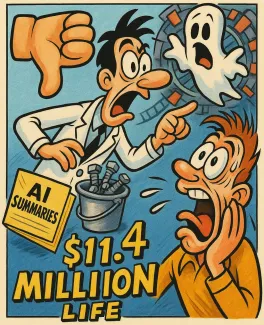
“The purest description of the scientific method I ever saw was in a novel by Kurt Vonnegut. A workman discovers that if he puts a bucket full of nuts and bolts on one of the many supporting struts of the Tevatron supercollider, he can talk to the dead. He shares his finding with a scientist who, rather than scoffing as one might be inclined to do, says “show me”. That’s it. Not a method as such: more an attitude of mind.
No one has yet found a scientific method that can regularly mint scientific truths, but somehow scientists go on finding things out anyway. Of course, they get a lot of stuff wrong too, but the willingness to be wrong – to find, despite everything life has taught you up to this point, that one can communicate with the dead using nothing more than a bucket full of bolts and a synchrotron – is perhaps the most important part: being right is inseparable from being wrong.”
From Diagram Monkey, How to science a science with science
One of the main facets of my job is to read articles, summarize what I think are the salient points and present them along with my commentary.
“An abstract, …was a navigational tool used to guide intellectual journeys — an efficient means of identifying and prioritizing, among a welter of possibilities, those articles one actually needed to read to advance one’s knowledge in a subject. The summaries pumped out by GPTs can serve a similar role. Experts can use them to survey the latest writings in their field and plot a path through them. But in their common use — by students, by paper pushers, by the general public — they aren’t navigational aids. They’re substitutes. The machine-generated summary takes the place of the human-written work. The gist becomes the end product.” [emphasis added] ”
From Nicholas Carr, Against Compression
Why are we increasingly more risk adverse, especially in an age with dangers have greatly diminished?
“How much is your life worth? Not just in the abstract: I mean literally, what dollar value would you assign?
If you're American, the Environmental Protection Agency (EPA) says $11.4 million. That's the ratio they use when deciding whether it’s worth enacting regulations that would in aggregate save one life. In 1980, you were worth $3.3 million (inflation-adjusted). Your great-grandfather in 1940? Maybe $500,000.
But here's the strange part: we're not getting 20x more life than our great-grandparents. We get maybe 10-20 extra years. So why has the price tag on those years exploded? And why is this happening everywhere?”
From a new SubStack by way of the Browser, Why Are We All Cowards?

Chuck Dinerstein, MD, MBA
Director of Medicine
Charles Dinerstein, MD, MBA, is the Medical Director of the American Council on Science and Health. A vascular surgeon with more than 25 years of clinical experience, he brings a physician's understanding of medical decision-making, an appreciation for scientific uncertainty, and a broader perspective on healthcare economics and policy to his writing.