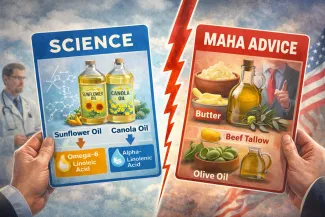
In the new, 2025–2030 Dietary Guidelines for Americans, readers are advised to “prioritize oils with essential fatty acids, such as olive oil. Other options can include butter or beef tallow.”
On the surface, the olive oil recommendation seems reasonable. But in nutrition, “essential” has a precise definition, and olive oil is not a concentrated source of the fatty acids that qualify. It is even less so than butter or beef tallow, which a reasonable reader might assume are reliable sources given their listing right alongside.
What “essential” means in nutrition science
Essential refers to nutrients the body cannot synthesize in sufficient amounts and therefore must obtain from the diet. There are just two fatty acids that are truly essential:
- Linoleic acid (LA): the parent of the omega-6 polyunsaturated fatty acid family
- Alpha-linolenic acid (ALA): the parent of the omega-3 polyunsaturated fatty acid family
Every other form of fatty acid can be built from these two or other precursors in the human body. Most nutritionists would say it’s acceptable to stretch the definition of “essential fat” to also include some downstream members of the omega-6 and omega-3 groups—particularly the biologically active longer-chain omega-3s, DHA and EPA, which the body can struggle to make efficiently from ALA alone.
The low essential fatty acid content of olive oil
The primary fatty acid in olive oil, oleic acid, is neither essential nor does it belong to the omega-6 or omega-3 families. It is a monounsaturated fatty acid that the body can synthesize from dietary carbohydrates and other precursors. Olive oil remains a healthy option for many reasons, but rich in essential fatty acids? No.
The combined omega-6 and omega-3 content of typical commercial olive oil is around 8–12%. Butter and beef tallow are lower still in essential fats, while being high in saturated fat, a category most Americans already consume in excess [1].
Citing olive oil, tallow, and butter as examples of oils “with essential fatty acids,” while omitting the oils that are genuine concentrated sources of linoleic acid and alpha-linolenic acid suggests either:
- a poor grasp of basic nutritional science, and/or
- a bias against plant (particularly “seed”) oils and towards animal fats
And this is where the irony is hard to ignore.
The Oils That Actually Concentrate Essential Fatty Acids
The oils that most reliably supply the essential fats we must obtain from the diet are sunflower, safflower, soybean, and canola oils. [2] These are the primary concentrated sources of linoleic acid in the modern food supply. Canola oil, in particular, also provides meaningful amounts of alpha-linolenic acid.
Yet these are the oils that Robert F. Kennedy Jr. and the MAHA movement have repeatedly characterized as harmful, despite a lack of convincing clinical evidence that they drive chronic disease when consumed within normal dietary patterns.
By referencing “essential fatty acids,” the guidelines appear to acknowledge established nutritional science. Yet by citing olive oil, butter, and tallow as examples, they steer readers away from the oils that most efficiently provide those essential fats—and toward fats currently undergoing rehabilitation under the MAHA agenda.
Getting the examples right matters
This doesn’t mean seed oils are miracle foods. We don’t need cooking fats or oils to obtain linoleic acid and alpha-linolenic acid; they are also found in nuts, seeds, avocados, and, if we broaden the definition to DHA and EPA, oily fish.
Olive oil is a perfectly good oil. Tallow is traditional. And seed oils—however inconvenient it may be for the current narrative—remain among the richest dietary sources of linoleic and alpha-linolenic acids.
But if national guidance explicitly tells people to prioritize oils “with essential fatty acids,” then accuracy matters.
Biochemistry does not bend to politics.
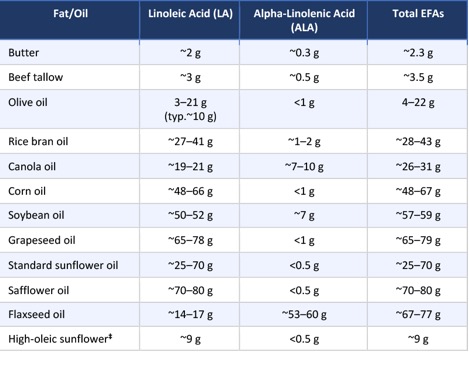
Here is how common cooking fats and oils compare for essential fatty acid content per 100 g. [3]
[1] On the saturated fat and cardiovascular risk question: there is genuine ongoing scientific debate about saturated fat subtypes and food matrices, but the mainstream consensus—supported by the American Heart Association—remains that excess saturated fat is a concern overall.
[2[ Modern sunflower oils, increasingly used in reformulated ultra-processed foods, are often bred to be lower in linoleic acid and higher in oleic acid. The highest-oleic versions are nutritionally much closer to olive oil than to traditional sunflower oil.
[3] Sources: USDA Food Data Central; National Sunflower Association fatty acid profile data; U.S. Canola Association / ScienceDirect (canola); Soy Connection / USDA (soybean); peer-reviewed literature for olive oil LA range, grapeseed oil, corn oil (ScienceDirect), and rice bran oil. All values are per 100 g of oil; ranges reflect cultivar, origin, and processing variation.

Angela Dowden
Angela Dowden is a British health journalist, author, and Registered Nutritionist. She has nearly 30 years’ experience bringing food, nutrition, and health science to life for international audiences through her print and online work.