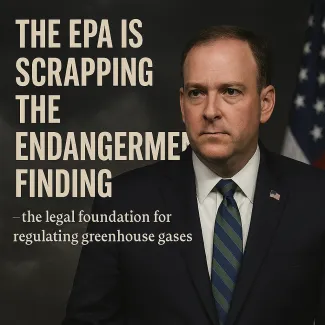
In a generational policy change, the Environmental Protection Agency proposed to repeal the “Endangerment Finding”, the determination that underpins the government’s legal authority to regulate greenhouse gases and, in turn, is the underpinning for almost all its regulations to curb climate change. According to Lee Zeldin, the administrator of the EPA, “the proposal would, if finalized, amount to the largest deregulatory action in the history of the United States.” Environmental groups have already announced their intention to sue the EPA, setting the stage for a prolonged legal battle.
While many were surprised by the EPA’s proposal, it does not come as a surprise to regulatory lawyers who are familiar with presidential executive orders. On President Trump’s first day of office, he signed Executive Order 14154, “Unleashing American Energy.” Halfway through the order, one paragraph requires the EPA Administrator to submit recommendations on the legality and continued applicability of the Endangerment Finding of the Clean Air Act. An Executive Order signed on the President’s first day of office signals this is a crucial issue to the Administration.
The proposal is based upon two-prongs:
- They believe that there is no statutory basis under the Clean Air Act for regulating greenhouse gases (water vapor, carbon dioxide, methane, and nitrous oxide).
- The scientific data used to support the Endangerment Finding is, in many cases, outdated, incorrect, and presents a misleading picture of climate change.
A Statutory Basis for Regulating Greenhouse Gases?
Does the Clean Air Act (CAA) provide a statutory basis for regulating greenhouse gases, atmospheric gases that trap heat and warm the planet? One section of the CAA mandates the EPA to regulate six “criteria” pollutants: ozone, carbon monoxide, nitrogen oxides, sulfur oxides, particulate matter, and lead. The Endangerment Finding, found under section CAA (202a), requires the EPA to regulate air pollutants for new motor vehicles if it finds that they
“cause or contribute to air pollution which may reasonably be anticipated to endanger public health or welfare.” [emphasis added]
The EPA believes that the CAA never envisioned greenhouse gases or global warming as pollutants or effects of concern.
In 1999, the EPA received a petition to regulate greenhouse gas emissions from new motor vehicles under the CAA. The EPA denied the petition in 2003, stating that greenhouse gases were not “air pollutants” under the CAA. A lawsuit ensued, and in 2007, the Supreme Court ruled that greenhouse gases are air pollutants under the CAA, requiring the EPA to either determine endangerment or provide a reasonable explanation for not doing so.
In 2009, the EPA, under President Obama, concluded that each greenhouse gas poses a threat to public health and welfare, and that combined greenhouse gases from new motor vehicles contribute to pollution that also poses a threat to public health and welfare. The EPA concluded in its Endangerment Findings that greenhouse gases, including carbon dioxide, are associated with climate change and its related effects, including changes in air quality, increases in temperatures, changes in extreme weather events, increases in food- and water-borne pathogens, and increases in allergenic illnesses.
These findings were upheld in numerous court challenges and are the basis for many of the EPA’s rulings on greenhouse gas emissions, including emission standards for motor vehicles.
The EPA’s New Stance
The EPA's proposed rule is 300 pages long and states that, according to the Clean Air Act, Congress has not granted the EPA the authority to regulate greenhouse gases. It also:
- Overturns the 2009 Endangerment Finding.
- Eliminates all greenhouse gas emission standards for motor vehicles, including those first set in 2010 and 2011.
- States that the economic benefits of repealing regulations consist of saving Americans $54 billion annually, and more than $1 trillion in total.
- Questions the scientific assumptions behind the 2009 Endangerment Finding, stating that greenhouse gases may be less economically damaging than previously thought.
- Questions the scientific consensus on climate change, including the UN Intergovernmental Panel on Climate Change.
What is the Scientific Basis for Reversing the Current Policy?
The EPA based its scientific assessment primarily on a new report from the Department of Energy, a “Critical Review of Impacts of Greenhouse Gas Emissions on the US Climate.”
This report, developed by the 2025 Climate Working Group, evaluated peer-reviewed literature and government data on climate change from greenhouse gases. The report concluded that the computer models have overstated the risks of a warming planet and underestimated the societal benefits of burning fossil fuels, as carbon dioxide has positive effects on plant growth and increasing agricultural productivity. They also determined that US policy actions would have a minimal impact on global climate change, as they account for a small share of global emissions.
Some criticize the selection of the report's authors, all of whom are known for questioning the role of burning fossil fuels in climate change, rather than using mainstream researchers. Others felt that the EPA should have relied on the National Climate Assessment, which involved many scientists and underwent peer review by the National Academy of Sciences.
The report has been criticized for using “misleading and inaccurate statements to argue that climate science has overstated the risks of a warming planet”. Among the claimed scientific inaccuracies:
- Human greenhouse gas emissions are not the exclusive source of increasing carbon dioxide concentrations and rising global temperatures.
- Extreme weather events are not related to climate change.
- Marginal increases in carbon dioxide concentrations have substantial beneficial impacts on plant growth and agricultural productivity.
- The world is on track to experience less warming than the UN Intergovernmental Panel on Climate Change’s worst-case scenarios, and these studies have led the public to believe that climate change is more harmful than it actually is.
What Comes Next?
The EPA’s proposal will be available for public comment through September 15, 2025. The comments will be summarized, and the EPA will publish its responses. It will then choose to adjust its original proposal or proceed with a final rule. Lawsuits are likely to follow, and environmental groups may not want to wait until the final rule is issued to challenge it. While legal wrangling would typically take years to complete, the high priority given to this regulatory change by the Administration means they plan to expedite its completion.
“Trump undid the Obama regs, and then Biden undid the Trump regs and redid the Obama regs, and now Trump is undoing the Biden regs and redoing them. If the endangerment finding is withdrawn, then this ping-pong match will be much harder for a future Democratic administration, or a green Republican president, to undo.”
- Myron Ebell, chairman of the American Lands Council, a conservative advocacy group.
Although it is never safe to predict the future, it is likely that this far-reaching proposal, if finalized, may prompt some states to draft their own greenhouse gas rules, like California, which mandates stricter standards than those required by the CAA. Another prediction is that this EPA proposal is likely to end up in the Supreme Court. This entire problem stems from Congress’s inability to amend the CAA to clearly state its intention for greenhouse gas regulation. If the statute were clear, this kind of policy shift simply wouldn’t happen.

Susan Goldhaber MPH
Susan Goldhaber, M.P.H., is an environmental toxicologist with over 40 years’ experience working at Federal and State agencies and in the private sector, with an emphasis on issues concerning chemicals in drinking water, air, and hazardous waste. Her current focus is on translating scientific data into usable information for the public.