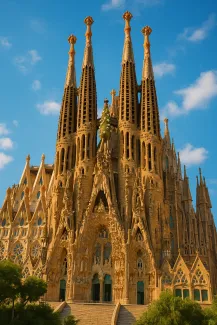
The Italians and Spanish are renowned for their ability to build beautiful cathedrals. We let the French be runners-up, and to my eye, the British churches are too dark. Sagrada Familia is Antoni Gaudí’s gift to Barcelona and the world.
“We ought to remember what Antoni Gaudí told us: “The straight line belongs to men, the curved one to God.” In sad proof of that aphorism, Gaudí stirred up intense controversy when he tried to bring those curves into modern architecture. But the public understood, at some instinctive level, the power and allure of his organic shapes.”
An ode to the curvelinear, from The Honest Broker, The Importance of Counter-Clockwise Dance Rituals
The trolley problem has been used for some time as an ethical dilemma, especially when determining how to program or teach autonomous vehicles.
“Imagine you’re the driver of a runaway trolley whose brakes have failed. Ahead on the track, five people are working and will be killed if you do nothing. But you notice a side-track—if you switch the trolley to it, you’ll avoid the five, but one person on that track would be killed instead. Should you pull the lever and switch the tracks—killing one to save five?”
This is the narrative. Jono Hey, from Sketchplanations, has the visual.
Could it be that the Catholic Church gets a bad rap with science and scientists for the trial of Galileo? For well over a 100 years, the Church has supported its own observatory. It may be time to meet the Pope’s astronomer.
“The Church’s study of the stars dates back at least as far as the late sixteenth century. Under the leadership of Pope Gregory XIII, a meridian line was installed in the Vatican to illustrate the need to reform the Julian calendar. A Jesuit, Christopher Clavius, helped propose that the Vatican adopt the Gregorian calendar, which it did in 1582. According to the historian Jonathan Wright’s book “The Jesuits,” when the realignment caused ten days to be subtracted from the year, mobs across Europe attacked Jesuit houses to protest the time stolen from them.
In the late eighteenth and early nineteenth centuries, an observatory was built atop the Vatican Library and Museum, in what is known as the Tower of the Winds. Eclipses were observed and meteorological measurements were taken. The Vatican Observatory that exists today was set in motion by Pope Leo XIII when, in the late nineteenth century, he devoted a second observation tower in the Vatican to astronomical work.”
From the New Yorker, The Vatican Observatory Looks to the Heavens
I love the stories of Damon Runyon, Jimmie Breslin, and Pete Hamill – all told great tales of an older, more corrupt (?), certainly colorful New York, writing in the manner of their subject.
“Rothstein was a major figure long before Prohibition. His later myth—of a wise man thrust into crime by circumstance—owes more to Hollywood than to history. In reality, Rothstein was a louse, forever at odds with his Orthodox father, Abraham, and upright brother Harry. He was the image of the “wicked son” of the Passover Haggadah: contemptuous of his heritage and dismissive of its demands, marrying outside the faith and, more flamboyantly, mistressing outside it as well. He kept a roster of Ziegfeld Follies girlfriends scattered across town, but, like his racehorses or his English suits, they were little more than trophies, accessories for a man in his position. His wife, Carolyn, recalled that even after he’d become wealthy—owning a couple of hotels, including the Fairfield on West Seventy-second Street—he would go out late at night to collect the smallest of debts. In photographs, he strained for geniality, but what lingers is a peculiar rictus: his nearly invisible upper lip clamped over a row of sharp false teeth. In every portrait, he appears more raptor than rabbi.”
From the New Yorker, a tale of the city’s gambling, as the city now decides on what corporate entity gets to put a casino in the Big Apple, The Engines and Empires of New York City Gambling
Chuck Dinerstein, MD, MBA
Director of Medicine
Charles Dinerstein, MD, MBA, is the Medical Director of the American Council on Science and Health. A vascular surgeon with more than 25 years of clinical experience, he brings a physician's understanding of medical decision-making, an appreciation for scientific uncertainty, and a broader perspective on healthcare economics and policy to his writing.