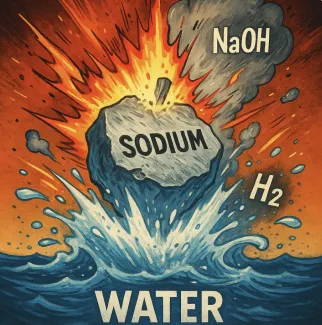
One way to think of sodium metal is as an "amusing lethal weapon." Here's why.
Sodium is exciting!
Despite its extreme reactivity, most chemists find it "fun" to use. It's not like any metal you've encountered. It's so soft that it is easily cut with a butter knife. But don't try this at the dinner table. It's so reactive, with pretty much anything, that fresh-cut sodium metal reacts immediately with oxygen to form sodium oxide, a filmy white solid. This takes only a few seconds.
Oxygen? Please
There are so many things that blow up when they come into contact with sodium that you almost need a ranking system. I made one up.
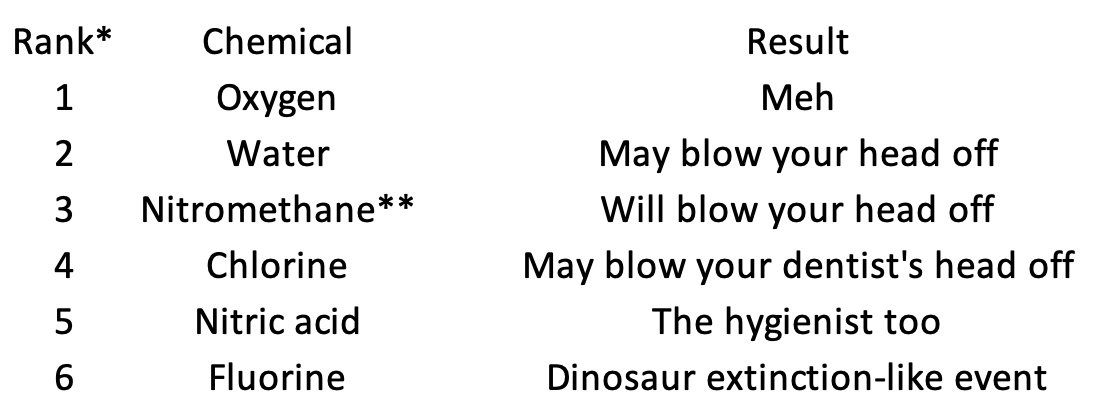
*This number is arbitrary, but the order of reactivity is accurate.
** Nitromethane is used in drag racing. Need I say more?
Teflon (and other PFAS) are boring.
Perfluorinated [1] alkanes and carboxylic acids are snoozers. They are indifferent to almost everything in the universe. This is why they are useful and also why they may be problematic. These classes of chemicals were created to be inert, which is fine when you need something inert, but not so great when you want to get rid of it. This is why there is concern (which may or may not be valid [2]) about the persistence of PFAS in the environment.
The irresistible force meets the immovable object.
What happens when bad-ass sodium meets pain-in-the-ass PFA? It depends.
Chemists at the Universities of Birmingham and Newcastle have come up with a nifty way to get them to go to war, and to do so without collateral damage. In other words, if you heat sodium with just about anything, it will destroy it, sometimes spectacularly so.
But molten sodium isn't exactly something you'd gargle with, which is what Roly J. Armstrong and his colleagues at U. Birmingham addressed in a new paper in the Journal of the American Chemical Society, the most prestigious chemistry journal.
The researchers discovered that if you grind Teflon together with chunks of sodium metal in a ball mill (not the one in Ikea), you get a miracle: the Teflon decomposes. No heat, no solvent, no toxic mess — just a metal ball bearing slamming around. The fluorine atoms — normally cemented to carbon by one of the strongest bonds in chemistry — are ripped away, and what's left is harmless carbon dust and sodium fluoride.
Not just destruction, also toothpaste
Not only is the process clean, but the end product, sodium fluoride, can then be reused in toothpaste. That is, unless you believe all the RFK nonsense about fluoride causing (you name it) [3], in which case it can be used to protect someone else's teeth.
How it works
Inside the steel jar, it’s controlled chaos. Sodium metal and PFAS are schmushed together by steel balls, each collision releasing a burst of heat and pressure. Those impacts rip apart the polymer chains, exposing “fresh” carbon–fluorine bonds. Sodium’s lone valence electron — desperate to escape — attacks and breaks those bonds, forming sodium fluoride and leaving behind carbon dust. No solvents, no flame, just brute mechanical energy turning chemical stability into salt and soot.
Bottom line
There have been numerous studies about methods of destroying highly fluorinated organic compounds. This may be the most efficient. And it won't blow up your dental hygienist. [4]
[1] Perfluorinated means that all carbon-hydrogen bonds have been replaced by carbon-fluorine bonds. These are very different.
[2] I am not commenting on whether PFAS exposure is harmful or just another fake scare. Susan Goldhaber, MPH, an environmental toxicologist, discusses this in detail in her June 2025 article.
[3] "Fluoride exposure has been associated with lower IQ, thyroid problems, arthritis, bone fractures, and even bone cancer.” – Campaign statement cited by PBS NewsHour, 2024.
[4] The authors use polytetrafluoroethylene (PTFE) for their experiments. Same animal.

Josh Bloom
Dr. Jonathan (Josh) Bloom, ACSH's Director of Chemical and Pharmaceutical Sciences, earned his Ph.D. at the University of Virginia and completed postdoctoral training at the University of Pennsylvania. During his 20-plus years in drug discovery at Wyeth, his research group discovered the antibiotic Tygacil®, approved in 2005. He holds 25 issued patents and has authored 35 academic papers. Since joining ACSH in 2010, he has written more than 2,000 articles and dozens of op-eds for major newspapers, including The Wall Street Journal and Chicago Tribune.