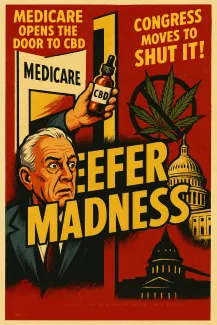
Medicare Tiptoes Toward Medical CBD
The newest twist in America’s long, awkward relationship with cannabis isn’t coming from a dispensary, a state ballot initiative, or a celebrity brand. It comes from a proposed federal regulation that quietly signals Medicare may soon allow coverage for certain CBD products—an unusual move for a program that rarely covers supplements. Coverage would apply only to products that are legal under both federal and state law.
CMS signals that CBD may belong inside mainstream medicine
This proposed change, published by the Centers for Medicare & Medicaid Services (CMS) in the Federal Register, would revise how Medicare programs—especially Medicare Advantage—treat “cannabis products.” Only products illegal under applicable state or federal law would be barred. The shift matters because when Medicare policy treats something as coverable, it implicitly treats it as real medicine, or at least as something worthy of formal evaluation.
Medicare would, in turn, be positioned to evaluate CBD treatments in real-world clinical settings, assessing safety, dosing consistency, product quality, and patient outcomes—especially for conditions common in older adults, such as chronic pain, palliative care needs, and sleep disturbances.
Advocates immediately recognized the significance. Realm of Caring, a Colorado nonprofit focused on cannabinoid therapies, framed the proposal as an overdue acknowledgment that evidence-based cannabinoid products can play a role in older adults’ health, comfort, and longevity. A local NORML chapter similarly treated the change as a validation that hemp-derived cannabinoids are no longer “fringe curiosities,” but increasingly part of public health and regulatory conversations. These groups, of course, have a stake in broader acceptance of these products.
Do the proposed policies reflect the authority of science or culture in today’s CMS? To evaluate whether CMS’s openness reflects scientific rigor or cultural momentum, it's worth surveying the evidence.
What the Science Actually Says
Before jumping into specifics, it is essential to note that there are very few studies that focus solely on CBD. Most involve FDA-approved cannabinoids: the plant-derived cannabidiol, the only exclusively CBD drug, as well as dronabinol and nabilone, both synthetics with THC components. With that context, the evidence across health conditions becomes easier to interpret.
Chemotherapy-Induced Nausea and Vomiting (CINV)
Despite best-practice medical therapy, roughly 50% of chemotherapy patients experience nausea and 10 to 37% associated vomiting - chemotherapy-induced nausea and vomiting (CINV). A randomized, double-blind, placebo-controlled, crossover phase II trial of an oral THC: CBD extract, focused on patients with three common cancers and refractory CINV, found symptomatic improvement in 25% of the cohort, compared with 14% in placebo-treated controls. There was no difference in whether the patient moved from placebo to treatment or vice versa. Quality of life questionnaires detected a slight day-to-day reduction of CINV in the life of the treated group; however, it was not necessarily clinically meaningful
CBD-only efficacy for nausea remains unproven in high-quality clinical trials.
Chronic pain
The evidence for CBD alone in treating chronic pain is limited and often underwhelming. A Lancet meta-analysis concluded that CBD cannot currently be recommended for musculoskeletal pain such as osteoarthritis. A more curated study of chronic pain and CBD in Cureus found combined THC–CBD sprays showing modest benefits, but these findings do not generalize to pure CBD and are still insufficient to firmly establish efficacy or make strong recommendations. Overall, the most substantial pain-related effects in the literature come from products containing THC or multiple cannabinoids, not CBD alone. My friend and colleague, Dr. Josh Bloom, covers CBD and pain more in depth here.
CBD-only is not a clearly effective chronic pain treatment based on current clinical trials, and much of the “cannabis helps pain” narrative comes from products that include THC and/or a mixture of cannabinoids.
Insomnia
A meta-analysis in BMC Medicine found improved sleep outcomes with general cannabinoid treatments, but these effects did not hold when examining only CBD. A small pilot study suggested CBD may modestly improve subjective mood in people with insomnia, but the evidence base is very early. At this stage, no firm conclusions about CBD’s effectiveness for sleep can be drawn.
Anxiety
Here, the therapeutic signal is more promising — but still not settled. A meta-analysis in Psychiatry Research involving the efficacy of CBD in treating generalized or social anxiety disorders, and post-traumatic stress disorder, reported a statistically significant reduction in anxiety, especially for social anxiety. Studies suggest CBD may cause fewer side effects than some standard medications, possibly allowing it to replace part of existing regimens. However, the underlying trials were relatively small, with varying dosages and populations.
CBD may reduce anxiety symptoms for some people, but the current evidence is limited. It’s not yet a slam-dunk replacement for standard therapies.
“Wellness”
“Wellness” is a marketing, not a clinical endpoint. However, a meta-analysis in the BMJ found:
“Most outcomes associated with cannabinoids are supported by weak evidence (observational studies), low to very low certainty …, or are not significant.”
The review did find a benefit for individuals with epilepsy, in which instance, there is an FDA-approved CBD product.
Even where the benefits remain uncertain, safety considerations are crucial for older adults.
Risks and Realities for Older Adults
Even if efficacy is uncertain, the safety and risk of drug interactions are critical in older adults who often are at risk for falls and oversedation, and require multiple medications (polypharmacy). A study reported in Neuropsychopharmacology concluded: “the only adverse outcome associated with CBD treatment was diarrhoea …In summary, the available data from clinical trials suggest that CBD is well tolerated and has relatively few serious adverse effects, however interactions with other medications should be monitored carefully.”
The scientific consensus seems to be that CBD alone “may help, can’t hurt.”
Medicare access in theory, a hemp ban in practice
Unsurprisingly, in an Administration confusing words and deeds, just as CMS is crafting a pathway for Medicare coverage of legal CBD, Congress has advanced (via the budget deal reopening the federal government) a looming federal hemp restriction that could make most CBD products illegal in short order.
The core problem is that the proposed restriction would ban hemp products containing even trace amounts of THC or other cannabinoids. Most commercially available CBD products are not chemically pure—they include small amounts of other cannabinoids because they are full-spectrum extracts, because plant extraction leaves residual compounds, or because manufacturing can vary. Advocates argue that the new definition would make compliant CBD production “next to impossible,” jeopardizing access for the very people CMS is trying to serve. Critics of the restriction warn that it could erase a large segment of the regulated market overnight.
CMS is offering coverage only for products that remain legal, and Congress has moved to make the relevant products illegal. That contradiction sets up a final question: what, exactly, does federal leadership want CBD to be?
So, who is “smoking weed now”? Not seniors suddenly sparking joints in the retirement home, but the federal government, which is managing to generate maximum haze with minimum coherence. CMS is signaling that legally compliant CBD might be evaluated and reimbursed like a legitimate therapeutic tool. For a leadership with grave concerns about the COVID vaccine as experiments on children and adults, where is a similar concern about a CBD experiment on the seniors? Meanwhile, Congress inches toward a hemp restriction that could make the very products CMS would consider effectively illegal. Layer on the still-thin evidence for CBD-only benefits in pain and sleep (and genuine concerns about interactions from polypharmacy), and the result is policy-by-vibe: medicine implied, legality threatened, outcomes uncertain. If federal leaders want to claim “gold-standard science,” they’ll need to decide whether they’re guided by clinical evidence or cultural mood.

Chuck Dinerstein, MD, MBA
Director of Medicine
Charles Dinerstein, MD, MBA, is the Medical Director of the American Council on Science and Health. A vascular surgeon with more than 25 years of clinical experience, he brings a physician's understanding of medical decision-making, an appreciation for scientific uncertainty, and a broader perspective on healthcare economics and policy to his writing.