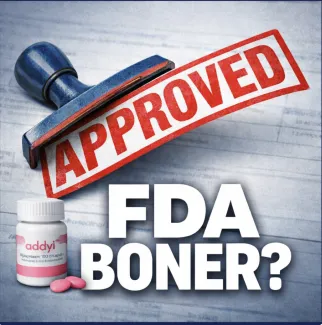
I can hardly believe that it's been more than 10 years since I torched flibanserin (Addyi), aka "Female Viagra."
I gave it a smackdown because:
- It barely works (more below)
- It has plenty of side effects
- The story of Addyi is a fine example of Pharma Sleaze.
- It was approved after a large coalition of women's groups, called Even the Score, began lobbying Congress and the FDA.
- Before that, the drug was rejected twice.
- Unsurprisingly, Even the Score was funded by Sprout Pharmaceuticals, the company that owned Addyi
- The women believed (or were instructed to believe) that the absence of any drug comparable to Viagra for women was simply a result of "sexist attitudes at the FDA," as they put it.
- Possibly, someone really believed this.
- While we're at it, in the interest of "pharmasexual equality," I maintained that an IUD for men was only fair.
- Still waiting on that.
Sometimes it really is all about money
One can hardly blame Sprout Pharmaceuticals for wanting a bigger market. The drug hasn't exactly been a Black Friday sale item, more like a pork roast at a bar mitzvah. In its first six months of life, doctors wrote a measly 4,000 prescriptions for the stuff. By contrast, Lipitor/atorvastatin is prescribed more than 100 million times per year. Addyi's web page claimed 30,000+ prescribers in 2024-25. That's seriously bad for a newly marketed drug.
But not without a reason
There’s a bunch of data that supported Addyi’s original application and subsequent approval. Without going into detail, here’s the overall picture:
- Baseline Satisfying Sexual Events (SSE): ~2–3/month
- Placebo gain: +0.8 to +1.5/month
- Addyi gain: +1.6 to +2.5/month
- Drug-attributable gain (vs. placebo): +0.7 to +1.0/month
- (Translation: best case, you’re looking at one extra satisfying event every 4–6 weeks, beyond placebo.)
- Net gain vs. placebo: ~10–15%
- Stopped due to adverse events: ~10–13% on Addyi vs. ~6–7% on placebo
These are not great numbers
Addyi was (and still is) a marginally effective drug with significant side effects. It is not an example of a safe and effective drug somehow being withheld from women because of “sexist attitudes.” It just plain old sucks, and all the lobbying, marketing, and label expansions aren’t going to change that.
NOTE:
[1] There's more to that indication: "...where low desire causes marked distress or interpersonal difficulty, and isn’t due to a medical/psychiatric condition, relationship problems, or meds/substances."

Josh Bloom
Director of Chemical and Pharmaceutical Science
Dr. Josh Bloom, the Director of Chemical and Pharmaceutical Science, comes from the world of drug discovery, where he did research for more than 20 years. He holds a Ph.D. in chemistry.