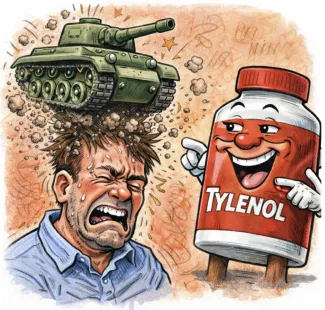
Every New Year’s Day, those who have overindulged perform the same ritual. They stagger to the medicine cabinet and try to focus on the Tylenol. Next, they down a couple of tablets, and—assuming they stay down—pray for relief (or a quick death–either will do), because they're dealing with the dreaded headache from hell.
This ritual no doubt makes the folks over at Kenvue [1] happy. The company, formed in 2023 after spinning off from Johnson & Johnson, sells a wide range of over-the-counter products. The most popular? Tylenol (acetaminophen), and they must sell a whole bunch of it on New Year's Day.
But does it help?
(Un)happy New Year!
So, you woke up at 7 a.m. feeling like a Sherman tank had been dropped on your head. Tylenol seems like an obvious choice. But this ritual persists despite an inconvenient fact: Tylenol offers little or no meaningful relief for headaches of any kind—a claim that deserves evidence, not just attitude.
Let’s look at the evidence.
We all know that many studies are awful. And it’s not always obvious which ones are awful. Journals don’t exactly advertise methodological failure in their titles.
You’ll probably not see something like this:
“This Study Sucks. A Retrospective Analysis.”
Fortunately, there are high-quality, long-standing reviews published by an independent international research collaboration. These are called Cochrane reviews, and they exist for exactly this reason: to separate the wheat from the chaff—or the "suck" from the "don’t suck." Review authors systematically sift through the literature and make clear which studies hold up under scrutiny and which ones don’t. Their analyses are published in the Cochrane Database of Systematic Reviews, a widely used source for evidence-based medicine.
And Cochrane Says…
Tylenol's relief of the pain of tension-type headaches is unimpressive. Here are the details.
For complete pain relief in 2 hours:
- About 24% of patients were pain-free when given 1,000 mg of acetaminophen.
(This isn't terribly impressive, but at least you have a 1 in 4 chance of getting some help from the drug, right?)
No. That's wrong.
- But about 19% of patients given a placebo were also pain-free.
- So, the absolute benefit from the drug is about ~5% – ghastly.
- Put another way, the number needed to treat (NNT) is 22. In other words, 22 people have to take acetaminophen for one additional person to be pain-free at two hours.
Does anyone really want to wait two hours for a 5% possibility of relief?
The results are pretty much the same when the endpoint is either pain-free or mild pain at 2 hours:
- ~59% improved with acetaminophen
- 49% improved with placebo (Absolute benefit: ~10%)
- NNT ≈ 10 (10 people have to take the drug for one additional person to get relief from the drug)
Migraine Headaches: Lots of pain and little gain
If you're taking acetaminophen/Tylenol for a migraine, your new year is gonna be anything but happy. The numbers are similar to those from tension headaches.
- Endpoint: pain-free at 2 hours: ~19% with acetaminophen vs ~10% with placebo (Absolute benefit: ~9%)
- NNT ≈ 11–12
- Endpoint: Pain reduced to mild or none at 2 hours: ~56% with acetaminophen vs ~36% with placebo
- Absolute benefit: ~20%
- NNT ≈ 5
- At 1 hour, the benefit is barely distinguishable from a placebo.
Bottom Line
While this represents only a fraction of the published headache research, it focuses on the most rigorous evidence available. Carefully conducted systematic reviews tell us far more about real-world effectiveness than dozens of weaker, individual studies.
So, if you're hungover and feel like a mule kicked your head, acetaminophen probably isn't a great choice. The drug can outperform a placebo, but beating a placebo is a low bar. For many people, the real-world experience is: Take Tylenol, wait, and the headache will fade on its own. Or, it won't.
NOTE:
[1] Kenvue Inc., is a company that sells many common OTC products, including Tylenol. It was spun off from Johnson & Johnson in 2023.

Josh Bloom
Dr. Jonathan (Josh) Bloom, ACSH's Director of Chemical and Pharmaceutical Sciences, earned his Ph.D. at the University of Virginia and completed postdoctoral training at the University of Pennsylvania. During his 20-plus years in drug discovery at Wyeth, his research group discovered the antibiotic Tygacil®, approved in 2005. He holds 25 issued patents and has authored 35 academic papers. Since joining ACSH in 2010, he has written more than 2,000 articles and dozens of op-eds for major newspapers, including The Wall Street Journal and Chicago Tribune.