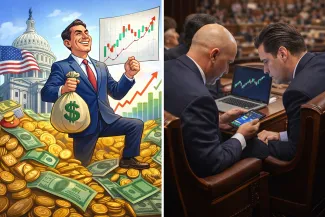
The members of the 119th Congress have a lot on their legislative plates. Legislation on invading Venezuela and Greenland, healthcare costs, a bill to fund the government for the year, and regulating AI, to mention just a few. So it would be little surprise that H.R. 1908 - the End Congressional Stock Trading Act, a bipartisan piece of legislation crafted by Texas Republican Rep. Chip Roy and Rhode Island Democrat Seth Magaziner - is not their chief concern.
As Rep. Seth Magaziner has argued, the opportunity for corruption is “just so great” when lawmakers vote on bills that could affect their own investments. Rep. Chip Roy echoes the same concern, warning that trading stocks tied to the very issues Congress is meant to regulate undermines the purpose of public service. That said, there is at least some verbal support from Congressional leadership, including House Speaker Mike Johnson and House Minority Leader Hakeem Jeffries. Senate Majority Leader John Thune and Senator Ron Johnson, on the other hand, are not on board.
There are persistent concerns over “insider” trading. In 2012, Congress attempted to address them through the STOCK Act, which requires lawmakers to disclose trades over $1,000 within 30 days and imposes a modest $200 fine for failure to report. [1] While the penalties are widely viewed as weak, the law inadvertently created a valuable dataset—one that a new National Bureau of Economic Research working paper, “Captain Gains” on Capitol Hill, uses to ask an old question: qui bono—who benefits?
The paper examines whether top congressional leaders achieve different stock-trading outcomes than “regular” members of Congress, focusing on whether leaders trade in companies connected to them (such as donors or home-state firms) and whether their trades predict later political or corporate events. The authors also tested whether trading performance changes once someone becomes a leader by comparing leaders to similar non-leaders.
The authors define leadership as roles such as Speaker, floor leader, whip, and conference or caucus chair—12 positions in total. Between 1995 and 2021, 47 people held these roles, and 20 traded stocks both before and after becoming leaders. Although the sample is small, the researchers note that it represents the entire universe of congressional leadership. Each leader was matched to a comparable non-leader based on tenure, party, chamber, age, and sex to ensure a fair comparison.
The primary outcome measure was the Buy-and-Hold Abnormal Return (BHAR) metric. It’s a way to measure how much the leadership’s investment outperforms or underperforms that of the regular Congress member (the benchmark) over a period of time if you buy it and hold it. The paper uses a statistical model [2] to estimate returns, BHAR and how leadership status interacts with many other factors, asking: when a member of Congress buys or sells a stock, do they earn unusually good (or bad) returns afterward compared with what the market would usually give—and is that especially true if the member is an influential leader?
To answer this fairly, the model controls for lawmakers’ ties to the company, their political power and seniority, firm characteristics such as size and profitability, and broader market conditions. The goal is to isolate whether political influence, in itself, is associated with superior trading outcomes.
Before we look at their findings, a critical caveat. The authors do not claim to have definitive proof of illegal insider trading or STOCK Act violations; however, they argue their evidence is consistent with serious concerns and should inform the current debate.
The results point to several striking patterns:
- Behavioral change: Overall trading activity declined after the 2012 STOCK Act, suggesting disclosure rules altered behavior.
- Leadership effect: After becoming leaders, lawmakers experienced a significant improvement in trading performance—up to 29% higher returns on purchases and 24.5% higher returns on sales within six months.
- Information and influence: Leaders overseeing heavily lobbied industries earned higher returns, consistent with advantages tied to regulatory power.
- Timing of sales: Leaders’ stock sales predict subsequent hearings and regulatory actions, suggesting they can exit positions before negative information becomes public.
- Policy alignment: After leaders buy stocks, aligned legislation and federal contracts—especially non-competitive ones—become more likely for those firms, implying influence beyond mere forecasting.
"Members of this body are privy to information that the normal person is not, [but] nobody really believes that the information we get is not valuable. It is quite valuable."
-Senator Josh Hawley
- The study also finds that leaders’ trades predict whether future corporate news will be positive or negative, a pattern that emerges only after they attain leadership roles. This predictive power is strongest for executive-controlled announcements, such as dividend changes, rather than unpredictable events like lawsuits. While this supports the idea of privileged information flows, the authors note a more benign explanation: simply knowing which legislation or regulations are coming could confer a trading advantage, even without explicit insider tips.
Could You Invest Like a Congressional Leader?
The researchers then ask a practical question: if an ordinary investor copied the trades of congressional leaders, would that strategy yield abnormal profits?
To test this, the researchers constructed hypothetical portfolios based on leaders’ trades, both at the time the trades occurred and at the later disclosure date. In both cases, the portfolios outperformed expectations, suggesting that leaders’ trades contain information that even outside investors could partially exploit.
An Investment Edge
“This paper documents that members of Congress exhibit significantly improved stock trading performance only after ascending to congressional leadership positions. … leaders outperform their matched peers by up to 47 percentage points per year. We hypothesize two mechanisms behind this sharp improvement: (i) advanced knowledge of, and influence over, the regulatory and legislative agenda, and (ii) enhanced access to nonpublic corporate information. Our results support both channels.”
Congress has attempted to reassure the public through disclosure rules and modest penalties, but the evidence suggests a deeper structural problem. While the research does not prove illegality, it indicates that leadership power itself confers a measurable financial edge. Banning individual stock trading, requiring genuine blind trusts, and enforcing meaningful penalties would reduce conflicts of interest and potentially reshape who seeks power in Congress. Removing the quiet financial rewards of political access would not diminish public service—it would clarify its purpose.
[1] Federal penalties for illegal insider trading are severe, including up to 20 years in prison, fines up to $5 million for individuals, and civil penalties up to three times the profit gained or loss avoided, plus disgorgement of profits. Penalties vary based on the amount of money involved, with significant enhancement for abusing positions of trust.
[2] The researchers boiled the problem down to a simple question: do powerful congressional leaders make stock trades that turn out unusually profitable—and if so, is it because of their power and connections rather than ordinary investing skill? They focus on whether the trader is a top Congressional leader, because leadership brings influence, access, and early knowledge of what the government might do next. They consider special ties to the company they’re trading, e.g., donors, located in the lawmaker’s home state, and firms in industries the lawmaker’s committees oversee. All situations where closeness to the company could lead to more private conversations, greater influence, or better information. They account for lawmakers’ power, e.g., their party might control the chamber, they might hold a key committee role, or they might sit on committees that oversee heavily lobbied industries—places where policy and corporate fortunes regularly collide. They also control for basic personal factors like wealth, age, and time in office, because those can shape how someone invests and who they know. Finally, they control for the kind of company being traded; its financial health and risk, e.g., debt load, size, profitability, and bankruptcy risk. And the firms' political engagement through lobbying and donations, because politically connected firms may behave differently and interact more with lawmakers.
[3] The researchers note that this pattern of stronger gains on purchases than on sales is similar to that observed in corporate insider trading research.
Source: "Captain Gains" On Capitol Hill NBER Working Paper 34524

Chuck Dinerstein, MD, MBA
Director of Medicine
Charles Dinerstein, MD, MBA, is the Medical Director of the American Council on Science and Health. A vascular surgeon with more than 25 years of clinical experience, he brings a physician's understanding of medical decision-making, an appreciation for scientific uncertainty, and a broader perspective on healthcare economics and policy to his writing.