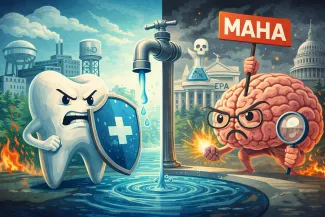
The EPA recently took its first step toward determining safe levels of fluoride in drinking water, publishing a "Preliminary Assessment Plan and Literature Survey". The toxicity assessment will focus on the potentially harmful effects of fluoride and will not consider its beneficial effects, including its role in preventing dental disease.
In practice, what does the EPA’s announcement mean?
The Studies Behind the EPA’s New Assessment
EPA’s current standard for fluoride, the maximum amount allowed in public drinking water supplies, is 4 milligrams per liter (mg/L), based on preventing crippling skeletal fluorosis, which results in painful bone deformities. After the EPA’s toxicity assessment is complete, the EPA is likely to propose lowering the standard.
This is because a 2024 National Toxicology Program (NTP) report concluded with “moderate confidence” that fluoride concentrations above 1.5 mg/L are associated with neurodevelopmental effects, primarily lower IQ in children, and with “low confidence” that fluoride was also associated with adverse effects on adult cognition.
“It is important to note that there were insufficient data to determine if the low fluoride level of 0.7 mg/L currently recommended for U.S. community water supplies has a negative effect on children’s IQ.”
- Fluoride Exposure: Neurodevelopment and Cognition (NTP)
This is a flawed report. The NTP report was not designed to evaluate the health effects of drinking fluoridated water alone. It was based on 72 studies, of which 19 were deemed of sufficient quality to review. None of the accepted studies were conducted in the U.S.; 10 were from China, 3 each from India and Mexico, 2 from Canada, and 1 from Iran. Most of these studies have significant socioeconomic conditions that could affect IQ measurements.
A Flawed Metric
The other major problem is that the studies all use IQ as a measure for neurodevelopmental effects, a flawed measure. IQ does not measure neurological functioning; it is a total score derived from a series of standardized tests designed to test human intelligence. Because scores may vary due to measurement error or the circumstances under which the test was administered, most IQ tests provide both a specific IQ score and a margin of error, a range of approximately 5 points on either side of the score. [1] Most of the NTP-cited studies on fluoride exposure showed small decreases in IQ scores, well within the 5-point margin of error.
The NTP used IQ as a measure of neurodevelopmental effects because they found no studies demonstrating other effects in children at these low levels. All other adverse effects from fluoride exposure were found at much higher levels.
If the EPA plans to restore gold-standard science to the federal government by following Executive Order 14303, as they say they do, they must give equal weight to studies that did not find effects of fluoride on IQ with those that did. For example, this study in New Zealand found no association between fluoride and IQ, and this meta-analysis of studies on fluoride found “no convincing evidence of harm from community water fluoridation at concentrations between 0.7 and 1.0 mg/L, whereas uncertainty remains at higher concentrations.”
However, I predict that the EPA will conclude that lowering the standard will be protective against changes in children's IQ. Once this happens, the CDC has several options for their recommendations, including making no recommendation or removing their current recommendation (an optimal level of fluoride of 0.7 – 1.2 mg/L to prevent tooth decay while minimizing tooth discoloration), replacing it with a recommended level equal or below EPA’s new standard for fluoride or even concluding that there is no safe level of fluoride in drinking water.
A MAHA Win?
While neither the EPA nor the CDC has the authority to require fluoridation of drinking water, a role reserved to States or localities, the CDC’s recommendation of a safe, optimal level of fluoridation is often the basis for States' or localities’ decisions. If the CDC removes its recommendation, this could have a substantial impact on state and local decisions to continue or discontinue fluoridation.
This sounds like a slam dunk for the MAHA movement; however, there is another player to consider, the American Dental Association (ADA). Their stance is clear; they
“remain committed to the oral health benefits of optimally fluoridated water….Eighty years of evidence show community water fluoridation is safe, effective, and reduces tooth decay.”
Several studies support the ADA’s position that suggest a large decline in the dental health of children when water fluoridation is ended:
- Juneau, Alaska: Juneau stopped fluoridating its water in 2007. For children under 6 years old, cavities increased from 1.55 to 2.52 per year. Between 2003 and 2012, the average number of cavities treated among children enrolled in Medicaid increased by 16% in Juneau, compared with a 6% decline in Anchorage, which maintained fluoridation.
- Calgary, Canada: Calgary stopped fluoridating its water in 2011. Studies that compared it to Edmonton, which continued fluoridating, showed that 64.8% of children in Calgary had one or more cavities in their baby teeth, compared with 55.1% in Edmonton. This difference in cavities has widened over time.
- Israel: Israel began fluoridating its water in 1981, but stopped in 2014 after the health minister changed policy. There was a significant increase in dental restorations and crowns among children ages 3 to 5, and an increase in dental treatments at all ages after the end of water fluoridation.
The ADA has very strong relationships with its local State legislators and leaders, making their opinion influential. The battle between the EPA and the ADA will be worth watching; get your popcorn ready.
A Better Way
The EPA’s review should not treat fluoride as though it were just another industrial contaminant. The regulatory law, the Safe Drinking Water Act, does not say that beneficial effects cannot be considered. It has not been done because most of the chemicals that the EPA regulates have no beneficial effects! Fluoride is different; while it does carry real risks at high doses, it also delivers one of the clearest, most widely documented public health benefits in modern dentistry.
Ignoring those benefits would distort the science and virtually guarantee a collision with the American Dental Association. If the agency lowers standards without weighing both the harms and the benefits, this debate won’t end in regulatory fine print; it will end in court. The fluoride battle royale is just beginning.I wouldn’t bet against the ADA.
[1] IQ testing is “standardized” to a large population, with the average score, incorporating just over 50% of test takers, set at 100

Susan Goldhaber MPH
Susan Goldhaber, M.P.H., is an environmental toxicologist with over 40 years’ experience working at Federal and State agencies and in the private sector, with an emphasis on issues concerning chemicals in drinking water, air, and hazardous waste. Her current focus is on translating scientific data into usable information for the public.