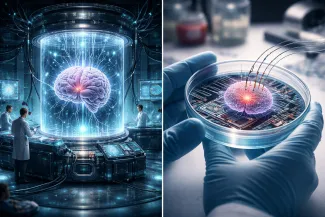
Enter the organoid
To address these issues and others, scientists are developing organoids—miniature, three-dimensional tissue cultures that mimic the structure, function, and cellular complexity of human organs—with a fair bit of success and positive publicity. For example, they are using organoids instead of animals for drug testing or to evaluate how diseases like Alzheimer’s hijack the brain’s memory.
The organoid technology is not new. By 1907, American biologist Henry Wilson discovered that sponges re-form into living creatures when their cells are broken apart through a fine mesh screen. Once we could harness and isolate adult pluripotent stem cells to become any cell in the body, creative scientific imagination was unleashed. In 2013, Madeline Lancaster’s team created the first brain “organoid,” a tiny 3-D cell culture that can mimic the human brain. Teaching them to maintain their position in space was the first hurdle, done using a mini-algorithm. (Humans do this naturally, brain organoids need computerized assistance.) What is critical here is that now we can give these rudimentary neural circuits (human) goals to pursue.
Organoid to Bio-processor
The bio-processor couples a brain organoid with a silicon chip, enabling the cells to self-direct their rewiring and to evolve as it learns. Each unit contains about 800,000 human neuron cells, maintained by an integrated life support system that supplies nutrients and controls the environment. To make them more human-like, one company, Final Spark, embeds each organoid with eight electrodes connected to a conventional computer, electrically stimulates the neurons, and then exposes them to human motivational neurotransmitters like dopamine and serotonin to guide, engage, and support their training.
Researchers at Harvard implanted a thin, stretchable bioelectronic device into a tadpole embryo's neural plate, which eventually becomes the animal’s spinal cord, demonstrating potential for seamless integration into the developing brain. The Cyborg tadpoles are supposedly being developed to help research autism, bipolar disorder, or schizophrenia—disorders that develop early in development, at a stage where research on human embryos is prohibited.
The University of Bristol incorporates these “cyborgs” into robots so they can “learn on the go,” developing motor skills through specific “experiences” such as touch with the goal of “one day helping the robot understand what it’s interacting with.”
MIT has developed a different variation—a 3-D human organoid platform that combines all six major brain cell types and their vasculature into a single entity. These tiny brains (miBrains) mimic essential features and functions of human brain tissue, can be produced in large quantities, and are now suitable for gene editing. They can be assembled into working units, including blood vessels, immune defenses, and signal pathways. Although this version is marketed solely for brain disease research and is undoubtedly better than animal models, integrating it with a silicon chip is just an inventor’s dream for other potential applications.
To Go Where No Human Has Ever Gone Before
But the lack of regulation governing the creation of these “bio-brains” raises a host of ethical questions that have yet to be fully recognized, let alone addressed. Complicating the issue is that there are multiple approaches to creating these artificial cyborgs, each one raising its own set of conundrums.
One company’s product, Neuroplatform, allows anyone to run experiments using a cluster of these organoids for $1000 a month. Cortical Labs sells its bioprocessing units for $35,000 a month (though you can rent them weekly for $300). The availability of these systems based on affordability raises the ethical issue of “commodification” or cheapening of the essence of the individual (which some might call enslavement), even if only part of the merchandise is human.
Some labs are implementing responsible controls, such as not waiting for an organoid to show even a hint of consciousness and establishing frameworks—similar to those used in animal research—with review boards and protocols to prevent suffering. Cortical lab requires buyers to obtain ethical approval for new cell lines and to operate within a lab environment. However, this is a convention of one company, as no regulations are in place to govern the entire industry. One lab even uses a commercial bioprinter and standard imaging technology for their study, opening the door to unsupervised “citizen science.”
When do these organoids become organs?
General biology teaches the hierarchy of biological development: cell, tissue, organ, system. So where does an organoid fit in? Our regulation of organs is strict, but organoids are not considered organs. At what point does this biological entity experience pain? If it reacts to neurotransmitters, does that mean feelings—pain or otherwise—apply to organoids? If they respond to dopamine and “relax” with serotonin, shouldn’t we assume they have some level of human-like feelings?
The same societal trigger points arise here. Some regulations could set limits on an organoid’s age, the types of experiments allowed, how cells are sourced and produced, and, if they originate from a human, how to use them responsibly and with donor consent.
Ethics, Anyone?
The standard Beauchamps and Childress bioethics paradigm (autonomy, beneficence, non-maleficence, and justice) doesn’t seem applicable here. Neither does the common worry that these organoids might soon become conscious, defined as the ability to be self-aware. Even the traditional definition of the capacity to experience feelings or sensations is beginning to be challenged if we can “reward” these organoids with feel-good chemicals, like dopamine or serotonin.
Furthermore, even if a uniform standard could be reached, unless regulations are on the books, loosey-goosey guidelines may offer little reassurance. While enforceable regulations might hinder production or research, this is an area where we might wisely consider their use.
Ultimately, the promise of bio-brains forces us to face a question that technology has long allowed us to postpone: what moral status should we give to human-derived intelligence when it exists outside the human body? Organoids that can learn, respond to rewards, and possibly experience basic sensations blur the line between mechanical tool, cyborg, and organism. Their effectiveness and scientific importance are clear, but the absence of clear ethical and regulatory frameworks risks turning pieces of human biology into commodities for computing that may surpass human cognitive ability.
If we don't address that question now, innovation will likely outpace ethics—forcing us to face the consequences only after the technology has already changed the very definition of intelligence, especially intelligence paired with human compassion.

Barbara Pfeffer Billauer JD MA (Occ. Health) PhD
Professor Barbara Pfeffer Billauer is an internationally recognized scholar of public health law, bioethics, and the laws of medical care, focusing on the integration of science and law and its impact on day-to-day policy and legal outcomes. She has lectured and published extensively, in scholarly journals and law reviews, and has written and edited seven books for lay and academic audiences.