A Different Way to See Sugar
Like my colleagues at the American Council on Science and Health, I have discussed fructose in our food environment through the lens of the common narrative, treating it as simply another source of calories, interchangeable with other carbohydrates, so long as the numbers add up. However, a new article in Nature Metabolism suggests that this lens overlooks fructose’s essential role as a metabolic signal of abundance.
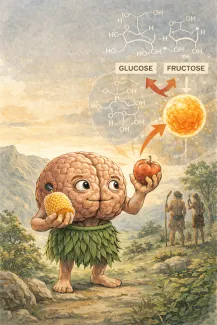
That signaling role likely made sense in our distant past, when seasonal foods rich in fructose, e.g., honey and ripe fruit, would have been valuable cues that energy was available and should be stored. In that context, fructose’s tendency to shift our appetite and push our metabolism toward fat production may have been adaptive. Through the lens of evolutionary biology, fructose is not inherently “bad,” nor are its ultra-processed forms the concern; rather, our modern diet delivers it in quantities and frequencies our biology was not shaped to handle. Fructose is an ancient signal being sent far too loudly, far too often.
To understand this argument, it helps to compare how the body processes glucose and fructose.
Glucose: Controlled Energy Flow
When we eat starches, the storage form of carbohydrates, which are long chains of glucose, they are broken down into individual glucose molecules, and much of it enters the bloodstream as the dominant circulating fuel. As blood glucose rises, the pancreas responds by releasing insulin, a hormone that acts as both a signal and a coordinator, directing tissues to take up and use or store this incoming energy.
Once inside cells, glucose enters a highly structured and efficient pathway (glycolysis) and is ultimately converted into energy, ATP. Early in this pathway, a critical enzyme, (phosphofructokinase-1 or PFK1) acts as a metabolic gatekeeper, regulating how quickly glucose is allowed to proceed through glycolysis based on the cell’s needs. The system is regulated by insulin, which promotes the breakdown of glucose for energy production or its storage as glycogen, an intermediate energy source in the liver, or as fat, our body’s long-term energy store. At the same time, the pathway is sensitive to the cell’s energy status: high ATP levels slow further energy production, while ATP precursors, AMP and ADP, accelerate it. The result is a dynamic balance of energy supply aligned with demand.
Yet this same system also hints at a paradox. While glucose metabolism is orderly and responsive, insulin’s role in promoting storage means that excess glucose—especially when chronically elevated—can still drive the body toward fat accumulation. In that sense, glucose metabolism is not just about energy production but also about energy management, with consequences that extend into long-term metabolic health.
In short, glucose enters, is processed through regulated checkpoints, and is either burned efficiently for energy or stored for later use. Its precision stands in stark contrast to the far less regulated and more disruptive pathways that handle fructose.
Fructose: Fast-Tracked and Loosely Controlled
While, in principle, fructose could be processed through the same early steps of glycolysis, in practice it largely bypasses the system’s main regulatory checkpoints and follows a different path. Unlike glucose metabolism, which slows down when the cell has enough energy, fructose metabolism proceeds quickly and with little feedback control, rapidly consuming ATP and creating a metabolic surge as largely unregulated breakdown products of fructose become glucose, glycogen, and fat.
One of fructose’s breakdown intermediates (F1P) acts as a metabolic cue, pushing substrates toward storage pathways. Fructose activates broader metabolic programs; it is a more potent driver of fat production from carbohydrate than glucose.
Where glucose metabolism is governed and responsive, fructose metabolism is less about careful energy balancing and more about signaling abundance, strongly oriented toward converting excess into stored energy. While fructose’s metabolic signal of abundance is advantageous in evolutionary terms, it loses its signaling value in our modern food environment.
These biochemical differences translate into broader physiological effects.
The Metabolic Consequences of Fructose
While glucose is content to act solely as a fuel, fructose serves as a metabolic signal beyond its role as a fuel, more forcefully directing metabolism toward storage, adaptation, and long-term physiological change.
- A stronger push away from fat burning: Fructose shifts the body more strongly toward carbohydrate oxidation, especially after a meal, altering which fuel the body prefers to burn.
- A more powerful trigger for making new fat: Fructose stimulates the liver to turn carbohydrate into fat through de novo lipogenesis more than glucose does.
- A greater rise in circulating triglycerides: Fructose raises blood triglycerides more than an equivalent amount of glucose. Triglycerides package newly made fatty acids into a safe, transportable form, allowing excess carbohydrate to be converted into distributed and stored energy, linking carbohydrate metabolism directly to lipid metabolism.
- A stronger drift toward insulin resistance: Fructose doesn’t acutely spike insulin like glucose, but it more effectively creates conditions for insulin resistance over time—by promoting liver fat accumulation through lipogenesis, impairing insulin signaling through its metabolic intermediates, and allowing the liver to continue producing glucose even when insulin is present.
- A heavier burden on mitochondria: Fructose metabolism rapidly consumes ATP, increasing nucleotide breakdown and uric acid production. Uric acid promotes oxidative stress by impairing mitochondrial metabolism and increasing reactive oxygen species. At the same time, the high metabolic flux forces mitochondria to work harder, reducing their resilience over time.
- A distinct hormonal signal: Unlike glucose, fructose stimulates vasopressin release, linking it more strongly to water retention, elevated blood pressure, stress-hormone responses, and metabolic syndrome.
Intake Overwhelms the System
Glucose is efficiently absorbed in the small intestine and quickly enters the bloodstream as the body’s primary circulating fuel. Fructose follows a more complex path. At low doses, intestinal cells metabolize much of it locally, limiting how much reaches the liver. But when intake is high, e.g., from high-fructose corn syrup, intestinal cells are overwhelmed, sending more fructose directly to the liver, where it drives fat synthesis. Fructose’s role as a signal is disruptive when supplied in abundance, in ways that excess glucose is not.
A Signal that Ripples Downsteam
Fructose’s biological signal influences appetite, metabolism, and disease risk across multiple organ systems, in ways that extend beyond calorie intake alone. Much of that signal is routed through the liver, where fructose metabolism helps drive fat production, disrupt insulin sensitivity, and set off downstream changes rippling across the body.
From there, the consequences broaden into disease. Fructose metabolism has been linked to, though not necessarily shown to cause, metabolic syndrome and obesity, fatty liver disease, hypertension, inflammation, and cognitive dysfunction. When we view fructose through the lens of metabolic signaling, rather than calories, it is not unreasonable to believe that the evolutionary advantages of fructose metabolism in our past become harmful under conditions of chronic abundance.
Fructose engages both positive and negative feedback signals to regulate food intake. It can lower cellular energy signals in the brain, reducing satiety and increasing responsiveness to appealing foods. At the same time, it may trigger hormonal signals that act as a brake on sugar consumption. In modern diets, this balance may be disrupted by the constant availability of fructose-rich foods.
A Shift in Perspective
Seen this way, my earlier view of fructose as merely a calorie source was incomplete. When fructose is treated solely as a calorie source, its effects can seem puzzling or overstated. However, as a biological signal atop its caloric value, the concern over fructose becomes much clearer. In the modern food environment, our evolutionary relationship with fructose, which was shaped by its limited availability, is no longer valid. We continue to activate a survival signal in an environment of abundance. It is the mismatch, not the fructose, that carries the biological meaning and consequences.
Source: Fructose: metabolic signal and modern hazard Nature Metabolism DOI:10.1038/s42255-026-01506-y

Chuck Dinerstein, MD, MBA
Director of Medicine
Dr. Charles Dinerstein, M.D., MBA, FACS is Director of Medicine at the American Council on Science and Health. He has over 25 years of experience as a vascular surgeon.