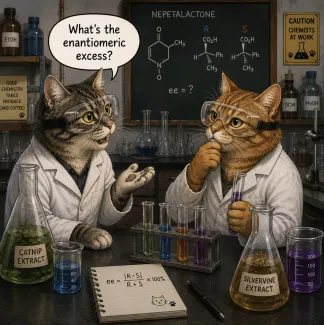
Ready for some weirdness?
Stereochemistry—the study of the three-dimensional arrangement of atoms in molecules and a leading cause of organic chemistry nightmares—has probably sent more than a few medical-school dreams to the litter box. I know this because I taught organic chemistry lab in graduate school. On a good day, the panic was palpable. By the time we reached stereochemistry, the class resembled a low-budget horror film.
Ironically, cats—a chronically underrepresented group in medical schools—understand it instinctively.
How could that be? The answer lies in part in a classic lesson from organic chemistry.
Consider carvone, an essential oil found in a variety of plants. As shown in Figure 1, it can exist in two distinct forms. Although the two forms contain exactly the same atoms connected in exactly the same order, they differ in their three-dimensional arrangement; one smells like spearmint while the other smells like caraway seeds.
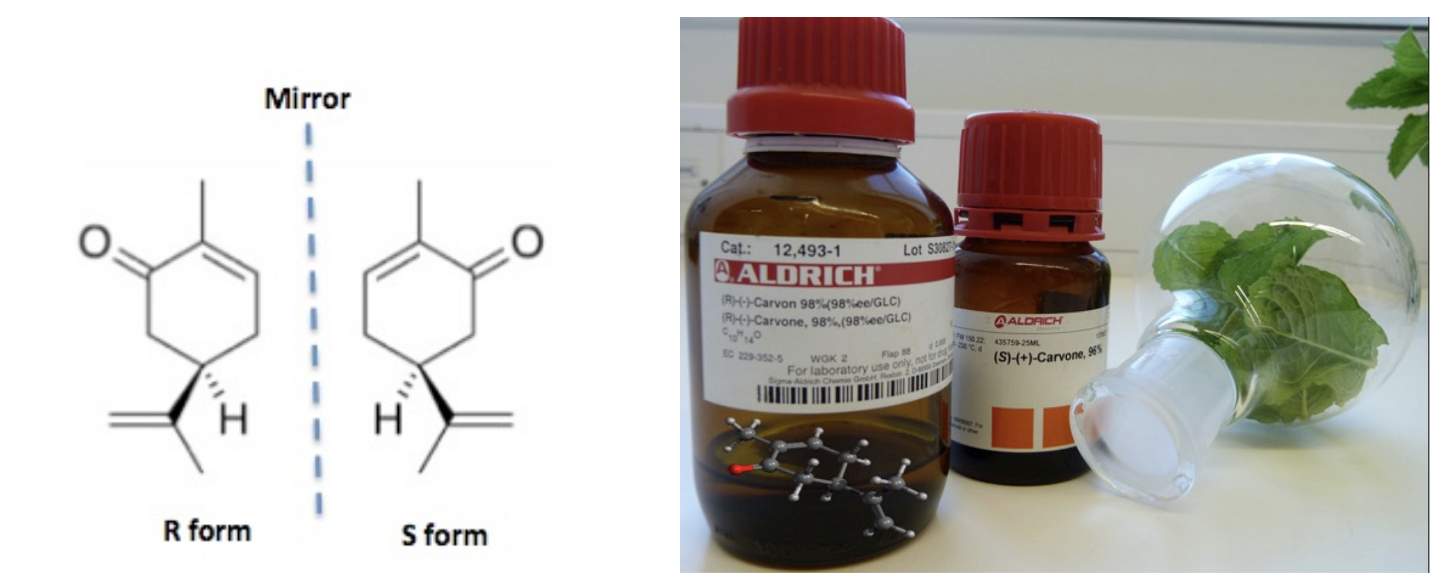
Figure 1. Carvone is asymmetric and therefore exists as two mirror-image forms called enantiomers. One smells like spearmint; the other smells like caraway seeds. Chemical supplier Aldrich sells both.
Ready for Steve and Irving?
Explaining what's going on requires a mercifully brief detour into stereochemistry, which automatically leads us to another installment of the Dreaded Chemistry Lesson From Hell®!
Longtime readers may remember our hosts, Steve and Irving, two unfortunate souls whose primary purpose in life is to make chemistry marginally less confusing. Today, however, Steve and Irving are on a wildcat strike, insisting on central air conditioning. But all is not lost.

Foofy (right) and Floofy were recruited during Steve and Irving's wildcat strike. Both appear annoyed at having missed a previously scheduled nap.
Stereochemistry is as easy as spearmint
As I've written before, seemingly identical molecules can be quite different in three dimensions. Carvone is a classic example (Figure 1).
What happens with catnip is similar, but not the same
The essence of a new paper in The Journal of Chemical Ecology is that free-roaming cats prefer the scent of a plant called silvervine to that of catnip. While this may sound inconsequential, it's not to the cats. Or chemists, who are little more than poorly-dressed cats.
Why is this interesting? It's similar (but not identical) to the carvone story. Virtually all of the essential oils in both plants belong to a class called iridoids (Figure 2). They look like this:
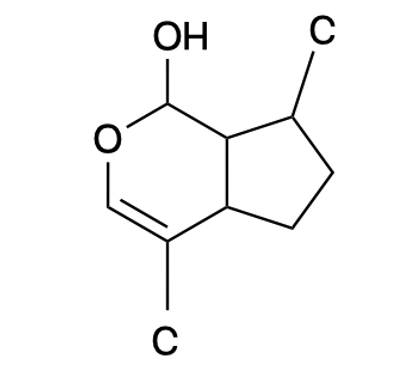
Figure 2. The generic structure of irioids.
But (stereochemistry time), as with carvone, small structural differences make a big difference. Figure 3 shows the chemical structures of nepetalactone, the chemical in catnip that makes cats go bazooey. Also shown are two isomers (of four) of nepetalactol, which is the primary extract of silvervine. One of them makes cats go nuclear. (Any of the zero chemists who are probably reading this will know that the story here is subtly different from that of carvone.)
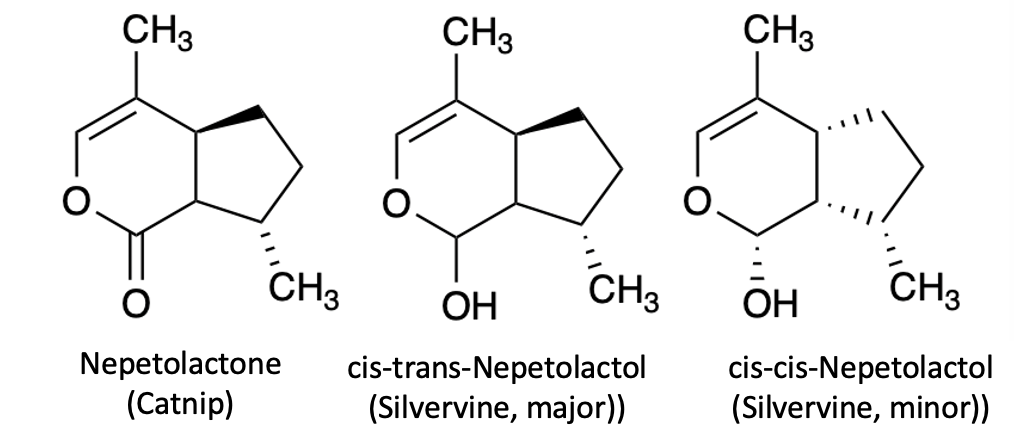
Figure 3. Welcome to stereochemistry hell. From left to right: cis-trans-nepetalactone, cis-trans-nepetalactol, and cis-cis-nepetalactol. Don't get worked up. There is no gender agenda here.
The essence of the paper is:
- Catnip and silvervine both contain iridoids, a family of compounds that attract cats.
- Catnip is dominated by a single iridoid, nepetalactone. You already know what it does to cats.
- Silvervine contains a more diverse mixture of iridoids, the most abundant of which is cis-trans-nepetalactol. Whatever catnip does, silvervine does it way better.
- Silvervine also contains smaller amounts of related iridoids, including cis-cis-nepetalactol and several others.
- Catnip contains roughly 40 times more total iridoids than silvervine.
- Despite this, cats strongly prefer silvervine. This is the strange part.
- The researchers suggest that silvervine's advantage may come from its chemically diverse mixture of iridoids and perhaps even compounds from other chemical families.
For those of you who identify more closely with dogs, this is analogous to preferring to sniff 500 ordinary butts rather than an exceptional one.
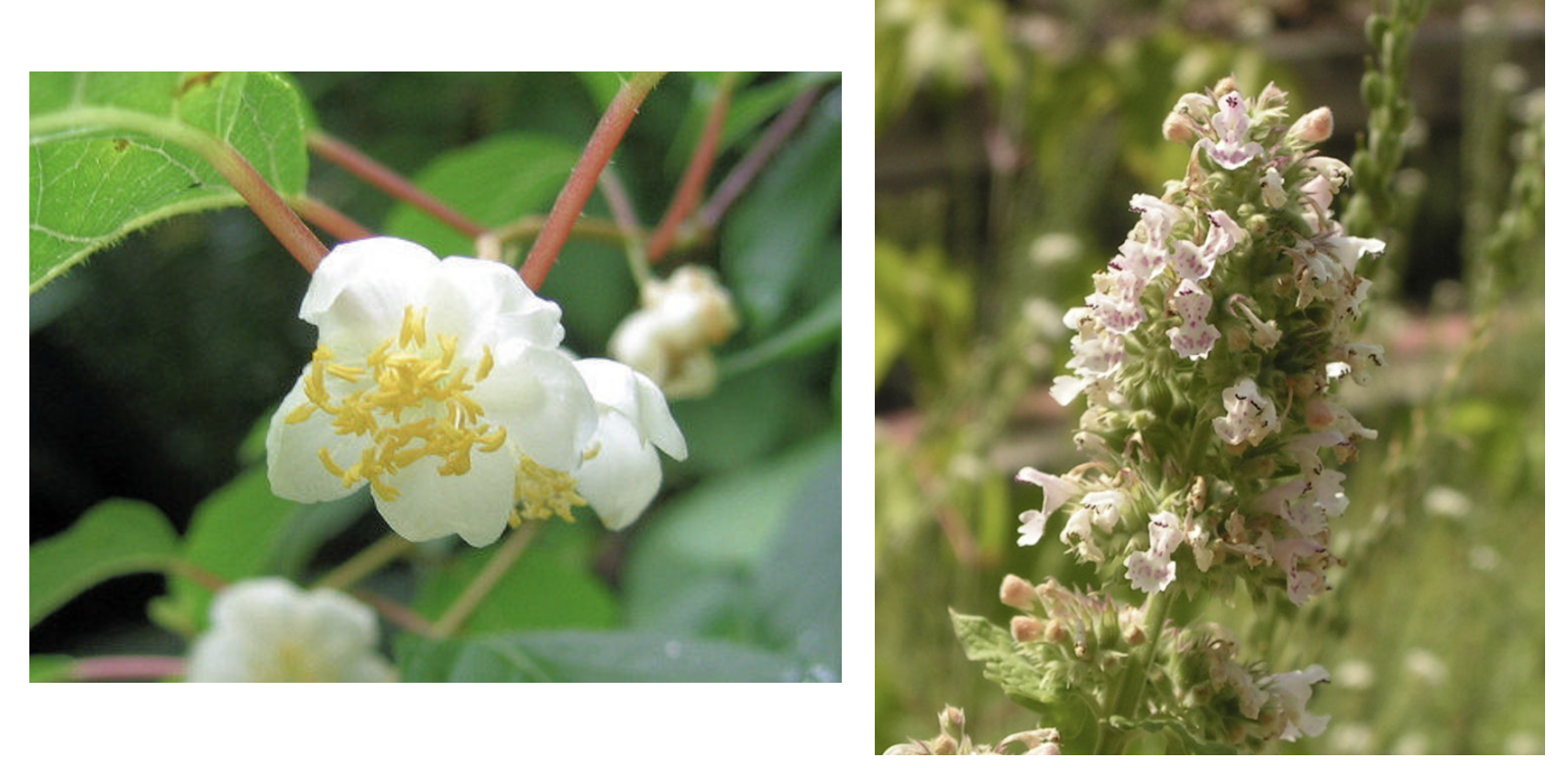
Silvervine (left) and catnip (right). Photo credit: Wikipedia
How to run this crazy experiment
The researchers conducted a simple but revealing experiment. Fresh silvervine and catnip leaves were placed in separate mesh pouches and presented to free-roaming cats, which were free to investigate either plant or walk away. Most chose silvervine. Not only did more cats respond to it, but those that did spent considerably more time sniffing, rubbing, licking, and rolling on the plant. The message from the cats was clear: silvervine beat catnip by a comfortable hairball.
One possible limitation of the study was that the researchers could only get six cats to participate. Recruiting volunteers proved difficult, much like herding cats.
Bottom line
Catnip contains roughly 40 times more iridoids than silvervine, yet the cats overwhelmingly preferred silvervine. Which means that after all this chemistry, stereochemistry, and botanical detective work, we have merely confirmed what cat owners have known for millennia:
Cats are weird.
But awfully cute.

Josh Bloom
Dr. Jonathan (Josh) Bloom, ACSH's Director of Chemical and Pharmaceutical Sciences, earned his Ph.D. at the University of Virginia and completed postdoctoral training at the University of Pennsylvania. During his 20-plus years in drug discovery at Wyeth, his research group discovered the antibiotic Tygacil®, approved in 2005. He holds 25 issued patents and has authored 35 academic papers. Since joining ACSH in 2010, he has written more than 2,000 articles and dozens of op-eds for major newspapers, including The Wall Street Journal and Chicago Tribune.