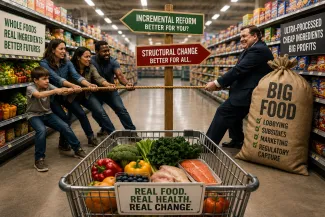
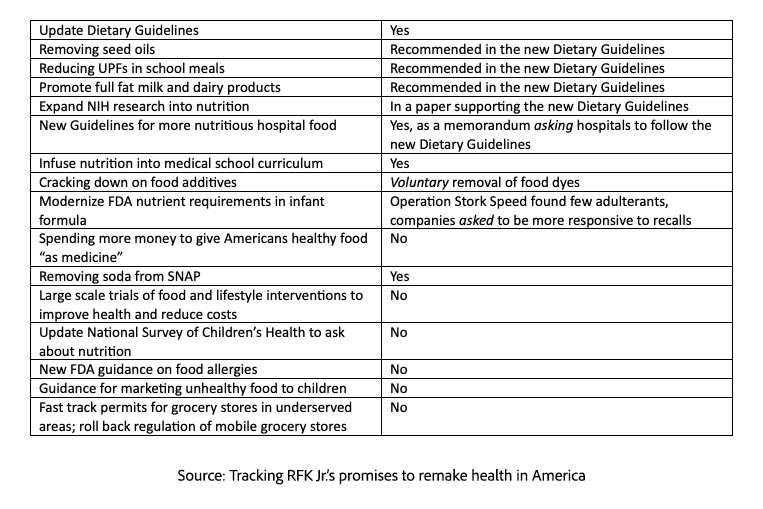
A recent STAT article cataloged the promises Secretary Kennedy kept and those unkept. The nutrition-related promises matter not only as a political scorecard but also as a test of whether the MAHA movement can translate frustration with the American food system into enforceable public health policy.
MAHA’s Frustration With Incremental Reform
His primary nutritional achievement was rewriting the Dietary Guidelines for Americans. He used the weight of the federal government to ask, much as Bonasera asked the Godfather for a favor, that hospitals, medical schools, and food manufacturers increase their nutritional education and improve the nutritional quality of their foods. He also granted waivers to States, removing soda from SNAP benefits.
For many MAHA supporters, Kennedy was expected to deliver structural change. Instead, his nutrition agenda has largely relied on guidance, pressure, and selective waivers. That gap explains some of the movement’s anger. It is not surprising that a political philosophy based on more freedom and less regulation and bureaucracy prefers to ask rather than demand. Yet the deeper issue is whether a movement built on skepticism of regulation can actually achieve the kind of regulation needed to reshape the food system – a tension sharpened by an older corporate playbook: the food industry’s ability to turn public-health criticism into marketable reform.
Lunchables and the Origins of “Better-for-You” Food
I recently wrote about Lunchables and a study examining how Big Tobacco consumed Big Food. The historical echo is hard to miss: tobacco companies once marketed Virginia Slims, filters, and low-tar cigarettes as ways to make smoking feel safer; today, food companies sell “better-for-you” versions of ultra-processed products. As public anxiety over childhood obesity mounted in the 1990s, pediatricians labeled Lunchables a "nutritional disaster," and the American College of Cardiology called them a "blood pressure bomb." In response, Philip Morris rolled out Low-Fat Lunchables, offering a product that "reduced guilt" to keep health-conscious moms loyal to the brand. The authors of that study argue that regulating Lunchables, as a form of ultra-processed food (UPF), would have been helpful then, just as MAHA argues now.
Regulation and Special Interests
The intersection of corporate adaptation and public health is deeply politicized, a reality that strongly shapes the response to Make America Healthy Again (MAHA). The regulatory arena is not a neutral space guided solely by objective data. It is a contested environment. Highly concentrated industries with massive economic stakes face low organizational costs and have clear, immediate incentives to lobby against regulation. Public interest groups representing large populations with somewhat aligned goals are harder to mobilize. MAHA itself reflects this difficulty: it is not a single-voice movement but a coalition whose members do not always agree on how much government power to use.
The regulatory arena of corporate change and public health that MAHA seeks to dominate is largely controlled by concentrated corporate power. Between 1998 and 2020, the ultra-processed food industry spent $1.15 billion on lobbying in the United States—surpassing the tobacco, alcohol, and gambling industries. The UPF ecosystem comprises hundreds of corporate clients and trade associations that promote an individualistic narrative of "personal responsibility" and willpower.
Tweaking
The UPF ecosystem—let’s call it Big Food for now—has had the time and money to engage in regulatory capture: shaping the rules, the science, and the agencies meant to oversee it so that public health concerns are softened, delayed, or reframed in industry-friendly terms. Moreover, they have an at times willing partner: the Federal and State agriculture departments are mandated to subsidize and promote domestic agricultural yields, including corn, soy, and dairy isolates that feed the ultra-processed food supply chain, while simultaneously publishing dietary guidelines instructing citizens to avoid them.
When a product faces severe regulatory or social backlash, manufacturers must decide whether to subtly tweak the existing formula to appease critics or to fundamentally redesign the product from the ground up. For Big Food, structural incentives almost always favor the incremental path, modifying a product just enough to shift public perception or clear a specific regulatory hurdle without disrupting the supply chains, manufacturing processes, and food science that drive profit.
A Stepping Stone or a Safety Valve?
But you can only tweak a product so much before its foundational defects catch up. Transitioning to a system based purely on fresh, whole foods would require a radical overhaul of agriculture, shipping, and storage. The question MAHA continues to pose, which fuels their anger, is whether an imperfect, realistic improvement is better than a perfect, politically impossible revolution. Fresh fruits, vegetables, and high-quality, minimally processed proteins are more expensive per calorie and require significant time, equipment, and “culinary literacy” to prepare. Incrementalism’s "better-for-you" changes deliver immediate, population-wide marginal health improvements. More importantly, as Secretary Kennedy’s scorecard indicates, when viewed through the lens of political and economic realities, the incremental "better-for-you" approach offers a safety valve for corporations and the government, diverting our attention to half-measures.
Ultimately, whether "better-for-you" is actually better depends on your timeline. For MAHA supporters, change requires strategic structural mandates, banning additives, eliminating corporate conflicts of interest, and removing UPFs from government tacit approval through subsidies. These are long-term measures. The more tactical approach, perhaps Secretary Kennedy’s point of view, works within real-world constraints to deliver marginal improvements in addressing specific dietary harms. Does this pragmatic compromise feel like a necessary stepping stone to you, or does it seem like a calculated maneuver by corporations to keep us hooked on an inherently flawed food system?
Food Choices Are Environmental Choices
Ultimately, MAHA’s success will be judged by whether it can use its political power to force a structural shift toward a whole-food economy—or whether it will be absorbed into the existing system and become a stamp of approval for a new generation of corporately optimized “better-for-you” foods.
A radical change requires recognizing that our diet is a direct reflection of our environment, shaped by several social determinants, including a poverty of time, economic stresses, and agricultural policies that shape our daily food choices. Lunchables succeeded because our social determinants stripped parents of time, built agricultural subsidies around cheap corn and processed meats, and created a stressed workforce that needed a cheap, reliable, self-contained lunch unit that their kids would eat. Corporations cater to our needs and reflect who we are.

Chuck Dinerstein, MD, MBA
Director of Medicine
Charles Dinerstein, MD, MBA, is the Medical Director of the American Council on Science and Health. A vascular surgeon with more than 25 years of clinical experience, he brings a physician's understanding of medical decision-making, an appreciation for scientific uncertainty, and a broader perspective on healthcare economics and policy to his writing.