For this issue, why should an economist lead? Why not a health economist? The answer: Many of the urgent problems are economic, so we need an economist, especially one versed in macro-economic issues and the world economy. To stop the global rise of drug-resistant infections, there's a supply-and-demand problem that needs to be fixed.
Search results
Policy & Ethics
The international protest "March Against Monsanto" was never based on truth. The movement perpetuated myths about GMOs to demonize a company that has a really bad PR department. But now that Bayer is buying out Monsanto, what is MAM to do? It's now promoting everything from anti-vaxxer propaganda to historical conspiracy theories.
Alex Berezow
Biomedicine & Biotech
For various reasons, fruits and vegetables grown out-of-season don't taste as good as the in-season variety. And some foodies turn their nose up at greenhouse-raised tomatoes. But a team of researchers from Purdue University wanted to determine if it was possible to enhance their flavor.
Alex Berezow
Food & Nutrition
A water birth video recently went viral without much mention of safety. Proponents of this fringe delivery method are solving a problem that we don't have. Human birth is an unpredictable and often traumatic journey — so why add a risk factor to an already-risky endeavor?
Jamie Wells
Drugs & Pharmaceuticals
Questions were raised about Hillary Clinton's health after a recent public dizzying episode. Her doctor released a "summary update" on the presidential candidate's health, "since the release of [her] previous medical statement in July 2015." What does this letter mean? Not everything and not nothing.
Jamie Wells
Drugs & Pharmaceuticals
What exactly happens to the lungs when someone stops smoking and starts vaping? A new study in Clinical Science tries to answer that question. The authors sought to evaluate the impact of smoking cessation on lung function and smoking related symptoms, using electronic cigarettes.
KedistTedla
Harm Reduction
Ovarian cancer is the most deadly cancer of the female reproductive tract — at least partly because it is not found until it has progressed. New research on mouse models of the disease suggests that there may be a way to halt that progression — by disinhibiting the body's immune system and allowing it to attack the tumor(s).
RuthKava
Drugs & Pharmaceuticals
A proposed resolution by the New York State PTA, to be voted on at their November convention, supports mandatory labeling and a GMO ban from school food. The resolution, which is shocking coming from an organization that, is packed full of pseudoscientific thinking and anti-biotechnology propaganda.
Alex Berezow
Policy & Ethics
For the second time this year, the EPA has published a report placing glyphosate in the "not likely to be carcinogenic to humans" category.
Julianna LeMieux
Other Science News
1. In the 2008 campaign, both Senator's Obama and Clinton promoted fear and doubt about vaccines, thinking they were capitalizing on the anti-business sentiment of their voters. Really, they were both against science, something they criticized the opposing party about when it came to the climate. In 2016, it seems like only the kooky fringe is against vaccines, wealthy elites from the coasts relying on poor kids for herd immunity on one pole and sub-literate people catering to a naturalistic fallacy on the other.
HankCampbell
Claims that the “the science isn’t settled” with regard to climate change are symptomatic of a large body of ignorance about how science works. So what is the scientific method, and why do so many people, sometimes including those trained in science, get it so wrong?
The first thing to understand is that there is no one method in science, no one way of doing things. This is intimately connected with how we reason in general.
Other Science News
Bayer, the German conglomerate, has agreed to buy Monsanto, the seed and pesticide company, for $66 billion, ending speculation about the acquisition. Now, the speculation turns to American anti-science groups and how they will continue to demonize a company that isn't part of evil America, but instead is based in the Europe they love to invoke.
HankCampbell
Biomedicine & Biotech
Sure, there are chemicals in your dust: phthalates, phenols, flame retardants, etc; they come from your furniture, flooring, toys, and cleaning products. None is toxic to your children, but one could be harmful in the fight against antibiotic resistance.
Often times news stories originating from the Galapagos Islands off the coast of Ecuador focus on animal preservation efforts that have fallen short, fragile habitats spoiled by humankind and endangered species of one form or another. But recently it was about a slow-moving, four-legged centenarian tortoise known as Diego, who has been credited with single-handedly bringing his subspecies back from the brink of extinction.
SportsNews
Biomedicine & Biotech
Anyone who has ever had shingles or its painful aftermath can testify that this is not a condition to take lightly. Luckily, for the last 10 years a vaccine to prevent the condition in those who have had chickenpox has been available. A new vaccine, one which may prove superior, is now in testing and thus far seems highly effective — even in those over 70 years of age.
RuthKava
Drugs & Pharmaceuticals
Showing up to work at all costs is very much the American way. Called "presenteeism" — the opposite of absenteeism — is when workers come to their place of business instead of recovering from whatever ails them. This behavior, which accounts for 75 percent of productivity loss, also racks up a number of health issues: fatigue, depression, sleep disorders, and anxiety.
Policy & Ethics
Some men would give their right testicle to have access to contraception that doesn't involve pleasure-killing condoms or cringe-inducing surgical snips. Biology, unfortunately, has made targeting contraception at the female reproductive system far easier than targeting the male reproductive system.
Alex Berezow
Drugs & Pharmaceuticals
Who could possibly forget Ebola - the virus that we were all talking about before Zika? In June of this year, the WHO declared the end of Ebola virus transmission in the Republic of Guinea and in Liberia. Due to the large numbers of survivors there, new information is being understood about the virus and its ability to remain in humans after infection. The results are both surprising and quite scary.
Julianna LeMieux
Disease
Richard A. "Red" Lawhern, Ph.D. is an advocate for pain patients and has given a report card on our healthcare system. It is not good.
It isn’t hard to imagine that as our enlarging and ever-stiffening polarized political spheres come to a head, an article about what maintains the penis’ potency might be a kind of crowning glory.
Jamie Wells
Drugs & Pharmaceuticals
By Stephanie Bucklin, Live Science Contributor
Men still aren't living as long as women — and that holds true for humans' primate cousins as well, a new study shows.
Food & Nutrition
About 1,500 cooking fires occur every Thanksgiving, mostly from deep frying turkeys. While this practice is fairly new, my family was exposed to a very different Thanksgiving hazard many years ago: Aunt Wilma's turkey. Which is worse? Hard to say.
Food & Nutrition
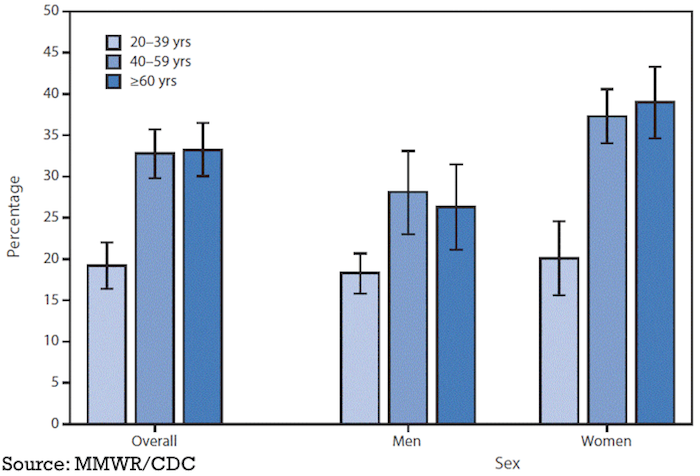
Tossing and turning in bed all night long, it can feel as if you're the only person in the world unable to sleep. It may be a small comfort to learn, however, that you aren't the only one. Millions of other Americans also struggle to sleep.
In the latest Morbidity and Mortality Weekly Report, the CDC reports data on the prevalence of sleep trouble by age group and sex. (See chart below.)
Alex Berezow
Food & Nutrition
Only 1 in 8 women are aware that density is a risk factor, and just 1 in 5 know that dense tissue reduces the sensitivity of mammograms to find tumors. Since breast cancer is second worst cancer killer among women, why hasn't there been more emphasis on the risk factors associatd with dense breasts?
Drugs & Pharmaceuticals
The immune system has been harnessed in a number of different ways, most notably, in fighting cancer. While some results have been spectacular, there have also been some spectacular failures, something that Juno Therapeutics just found out when its experimental leukemia drug killed five people.
ACSH relies on donors like you. If you enjoy our work, please contribute.
Make your tax-deductible gift today!


Popular articles

ACSH Podcasts