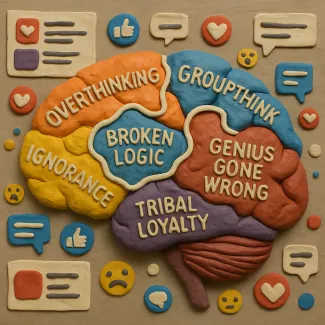
Beyond IQ—What Is Stupidity?
What if being stupid isn't just about low IQ or not knowing things? Most of us are familiar with the Dunning-Kruger form, where we confidently “know” what we don’t know at all; others may be familiar with Nobel Disease, the strange tendency for Nobel Prize winners, late in life, to cling to some bit of pseudoscience. Before jumping in, credit is due to Ian Leslie, who writes the Ruffian, and laid out this taxonomy of stupid several years ago. Along the way, we encounter the learning paradox: the more we study something, the more complex it becomes, even stupidity.
Defective hardware
Leslie argues that in its simplest form, stupidity can be likened to a malfunctioning computer. Pure stupidity is the equivalent of defective hardware. Not “defective” in a biological sense or even in the sense of neurodiversity, rather, the mental processor is incapable of reliably  identifying patterns or following logical arguments. It’s as though the motherboard came off the line without a graphics card—no amount of software updates can compensate for missing circuitry.
An Empty Hard Drive
With ignorant stupidity, the processor hums with potential; there’s nothing wrong with the machine, but the hard drive is nearly empty, reflecting an education gap, where individuals were never given or found the foundational scaffolding of knowledge required to build understanding. Without a basic knowledge structure, complex information doesn’t stick, creating a spiraling feedback loop that leads to knowing even less. Intelligence alone doesn’t prevent the descent into this loop; without information to process, even the best mental hardware sits idle.
The Curse of Genius
The third stupidity is characterized by Nobel Disease, where the expert or genius steps out of their lane, making bad choices because they assume their genius is a universal passport, failing to see that they've walked onto a different playing field with entirely different rules. Consider Luc Montagnier, who won the 2008 Nobel Prize for co-discovering HIV, later veering into homeopathy. In 2009, he published a non-peer-reviewed paper in a journal he founded, claiming that DNA from pathogens could emit low-frequency radio waves, prompting water molecules to form “nanostructures” that retained a “memory” of the original substance, even after extreme dilution.
Too Clever for their own Good
Overthinking stupidity illustrates how competent individuals can become less effective precisely because of their advanced cognitive abilities. They overanalyze, searching for the intricate when the simple may suffice. In a sense, it is the sin of overconfidence, particularly in a flawed premise. Their verbal fluency allows them to be incredibly convincing in defending fundamentally incorrect ideas. These individuals bend reality to fit the model they already love. Whether it’s Dr. Fauci or Dr. Bhattacharya, critics on both sides have accused the other of being too clever by half, lost in a fog of their models.
Steve Jobs exemplifies a heartbreaking example of overthinking stupidity, combined with a touch of Nobel Disease. There are many apocryphal stories of Job’s ability to persuade others to believe his vision and achieve seemingly impossible goals, his “reality distortion field.” While this worked well in his “lane” at Apple, it served him badly when he refused the pleadings of his physicians to undergo surgery for pancreatic cancer, instead opting for dietary supplements, acupuncture, and a vegan diet.
The Trap of Broken Rules, Flawed Algorithms, and Groupthink
“So stupidity is a very interesting class of phenomena in history, and it has to do with rule systems that have made it harder for us to arrive at the truth.”
- David Krakauer, D.Phil President, Santa Fe Institute
Dr. Krakauer was referring to rule-based stupidity, when we are trapped by already established systems, tools, and rigid ways of thinking – too much thinking “inside” the box. It's a type of stupidity where anyone, regardless of their inherent cleverness, can fall victim. It is not the data, but the process used to obtain that information or the concepts that frame our discussion of that data.
This is the home of powerful algorithms, flawed theories, fabricated facts, seductive stories, flawed metaphors, and misplaced intuitions. The highly partisan on either side of a disagreement are cognitively inflexible, drawn to clear narratives, and able to ignore contrary evidence, cherry-picking their facts. Most of today’s nutritional research is argued over methodology or conclusions, which is why coffee and wine ping-pong between beneficial and harmful.
Closely aligned with this is the sixth stupidity, groupthink. When “getting along” feels more important than being right, the collective intelligence of the group just evaporates. Cooperation and collaboration take unconscious precedence over careful disagreement. And when loyalty is prized over saying no, a group can fall off a cliff. The phrase, “drinking the Kool-Aid,” the cultural memory of the Jonestown Massacre, reflects both flawed algorithms and partisan loyalty. It is a situation that anyone can find themselves in, depending on the rules they choose to follow.
Belonging Over Truth
The final, and most challenging category, rests in our all too human “nature.” When people feel insecure or anxious, they find comfort in their “social group,” leading them to signal loyalty, like a wristband guaranteeing entrance to an exclusive party. Whether it be American flags festooned on a pickup, a Black Lives Matter sign, or, as Larry David famously demonstrated, a MAGA hat, psychologists refer to this defense mechanism as “identity-protective cognition,” where the fear of exclusion drives people to cling to whatever reinforces their group identity.
It’s not necessarily about agreeing with the message; it’s about staying in the club. For political extremists or conspiracy theorists, these beliefs offer comforting clarity and a ready-made community. And once you're in, staying in requires proving loyalty. That often means doubling down on the group’s ideas, no matter how absurd. Because in the end, belonging frequently beats truth. It's when you push information away because learning it would be too emotionally uncomfortable. It is a willful act, not a cognitive error. It is a psychological strategy we employ to navigate social complexities and protect our sense of belonging and self.
As Leslie writes in describing Twitter, now X,
"[Twitter is] a space where the forces of stupidity converge and dance. You have experts who feel compelled to pronounce on matters outside their expertise. You have insecurity and status anxiety: everyone jostling for followers, likes and retweets. You have people doing their thinking in public, in the gaze of peers and enemies. You have ideological communities and sub-cultures who are also up in each other’s faces all the time, in-groups gaining energy from out-groups. The result is that some quite stunningly stupid threads go viral and get celebrated by lots of smart people…”
Stupidity, in all its forms, isn’t always a bug in the system. Sometimes it’s a feature, serving as an emotional or social strategy to navigate a messy, tribal world. The real challenge isn't about pointing a finger at who's stupid. It's about turning that finger around and asking ourselves, when and why do I choose to be stupid?
Source: Seven Varieties of Stupid The Ruffian

Chuck Dinerstein, MD, MBA
Director of Medicine
Charles Dinerstein, MD, MBA, is the Medical Director of the American Council on Science and Health. A vascular surgeon with more than 25 years of clinical experience, he brings a physician's understanding of medical decision-making, an appreciation for scientific uncertainty, and a broader perspective on healthcare economics and policy to his writing.