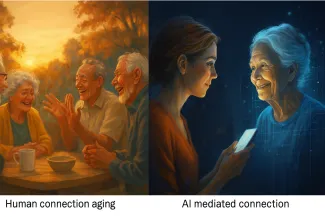
At a certain age, it becomes increasingly difficult to make new friends. You no longer have the “ropeline” at school where you meet the parents of other of your children’s classmates, and at work, you are senior enough not to run across many newbies. So what’s a person to do, especially as the reaper winnows your companions?
“I joined a monthly chat with Kate and Caleen, two college friends with whom I’d fallen out of regular touch. It was fascinating to learn about the lives we could not have envisioned 50 years ago when we sat in the darkened hallway between our dorm rooms talking into the night. We continued the conversation after the plague ended, and this summer met in person to commemorate our jointly turning 75. Inevitably, we dedicated our first breakfast to listing the pills we take every morning and the parts of our bodies that complain the loudest. For the rest of our exquisite four days together the subject was tabled. Even after all these years—even after all these decades—we speak in shorthand, with understanding, sympathy, and perspective right on the surface. We carry each other forward with full knowledge of our pasts.”
I am a part of what my wife’s friends call Romeos – retired old men eating out. From The Free Press, Ancient Wisdom: What Friends Are For
Has AI found a way to replace the Ouija Board?
“A week after we buried my grandmother, I had a dream that she and I had dinner at a Chinese restaurant in Midtown Manhattan and she gave me advice about my love life, which was odd, because she had never done that before.
I have been thinking about this dream ever since I learned of this new app called 2wai, which is apparently pronounced 2-way and enables “real-time, two-way conversations” with so-called HoloAvatars—including dead people. (Its website is a little coy about this, but a recent 2wai ad, which features a little boy named Charlie who grows up speaking with a grandmother he’s never met, is not.) “Human connection, reimagined in the age of AI,” the website promises.”
From the Free Press, AI Is No Way to Revive the Dead. But it may be more complicated than that,
“Imagine sitting in a theater listening to Auschwitz survivor Fritzie Fritzshall as she recounts her harrowing story of the Holocaust, in which she, as a 13-year-old, was ripped from her home and transported to the notorious concentration camp where most of her family was murdered. Imagine asking her questions about life during the Holocaust, about those Upstanders who risked their lives to save her, about her messages for our world today.
After watching a short intro film, you too will be able to ask questions to the holograms of Fritzie Fritzshall, Aaron Elster, and other Survivors…”
Will AI foster or suppress creativity? Ted Gioia argues that the culture war with creators is already underway.
“The people who have built careers on their creativity are now mobilizing. But the overseers who prioritize finance and profits will fight them at every turn. You might think that these two parties need each other—but that’s not how the bosses see it.
They love AI because it will reduce their dependence on human artists—who are often stubborn difficult people. Even worse, great artists are expensive people, so the suits inside the boardroom dream of replacing them with servile bots.
Very few of the bosses will say this openly. They can’t afford to stir up their creative workers—not yet. It’s too early and AI tech isn’t robust enough to replace all those folks in the cast and crew. But if you don’t think this is the plan, you don’t know how the people in those expensive boardroom chairs think and act.”
From Gioia’s Honest Broker, Paul McCartney Invents a New Kind of Protest Song

Chuck Dinerstein, MD, MBA
Director of Medicine
Charles Dinerstein, MD, MBA, is the Medical Director of the American Council on Science and Health. A vascular surgeon with more than 25 years of clinical experience, he brings a physician's understanding of medical decision-making, an appreciation for scientific uncertainty, and a broader perspective on healthcare economics and policy to his writing.