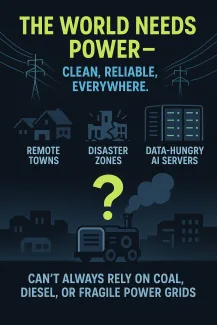
It seems we can hardly turn around without seeing yet another story about new, small nuclear reactors that are going to revolutionize…whatever. Crypto mining, AI, and the server farms that get a new computer (or toilet paper) to my home the next day—all require power. Likewise, when a power grid is knocked out by a natural disaster, getting emergency electrical power to the location is a huge priority. And then, some fairly remote places require power, e.g., mines, research stations, military bases, and small towns—but their distance from large-scale power generation means that a tremendous amount of electricity is lost to electrical resistance over hundreds of miles of power lines.
Today, in all of these cases and more, the power is either brought in over inefficient power lines or generated locally using relatively small power plants that run on coal, diesel, or fuel oil. Wouldn’t it be great to have a small, reliable, clean, and carbon-free way to quickly bring power (permanently or temporarily) to remote locations, power-hungry industries, and scenes of devastation? Enter the small modular reactor (SMR)! Right?
Well…maybe. And don’t get me wrong—I’m in favor of SMRs, and, for that matter, the SMR nuclear reactor plants I helped operate during my time in the Navy. I never had any qualms about their safety. During the 1960s and 1970s, the Navy was stamping out the S5W reactor plants installed in every new submarine being made; over 100 all told. While the design evolved, when I transferred from the S5W reactor plant on which I trained to the S5W reactor plant on my submarine, I was in familiar territory—I knew where the various valves and pumps were located, how to operate them during, say, a reactor startup, I was able to do maintenance, and so forth. And if I needed something in a hurry so we could get out to sea, I could go to any submarine on the pier with an S5W reactor plant and have a chance that they’d be able to help us out.
In many ways, that’s the same vision behind today’s SMRs: standard, interchangeable units built at scale. That’s the plan with the proposed SMRs—to crank them out on a factory floor, all identical, all operated the same way, ready to be shipped, assembled, and plugged in to provide power.
Here’s the thing—at the moment, the Nuclear Regulatory Commission is in various stages of review and licensing of dozens of reactor designs using at least a half-dozen basic technologies and a similar number of types of fuel. Not all of these variants will pass regulatory review and all of the pre-licensing rigmarole—some of the companies will run out of money, some will be bought out, some will run out of steam, and so forth. This attrition will inevitably reduce the sheer number of individual designs. However, we’ll still be looking at multiple technologies and multiple types of fuels when the dust settles. That diversity raises important questions about cost, training, and standardization.
From the point of view of technologies, that’s no big deal—all of these reactor and fuel technologies are decades old, and they can wait a little longer for their day in the sun. But might this affect the economies of scale if a finite number of new reactor purchases include several different technologies, different types of fuel, and different designs? And might the ease of moving from one plant to another be affected by this technological diversity?
The current fleet of nuclear reactors is almost all cooled by light water, all use the same type of fuel, and the same basic setup. But when we add liquid metal, high-temperature gas-cooled, pebble bed, liquid salt, TRISO, and prismatic fuel, and all the other variability, it’s promising to be like the Cambrian Explosion of nuclear energy. And just like the extraordinary creatures of the Cambrian era evolved into those who currently share our planet, all of this remarkable SMR variability is likely to take some time to settle into a smaller, more diverse array. It might take a few decades to reach the point where there are enough reactors of any of the new designs for operators to be able to move easily from plant to plant, as I did in the Navy.
It’s also important to remember that even the smallest micro-reactors need infrastructure. They require space for parking and hookups, plus buildings for maintenance, training, and administration. In practice, even a “portable” reactor will occupy several acres—at least the size of a football field—far more than a simple parking spot. And space is only one challenge; disaster recovery raises another.
And that brings us to using reactors for temporary power in the aftermath of a disaster. When a hurricane, earthquake, landslide, or other natural disaster disrupts an electrical grid, anyone without an electrical generator will lose power, and even those with generators will eventually lose power unless they can obtain more fuel. That’s what we saw in NYC in the aftermath of Superstorm Sandy—I had cell phone service for a day or so, then lost it when the emergency diesels ran out of fuel. Some were without heat; they lost their refrigerators and freezers, the Internet was out, as were traffic and street lights. In the affected areas, anything that required electrical power to function did not.
It would have been nice to have had an SMR airlifted, trucked, or barged to NYC to plug into the grid and bring back everything we’d lost. The thing is—where would we have plugged it in? We’d lost several transformers and other bits of infrastructure, and many electrical grids aren’t designed to make it easy to add an outside power source. Even the most flexible grid can’t accept power from an external source if the grid itself isn’t there. And that’s what we’re looking at in so many natural disasters, where the grid itself is gone.
None of these is a reason to try to hinder the ascendance of small modular reactors. But we have to realize that, for all their considerable promise, they are not a panacea. Their most impactful use might well be in powering our data farms, AI servers, crypto mines, and the other energy-intensive facets of our computation-heavy society, along with powering remote facilities and municipalities. And we also need to understand that simply relocating a nuclear reactor to a new locale does not necessarily ensure that the electricity is flowing. There must be a way to transfer it from the turbines to the power grid, and that’s not always a straightforward matter.
The bottom line is that small modular reactors can play an important role in our energy picture, especially in remote locations and in the aftermath of any emergency. But, as with anything else, they are not necessarily a simple fix. We must also understand that the sheer proliferation of technologies and designs means that, until the field settles out a bit—until there are enough reactors of any single design to take advantage of the economies of scale—our savings lie in the future.